Ships
- HMAS Sydney (D48) Captain from 15 May 1941 · In command when she was lost, 19 November 1941
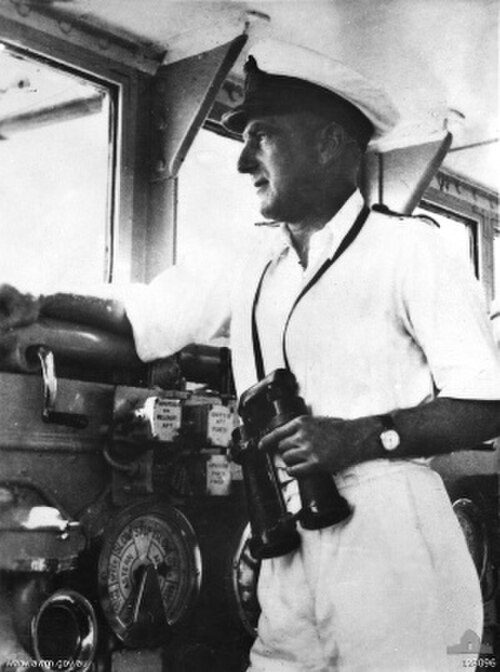
The photograph is Australian War Memorial 128096, captioned there as public domain. He is the Royal Australian Navy captain who took Sydney from John Collins and went down with her off Western Australia. He is not Admiral Sir Robert Lindsay Burnett of the Royal Navy, a different officer of an earlier generation, and not James Charles Burnett, the surveyor in the Australian Dictionary of Biography, who died in Brisbane in 1854. There is no Dictionary of Biography entry for this Joseph Burnett. No decoration for him turned up in the Memorial note or in his son’s article. His own diaries, records and photograph albums, the son wrote, were lost with him in the ship.
Origins
Joseph Burnett was born at Singleton, New South Wales, on 26 December 1899, the second son of Richard Burnett and Emily Burnett, née Adams. His son, writing in 1973 with help from an uncle, Dick Burnett, and from his mother, gives the grandfather as William Burnett, who left Cornwall for New South Wales in 1859 at twenty-four and worked as a blacksmith and later as a building contractor. The boy went to Singleton Primary School. The son remembered him as already able at books and at games. The father died when Joseph was seven. The year of that death, and anything more precise about the household after it, is not in the sources used here. What the son thought followed from it is carefully hedged: a free education, and “the glamour of the sea,” probably decided the application to the new Royal Australian Naval College. “Probably” is the son’s word. It is a guess about a motive, not a letter.
The dating of the entry is slightly tangled, and the tangle is worth keeping. The Memorial’s biographical note says he applied in 1912 and became a cadet midshipman, one of the first entrants, on 31 December 1912, at Geelong. The same note’s timeline repeats 31 December 1912. His son says he applied in 1913, was selected, and entered with the first intake, first at Osborne House, Geelong, and later at Jervis Bay, and points to F. B. Eldridge’s history of the College for the selection. The parliamentary inquiry into the loss of Sydney calls him one of the original 1913 entry. Both can be true in the way naval seniority was written: an appointment dated the last day of 1912, and a term that ever after called itself the 1913 entry. He was thirteen, turning fourteen three days after the dated appointment. The College was barely open. He was not a late arrival into an old service. He was part of the first attempt to grow Australian officers at home.
Formation
He got his colours at the College in rugby, cricket, tennis and athletics. A photograph the son published from 1916 shows him in the First XV, middle row. The Memorial dates his midshipman’s rank from 1 January 1917, and his first ship as the battlecruiser HMAS Australia, with the Grand Fleet in the North Sea, through to the end of the war. The son, who says he used official records as well as family memory, puts the same joining in 1917 “with others of his term” and then says the war service was “in the Atlantic.” The Memorial’s North Sea is the better geography. Australia’s war was the Grand Fleet’s. “Atlantic,” in the family article, is loose. A timeline attached to the Memorial’s note dates a sub-lieutenant’s promotion to October 1918. That timeline is not a clean document. In one line it says “Bridges attended Staff College at Greenwich,” which is somebody else’s sentence left in Burnett’s life. The October 1918 step is used here only as that timeline’s date, not as a checked Navy List entry. The Navy List and the personal service file were not opened for this essay.
Most of the next seven years, the son wrote, were with the Royal Navy in the United Kingdom. The Memorial says he was promoted lieutenant in January 1920 and qualified as a gunnery officer in 1922. The son puts the gunnery course at Whale Island, which is HMS Excellent. The Memorial’s timeline adds service in the battleship HMS Royal Oak in 1920–22, before the gunnery course. The son does not mention Royal Oak in those years. He does put Burnett in Royal Oak much later, as executive officer. The early Royal Oak posting is therefore the timeline’s, uncorroborated by the family article, and it sits in the same chronology that contains the “Bridges” slip. It is not narrated here as a cruise.
What both accounts agree on is that the English years made him a games player people remembered. The son says he played rugby as a half and as a three-quarter, for United Services, for Hampshire and for the Royal Navy, in the years when the Navy’s halves were Davies and Kershaw. Vice-Admiral Sir John Collins, a term-mate, later told the son he had seen Burnett play for the Navy against the Army at Twickenham. Tennis, cricket and athletics are in both the Memorial note and the son’s article. The son says he played in the Royal Navy tennis championships at Wimbledon, that a plaque at the Garden Island courts records two successive RAN singles titles, and that he represented the Royal Naval College, Greenwich, at cricket and athletics. Trophies, the son wrote, were still in the family. The plaque and the trophies were not inspected for this essay. The sporting reputation itself is not in doubt: Collins, decades later, called him “an outstanding sport with a good brain — an unusual combination.”
In 1924 he was gunnery officer of the cruiser HMAS Adelaide, then, the son says, on a showing-the-flag cruise round the British Isles. The same year he married Enid Ward of Waterlooville, in Hampshire. The family called her Jill. The day, the church and the rite are not in the sources read here. He came back to Australia by the Far East. Of the next three years, the son says two were as gunnery officer at Flinders Naval Depot. The Memorial note only says that he returned and, after three years, went to England again in 1927.
That return was to stand by the County-class cruiser HMAS Canberra, building at John Brown’s yard in Glasgow. The elder son was born there in 1928, the year Burnett became a lieutenant-commander. The Memorial dates that promotion 1 January 1928. He commissioned Canberra as gunnery officer. The son says the ship then circumnavigated Australia, again showing the flag. A second son, Rory, was born in 1929. The following year the father went back to England as squadron gunnery officer in the destroyer leader HMS Wallace. That Wallace appointment is the son’s. It is not in the Memorial’s prose note.
He stayed on to do the Naval Staff Course at Greenwich in 1932. Collins was a fellow student. He was promoted commander in December 1932 — the Memorial, the son and the later parliamentary quotation from Gill all say December, and the Memorial’s timeline does not give a day. In 1933 he came home to two years at Navy Office, Victoria Barracks, Melbourne. The Memorial’s prose agrees: two years at Navy Office from 1933. Its timeline does not. The timeline says that in 1933–35 he served there as Assistant Chief of Naval Staff and Director of Naval Intelligence. That is the wartime appointment moved back six years, and a title, Director of Naval Intelligence, that neither the Memorial’s own prose nor the son’s article gives him at all. It is rejected here. What the son does put in those Melbourne years is a naval pageant at the Showgrounds at the end of 1934, produced by Captain Angus Nichol, RN, in which Burnett took an active part. The son was six. He remembered being impressed, and later seeing the programme. His mother and Admiral Becher filled in details: a chorus about the toughness and the nuisance of naval life, and skits to operatic airs under the title “L’Appreziatione della Situatione,” an admiral and a staff whose intentions, in the heat of battle, are not understood. The son thought his father was in his element. He liked amateur theatricals. He would, the son wrote, sometimes embarrass his wife by playing the fool in public. One prop the boy remembered was a little mechanical frog, wound and set down, that jumped in the middle of a dull meeting.
In 1936 he went back to sea as executive officer of Canberra. The third child, a daughter, Bridget, was born that year. At the end of 1937 he returned to the United Kingdom for what the son calls the last exchange. He was executive officer of the battleship HMS Royal Oak. In her, the son says, he took part in operations during the Spanish Civil War, and at the time of the Munich crisis carried troops to Gibraltar under secret orders. The ports, the dates and the name of any convoy are not given. The Memorial’s prose mentions only the Royal Oak appointment. Its timeline adds the battleship HMS Resolution in 1937. Resolution is not in the son’s account. Like the early Royal Oak line, it stays a timeline entry, not a story.
He was promoted captain on 31 December 1938. The son says he was the third graduate of the College, after Farncomb and Collins, to reach that rank. The next year he completed the Imperial Defence College course. The Memorial’s prose has the same order: captain in December 1938, the course the following year, then the war.
War, ashore and then at sea
When the war began he was recalled to Australia. The son is more precise than the Memorial’s “when the Second World War began”: he succeeded Captain J. A. Collins as Assistant Chief of Naval Staff at Navy Office, Melbourne, in November 1939. He worked under Admiral Sir Ragnar Colvin, the Chief of Naval Staff. Colvin’s later judgment, which the son dates to The Times of 19 December 1941, is the best contemporary portrait of the staff officer, and it is not a funeral courtesy only. Gill, in the official history, printed a longer form of the same passage. The parliamentary inquiry quotes Gill:
“Vice-Chief” is Colvin’s phrase as Gill gives it. The appointment the son and the Memorial name is Assistant Chief of Naval Staff. The two titles are not reconciled in anything read here. The qualities are. The same Gill passage, as the inquiry quotes it, adds that he had a “Five First Class” record in his lieutenant’s courses. That claim was not re-checked against a course report.
The work was not only paper. In October 1940 he went to Singapore as the senior RAN representative at an Allied conference on the defence of the Far East if Japan came in. The son, citing Gill, says he was disturbed by what he found. The sentences the son prints as Burnett’s are short and unsoftened: the staffs at Singapore were “rather uninterested in Australian and New Zealand naval activities”; “the security of Singapore is of vital concern to us, and it is most disquieting to find a state of affairs there far removed from what was expected at the Empire’s main naval base in the Far East.” He recommended much greater decentralisation of command. Some improvement in Australian communications with Singapore followed, the son says, and the Chiefs of Staff and War Cabinet were told how serious the position was. Gill’s pages were not re-read for this essay. The quotation stands as the son’s citation of the official history, which he says is printing Burnett’s comment. It is the one place where Burnett’s own professional voice, rather than a mourner’s, is on the page: not angry, and not reassured.
German raiders at Nauru gave him a smaller, practical problem. In December 1940, the son says, he proposed to the Naval Board that volunteer yachtsmen patrol harbour approaches. The Naval Auxiliary Patrol was formed in June 1941. The son credits it with good service later in the war, and cites Gill for the proposal and the date. By then Burnett was no longer the man who would see it work. Captain F. E. Getting relieved him as Assistant Chief of Naval Staff in May 1941.
Colvin, again in that December Times piece as the son quotes it, said Burnett had looked forward to going to sea, and that Colvin had had no doubt he would do as well in Sydney as he had at Navy Office. The ship he was given was not a new command in a quiet sense. Sydney was the cruiser that, under Collins, had sunk the Bartolomeo Colleoni off Cape Spada in July 1940 and had come home famous. The Sea Power Centre dates the handover: on 15 May 1941 Collins turned the ship over to Captain Joseph Burnett at the end of Collins’s own time in her, Collins having been named Australian naval representative to the Commander-in-Chief, China. The Memorial’s timeline says he was “appointed to command” on 14 May 1941. Appointment and handover a day apart is ordinary. It is recorded here as a one-day difference in the sources, not as two commands. It was his first sea command. He was forty-one.
The son, drawing on a 1971 booklet by Collins, says the ship then did convoy work in the Indian and Pacific Oceans until September, including a twenty-five-knot passage escorting the transports Queen Mary and Queen Elizabeth from Jervis Bay into the Bight. That passage is Collins’s account as the son uses it, not a deck log read here, and it is not turned into a cruise. What belongs to Burnett, and is only his, is a day in September. The ship was at Melbourne for maintenance and exercises. The two boys were at school there. He took them to sea for a day and a night off Port Phillip. The elder son remembered the guns fired, the torpedoes, the aircraft, the engine room. It was the last time they saw him. Schoolmates, he wrote, were envious. That envy is the scale of what the children thought a warship was.
His last letter to that son is dated 5 October. The son still had it in 1973, and printed the advice:
The son thought the father had lived by it. Whether the close approach to Kormoran, six weeks later, was independence or something else is the question every inquiry has failed to put into Burnett’s own words. He left none.
Sydney sailed from Fremantle on 11 November 1941, Armistice Day, escorting the troopship Zealandia toward the Sunda Strait. At noon on 17 November she turned Zealandia over to HMS Durban and started back. The Sea Power Centre says she was expected at Fremantle on the afternoon of 20 November. Gill, as the parliamentary inquiry summarises him, had an earlier expectation, the evening of the 19th or the morning of the 20th, later amended by the ship herself to Thursday 20 November. The difference is a day of ETA, not a different voyage.
On the afternoon of 19 November, coming south off the north-west coast, she sighted a merchantman. The Sea Power Centre, using the German survivors and the 2009 inquiry, puts the sighting at about 4 p.m., G time, about 130 miles west of Shark Bay. The Australian War Memorial’s encyclopedia entry, following Gill, puts Kormoran about 150 miles south-west of Carnarvon, on a north-easterly course, and the sighting just before 4 p.m. The ship was the German auxiliary cruiser Kormoran, Commander Theodor Detmers, disguised as the Dutch Straat Malakka. She was not on Sydney’s plot. That single fact is the one the 2009 Cole inquiry treats as decisive, and it was available to Burnett before any flag was hoisted.
What happened next is not his report. Sydney sent none that is known. The account is the Germans’, tested in 2008 against the wrecks. He challenged by searchlight and closed. The raider’s flag hoist was fumbled and then flown where it was hard to read. When it could be read it was PKQI, Straat Malakka’s letters. At 5 p.m. Kormoran broadcast a “suspicious ship” signal in that Dutch ship’s name. It was heard, faint and broken, by the tug Uco and by Geraldton. No one ashore treated it, that afternoon, as the loss of Sydney. Sydney asked where the stranger was bound and was told Batavia. She then hoisted the two letters IK. To the Germans, on the ordinary code, that meant prepare for a cyclone. They were the middle letters of Straat Malakka’s secret call sign, IIKP. The outer letters were the required reply. Kormoran could not make it. Sydney then signalled, in plain language, to show the secret sign.
By then, on the Sea Power Centre’s telling of the 2009 reconstruction, she was almost abeam to starboard at less than a mile, both ships steering west-south-west at about fifteen knots, main armament still trained on the stranger, the amphibious aircraft on the catapult with its engine running. Gill had read the same German evidence in the 1950s and concluded she was at action stations, guns and tubes bearing, which he took as proof that Burnett was suspicious and still, at the end, made the wrong geometry. The Cole report, quoted by the Western Australian Museum from the 2009 volumes, says the opposite about the state of the ship: the consequence of his decision was that Sydney did not go to action stations, and that she approached to a position where every tactical advantage was gone and the surprise belonged to Kormoran. Guns trained, and an aircraft with its engine running, are not the same statement as “closed up at action stations.” Both cannot be fully right. The wreck cannot show which watch bill was in force. The geometry can. A light cruiser inside a mile of an unidentified ship had given away the range at which eight 6-inch guns, and speed, were supposed to decide the meeting.
At about 5.30 p.m. concealment was finished. Kormoran struck the Dutch colours, hoisted the German ensign and opened fire. The reconstruction used by the Sea Power Centre and by the Memorial’s encyclopedia, both resting on Gill and on the later wreck evidence, is that early hits wrecked Sydney’s bridge and director, that her first 6-inch salvo went over, that A and B turrets were knocked out, that the aircraft was set burning on the catapult, and that X turret, in local control, hit Kormoran in the funnel and engine room and started the fire that finished the raider. A torpedo struck Sydney forward, under A and B. She turned toward the German as if to ram, passed under the stern, and went off south, on fire from the bridge to the after funnel, still taking hits. Kormoran’s engines failed. Her last shot was about 6.25 p.m. Sydney was last seen about ten miles off, heading roughly south-south-east. A glare lasted until about 10 p.m., then flickers, then nothing by midnight. Gill thought she sank during the night of 19–20 November. The Sea Power Centre’s fate line says lost in action on 19 November. The Memorial’s Roll of Honour, and its biographical record, date his death 20 November 1941, killed in action, in the Indian Ocean, off Western Australia.
Of 42 officers and 603 sailors, the Sea Power Centre says, none survived. The 645 included six RAAF and four civilian canteen staff. Kormoran was scuttled. The Memorial’s encyclopedia, following Gill, gives her 393 officers and men, of whom 78 died in the action or in the boats, and two captured Chinese also killed. The first news that Sydney was in trouble did not come from the cruiser. She was reported overdue by the District Naval Officer, Western Australia, at 11 a.m. on 21 November. Navy Office was not yet alarmed: Zealandia had been late, and a ship on radio silence might have been sent somewhere else. On 23 November she was told to report. She did not. On 24 November the tanker Trocas picked up a raft of Germans. The search that followed brought in the Kormoran survivors. It did not bring in Sydney’s.
The cost
He was forty-one. Jill Burnett was left with three children: the elder boy thirteen, Rory about twelve, Bridget five. The papers that would have let them reconstruct him at sea went down in his sea cabin. What the elder son could still hold in 1973 was the October letter, the memory of the day off Port Phillip, and other people’s sentences.
Collins wrote to him: “Joe Burnett was one of our finest officers. An outstanding sport with a good brain — an unusual combination. With these qualifications and, as you so well know, a happy and cheerful disposition it is not surprising that he was one of the most popular of our year.” Colvin, in the Times of 19 December, said that whatever the mischance, “Burnett I know went with honour,” and that the RAN would miss him. A third Colvin passage, on Waller, Getting and Burnett together — “No finer sailors ever trod deck” — the son also attributes to the Times, but the footnote he prints sends the reader to Eldridge’s college history, page 238, not to the newspaper. The Times page was not read for this essay. The Eldridge reprint was not read either. The staff portrait and the “went with honour” sentence are the ones tied, by the son, to the 19 December paper.
The son’s own conclusion is harder than Colvin’s, and it is the conclusion of a man who had by then read Gill. The reasons for the close approach, he wrote, will never be known, “but it seems in the light of events that my father in this instance was too confident of his ability to handle any eventuality that might arise.” That is a son’s judgment, not a finding. It matches one of Gill’s conjectures and not all of them. Gill, as the 1999 parliamentary inquiry lays out his pages 450–60, said the reasons could never be known with certainty: why so close that speed and gun-power were thrown away; why the aircraft was not used at a safe distance; why Navy Office was not asked, by wireless, whether Straat Malakka was really there. Gill also thought Burnett lacked the kind of wartime sea-time that makes a captain suspicious of every chance meeting. He noted the criticism, inside Navy Office, of Farncomb’s caution earlier in 1941, when Canberra had stood off and spent a great deal of ammunition on the supply ship Coburg and the tanker Ketty Brovig. He guessed that the coming of darkness, and a wish to settle the identification quickly, may have tipped Burnett into over-confidence: first that the Dutchman was genuine, then that Sydney, with her armament bearing and manned, could overwhelm a trap before it was sprung. “Yet to act as Burnett did was to court disaster should a trap exist.” The Australian Dictionary of Biography’s life of Farncomb repeats the possibility that the scolding of Farncomb influenced Burnett. It is a “may.” Burnett never said so.
The son remembered a different man from the man in that paragraph: kindly, humorous, devout, patient with the boys’ games, fond of the bush and of walking, happy on a Devon farm and at village cricket, a Methodist by upbringing who had become a member of the Church of England and who kept regular worship at home and on board “in a broad-minded and practical way.” The son believed a book had mattered to him, Captain Rory O’Connor’s Running a Big Ship on the Ten Commandments. “Believed” is as far as the evidence goes. A petty officer who had been in Sydney told the son, years later, that the address on taking command ended, apparently, “I’ll play ball with you if you play ball with me.” “Apparently” is the son’s caution. It is one man’s memory of a speech, retold to the family. It is not a transcript.
Other men who had served under him, speaking decades later to the parliamentary inquiry, did not all remember a captain who played ball. Lieutenant Commander J. J. Ravenscroft, RANR, who said he served under Burnett from May to October 1941, called him a capable ship-handler who knew the ship’s company was skilled and who would listen. The inquiry also recorded descriptions of him as cautious, “safety-first,” cool, and extremely competent, and the Department of Defence’s evidence that he was an experienced executive officer and a very well-reported staff officer, in his first command, with considerable sea and operational experience. Against that, A. Templeton, who had served in the ship under him, told the committee that command itself had never been assessed before Sydney, and that his own view had hardened: short of common sense, too confident, ambitious, reluctant to take advice — though he allowed that not everyone had seen the reluctance. F. C. Sheldon-Collins, also a Sydney shipmate, told the committee that Burnett, eager to outshine Collins and not expecting a battle on that station, “threw caution and prudence to the wind and largely played at being at war.” That is a motive. It is a witness’s motive, offered half a century later. It is not used here as what Burnett wanted. Michael Montgomery’s book, which the inquiry discussed and did not adopt, recorded a “common verdict” that if Collins had still had the ship she would not have been lost, and then concluded, on the evidence Montgomery had gathered, that Burnett was capable, rigorous and procedurally thorough. The verdict and the conclusion pull in opposite directions. Both are argument.
The inquiry’s own landing place, in 1999, was narrower. Burnett knew there had been raider activity in the Indian Ocean. He had not, on the evidence the committee accepted, been sent after this particular ship, and the committee did not accept that Kormoran had been tracked onto him by high-frequency direction-finding. Closing on an unknown merchant ship, to identify her and to stop a scuttling, was common practice, and it had worked for other captains because the ships they closed were not armed. It was his misfortune, the committee said, that the practice ended this way once. The German account was feasible. Sydney and Kormoran had both fought hard. The committee did not pretend to know his mind.
In 2008 the wrecks were found. On 17 March the Australian government announced them, about 112 nautical miles off Steep Point, Kormoran at about 2,560 metres and Sydney about twelve nautical miles away at about 2,470 metres. The Cole inquiry — a Commonwealth commission under the Hon. Terence Cole, reporting in July 2009 — had the photographs. The Western Australian Museum’s summary quotes the report. Damage confirmed the closeness of the fight, the torpedo hit, the destruction of the bridge and control tower, fire through the bridge, and boats so smashed and burned that survivors could not have got away in them. “Apart from the account of Sydney firing torpedoes from her starboard mounts, all the damage observable in photographs of the wrecks confirms the accuracy of the German account.” There was no substance, Cole found, in the theories of an illegal decoy beyond the disguise of a raider, of a German conspiracy to hide a war crime, of a third ship, or of an official cover-up. People had wanted those theories, the report said, because they could not believe a competent Australian captain had been deceived into that position. Putting hindsight aside, Cole wrote, the hard thing to understand is the first decision: he assessed a ship that was not on the plot as appearing innocent. “The terrible consequence of his erroneous decision was that Sydney did not go to action stations and approached to a position of great danger, where all her tactical advantages were negated and the advantage of surprise was given to Kormoran. It resulted in the loss of Sydney.”
That is the heaviest official sentence passed on him, and it is not a charge of cowardice or of neglect of his men after the first salvo. The bridge was hit at the start. Cole thought that by the time the firing stopped something like seventy per cent of the company were already casualties, and that whoever was still alive had no usable boat. They died when the ship sank. The sinking, as Cole describes it, was violent enough that survival in the water was negligible. One body is associated with the loss: an unidentified sailor in a Carley float recovered off Christmas Island in February 1942, dead of a shrapnel wound to the head, immediately or soon after. He was not identified as Burnett. A Carley float taken from the sea eight days after the action by the tanker Heros, and a lifebelt taken by HMAS Wyrallah, were for a long time almost the only things of the ship that came home. The Heros float is at the Memorial.
After
There was no funeral. The Roll of Honour puts his name on the Plymouth Naval Memorial, with the men who have no grave but the sea, and on panel 7 of the commemorative area at the Australian War Memorial. The cause of death on the card is killed in action. Both dates are in official places. They mark an afternoon and a night, not two deaths.
In 1943 the family gave the College the Burnett Memorial Prize for rugby, the game the son thought he had been best at. The two boys, the son wrote, were the first sons of a College graduate to enter the College themselves as cadets. The article is signed Commander P. R. Burnett, RAN (Retired). A Mr Patrick Burnett spoke to the parliamentary inquiry about the secret call sign. The initial fits the byline. This essay does not treat the hearing as proof of a second given name beyond “Patrick,” and it does not give Rory a later rank. Nothing read here, except the 1973 article, establishes the sons’ careers past the College gate. Nothing read here says what became of Jill Burnett, or of Bridget.
His wife, in a letter the son used for the article — he calls her the person who knew his father best — ended with a sentence that is hers and not a citation: “He was a truly good man.” Set beside Cole’s “erroneous decision,” that sentence is the argument the family has had to live with. The man who told his sons not to believe a thing because everyone else believed it is remembered, by the people who loved him, as cheerful, devout and straight, and by the inquiry that had the wreck, as the officer who treated an unexpected ship as innocent and closed the range. The sea took the only witness who could have said which of those men was on the bridge at 5.30.