Ships
- USS Cabot (CVL-28) Captain from 24 July 1943 · Relieved on 5 May 1944
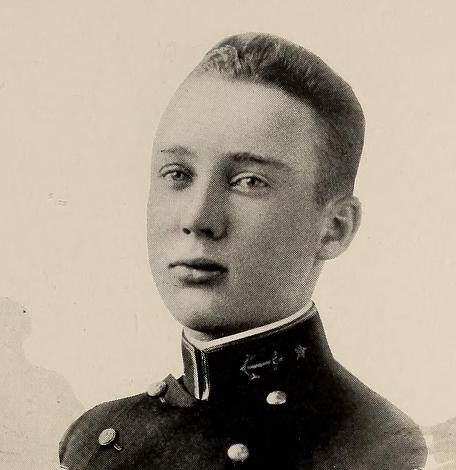
Malcolm Francis Schoeffel was born on 3 April 1898. His home of record was Heron Lake, Minnesota. He entered the United States Naval Academy with the Class of 1919, and that class was graduated early, on 6 June 1918, so its members could go to sea while the First World War was still being fought. His first duty was with the Destroyer Force in the Atlantic.
The Navy designated him a naval aviator in 1921. He served in air squadrons of the Pacific Fleet, and in a later sea tour he was navigator of the carrier Saratoga. He then became Assistant Director for Aviation Ordnance and worked with Navy Department committees on the weapons carried by aircraft. He was promoted to commander on 23 June 1938 and to captain, on a temporary basis, on 17 June 1942.
When the United States entered the Second World War he was at the Philadelphia Navy Yard, where he served as design superintendent and later as planning officer. The Legion of Merit recognized that yard duty. In the summer of 1943 he was ordered to a light carrier just finishing conversion.
The ship had been laid down at Camden, New Jersey, by the New York Shipbuilding Company as the cruiser Wilmington. She was renamed while still on the ways, launched on 4 April 1943, and in July reclassified as the small aircraft carrier Cabot (CVL-28), one of the Independence class. Captain Schoeffel took command when she was commissioned on 24 July 1943. After fitting out she embarked Air Group 31, sailed from Naval Air Station Quonset Point, Rhode Island, on 8 November, and reached Pearl Harbor on 2 December.
Cabot left for Majuro on 15 January 1944 and joined Task Force 58. Under Schoeffel her aircraft struck Roi and Namur in support of the Marshalls landings and joined the carrier raid on Truk on 16 and 17 February. After a short repair period at Pearl Harbor she raided Palau, Yap, Ulithi, and Woleai at the end of March. From 22 to 25 April she covered the Hollandia landings on New Guinea, and within a few days her planes struck Truk again, together with Satawan and Ponape. He was relieved on 5 May 1944 by Stanley John Michael.
Michael took Cabot on into the Marianas, including the Battle of the Philippine Sea in June 1944. Walton Wiley Smith commanded her from February 1945. After the war, Eugene Tatom and then Robert Webster Slye had the ship. The Presidential Unit Citation later given to Cabot covered forward-area service that began with the Marshalls strikes of January 1944, while Schoeffel was still captain, and ran on into the spring of 1945. In 1945 he was deputy chief of staff to the Commander in Chief, Pacific Fleet and Pacific Ocean Areas. He rose to rear admiral, and in 1950 he became Chief of the Bureau of Ordnance, the first naval aviator to head that bureau. He retired as a rear admiral and died in 1991.