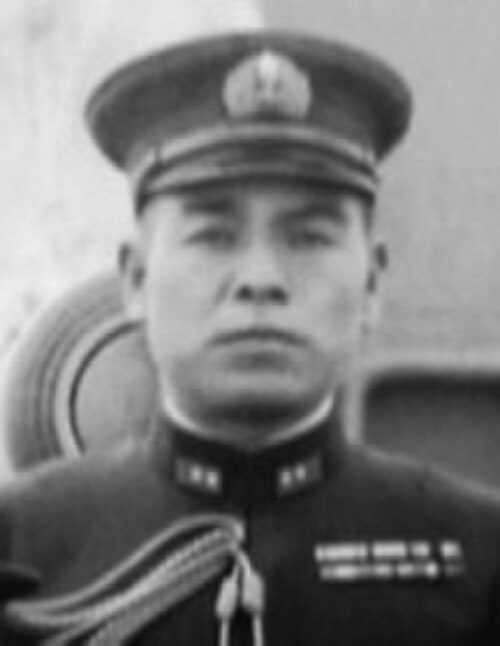
Morikazu Osugi was born in Shizuoka Prefecture on 11 March 1892 and was educated at the Naval Academy at Etajima. He graduated in December 1913, fortieth in a class of 118, and went to sea as a midshipman in the old armored cruiser Azuma. Commissioned ensign the following year, he served in the cruiser Yakumo and the battleship Haruna, and in 1919, as a lieutenant, joined the destroyer Shimakaze. He later finished the Naval War College. In the 1920s his duties included a destroyer division and a tour as an instructor at the academy.
By the late 1930s he was in shore billets: the Tokyo communications unit in December 1937, supply administration at Yokosuka, and then chief of staff of the Fourth Naval District. On 15 November 1939 he took command of the heavy cruiser Maya. On 15 April 1941 he became captain of the battleship Kongo, a short appointment that ended on 20 August, when he left for the Seito Base Force at Qingdao on the China coast. In that theater he was also connected with Japanese work to organize the navy of the Nanjing government.
In April 1942 he returned to Etajima as chief instructor of the Naval Academy. He was promoted rear admiral on 1 May 1942. On 21 June 1943 he was given command of Destroyer Squadron 10, with his flag in the new light cruiser Agano, a ship built to lead destroyers. The cruiser's own captain at that time was Captain Hiroshi Matsubara. Osugi was not Agano's captain.
At the end of October 1943 the squadron moved from Truk to Rabaul as American troops prepared to land on Bougainville. On the night of 1–2 November, Rear Admiral Sentaro Omori took a mixed force toward Empress Augusta Bay. Osugi had his flag in Agano on 2 November 1943, and with her were Naganami, Hatsukaze, and Wakatsuki. Omori's heavy cruisers, Myoko and Haguro, made up the center. In the dark the Japanese formation came apart. Hatsukaze lost her bow in a collision with Myoko and was then finished by American destroyers. Osugi kept his ships on the disengaged side of the heavy cruisers and, as the Japanese turned away, fired eight torpedoes at about 3:40 a.m. All of them missed. The striking force never reached the transports. Agano was not sunk.
The ships returned to Rabaul. Carrier aircraft near-missed Agano on 5 November. On 11 November a heavier raid struck the harbor: an aerial torpedo wrecked the cruiser's stern and bent her after propeller shafts, and strafing left Osugi badly wounded. She sailed for Truk the next day with the destroyer Urakaze. On that passage an American submarine torpedoed her, flooded a boiler room, and left her unable to steam, with ninety of her men dead. Osugi moved to Urakaze and shifted his flag there. He left Destroyer Squadron 10 on 3 December 1943 for the staff of the Combined Fleet.
In January 1944 he joined the staff of the Second Southern Expeditionary Fleet, and on 26 January he took command of the 23rd Base Force at Makassar on Celebes. He was promoted vice admiral on 1 May 1945. After the surrender a United States military court tried him over the killing of American prisoners by men under his command, nine at Kendari in November 1944 and four near Makassar in July 1945. The court found him guilty and on 31 October 1946 sentenced him to life imprisonment. He was removed from the active list that December. He died on 28 August 1948.