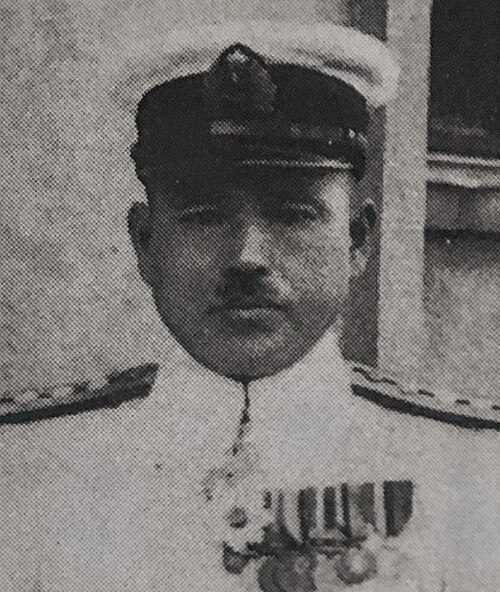
Sentaro Omori was born in Kumamoto on 3 October 1892. He graduated from the Imperial Japanese Naval Academy in December 1913, sixteenth in a class of 118, and served his midshipman time in the armored cruiser Azuma, the battle cruiser Kongo, and the battleship Iwami. Commissioned an ensign at the end of 1914, he made the torpedo his specialty, passed the advanced course at the torpedo school, and went back to that school at intervals as the weapons and the drill changed.
His first command was the destroyer Hibiki, which he took in December 1923. Later commands included the destroyers Namikaze, Kamikaze, and Yugiri, and in 1937 the seaplane tender Kamikawa Maru. From November 1939 he commanded the battleship Ise. In the autumn of 1940 he left Ise to lead Destroyer Squadron 1, and that November he was promoted rear admiral.
Destroyer Squadron 1 screened the carrier striking force when the Pacific War began. Omori’s destroyers went with the carriers to Pearl Harbor in December 1941, to the raid on Darwin in February 1942, and through the Indian Ocean operation in the spring of 1942. In June 1942, while the main fleet was engaged at Midway, he commanded the force that put troops ashore on Attu in the Aleutians.
In November 1942 he moved from destroyers to cruisers as commander of Cruiser Division 5. His flag was in the heavy cruiser Myoko, with Haguro the division’s other ship. For most of the following year the division operated from Truk with the Combined Fleet. Its first hard surface fight came when American troops landed at Cape Torokina on Bougainville.
On the night of 1-2 November 1943, Rear Admiral Omori came down from Rabaul to break up those landings. Myoko and Haguro sailed with light cruisers and destroyers. The transports he had been sent to cover never entered the fight. After the column was sighted on the way south, the troop movement was called off, and Omori went on with the warships toward Empress Augusta Bay.
A few miles off Cape Torokina he met American light cruisers and destroyers. In the short, confused night action Myoko collided with the destroyer Hatsukaze and cut off her bow. American destroyers then sank the crippled Hatsukaze. Myoko received only light damage in the collision and stayed afloat. The light cruiser Sendai was sunk as well. Near dawn Omori took the surviving ships back to Rabaul, and the landing at Cape Torokina continued.
He was relieved of Cruiser Division 5 for having broken off against a force his superiors regarded as inferior, and late in November 1943 he became commandant of the Naval Torpedo School. Promoted vice admiral on 1 May 1944, he headed the Special Attack Division from 13 September 1944 to 10 August 1945, the office that oversaw the Kaiten manned torpedoes. On 20 August 1945 he was appointed commander in chief of the Seventh Fleet. He left that post within weeks, went on the reserve list in October 1945, and died on 24 December 1974.