Ships
- USS Allen (DD-66) Captain from 28 September 1942 · Relieved on 28 May 1943
- USS Hailey (DD-556) Captain from 30 September 1943
He is not the later rear admiral Patrick H. Brady, a 1981 Naval Academy graduate. He is not Gideon Millard Boyd or James Boyd. The Dictionary of American Naval Fighting Ships uses the same day and the same styling: commissioned 30 September 1943, Commander Parke H. Brady in command. The initial H is not an initial in the books that name him in full. The 1930 Lucky Bag heads his page PARKE HOWLE BRADY. The Navy Registers of 1 January 1931, 1 July 1936, 1 July 1944, 1 July 1947, and 1 January 1955 print Parke Howle Brady, with the optical text stumbling over Howle (Howlo, 1lowle, Parks) and once, in 1943, over Parke itself. Howle is the spelling used here. A 2000 real-estate article calls him Parke Howell Brady. That is a later misspelling, not a second officer.
Origins
The Register of 1 July 1944 prints a birth date on his line, after the dittos in the rank columns: 7 October 1907. The Register of 1 January 1955, in the line captains' list, stacks the digits 10, 07, 07 under date of birth on the line of Brady, Parke Howle, captain. The month is spelled out in 1944. Those are the books followed. A secondary officers' list on uboat.net gives the same day and adds Washington, D.C., as the birthplace. No register read here prints a town beside the day. Washington is not used.
The Lucky Bag of 1930 puts Passaic, New Jersey, under the name, which in that book is the home a midshipman claimed. It is not, by itself, a birthplace. The Annual Register of the Naval Academy for 1929–30 has an optical line "Brady, Parke Howie" with the word Ohio sitting on the same broken line. Howie is Howle misread. The columns of that table are split, so Ohio is not treated as the state that appointed him. Passaic is what his classmates printed.
Nothing in the registers names a father or a mother. The Georgetown University finding aid for the Brady-Howle Family Papers describes a Washington family with ties to a house called Valley View, and records the papers as the 2018 gift of Sister Maria Theotokos, S.S.V.M., whose secular name is given there as Elinor Adams. That nun is his granddaughter, not his mother. The Howle in the collection title is the family name his middle name already carries. The finding aid does not inventory a letter, a photograph caption, or a date of birth. It is a label on unprocessed boxes, not a biography.
The woman the later record calls his wife is Elinor Ryan Brady. The Washington Post of 12 November 1993, writing about the Valley View estate on Foxhall Road in Northwest Washington, calls it the home, for almost sixty years, of Elinor Ryan Brady and her husband, Rear Admiral Parke H. Brady. A case caption in the Fourth Circuit in 1970 names the landowners as Elinor Ryan Brady and Admiral Parke H. Brady. Washington Life in September 2000 styles her Elinor Morse Ryan Brady, says she was a granddaughter of Thomas Fortune Ryan, says she built the house in 1935 at twenty-three on land inherited from a grandmother, Mrs. Alexander Morse, and says she died in June 1993. The legal caption and the Post do not print Morse, do not print the grandfather, and do not print 1935. Those details stay inside the magazine that asserted them. No marriage license was found. The year they married is not in any of these sources. "Almost sixty years" in a 1993 real-estate story is the paper's phrase for how long the couple were identified with the house. It is not a wedding date.
The children who can be named come from a 2013 obituary, not from a Navy next-of-kin card. Elena Ryan Brady Adams died on 21 September 2013 at sixty-four, at Elk Mountain in Nelson County, Virginia. The notice, published by Byrum-Parr Funeral Home and originally in the Charlottesville Daily Progress, calls her the daughter of the late Admiral Parke H. Brady and Mrs. Elinor Ryan Brady of Washington, D.C. She had married Thomas E. Adams in 1972. A daughter, Elinor Ryan Adams, was born in 1978 and later became Sister Maria Theotokos. Elena was survived by a sister, Anne Clarke Brady of Charlottesville, and a brother, Peter H. Brady of Port Orange, Florida, and had been preceded by a brother, Christopher Brady of Washington, D.C. Washington Life in 2000, writing after Elinor's death, named three surviving children: Peter Brady, Elena Brady Adams, and Clarkie Brady Mayo. Clarkie is Anne Clarke under a nickname, and Mayo is a surname the 2013 notice does not use. Christopher is absent from the magazine's list of survivors. The magazine may have omitted him, or he may already have been dead. The obituary does not date his death. Four children are named across the two pieces. No birth dates for the sons or for Anne Clarke were found, and nothing says which of them were born before the war.
Formation
He entered the Naval Academy on 22 June 1926. The Register of 1 July 1944 prints that day as his date of entry, on the same line as the birth date. He is in the Lucky Bag of the class of 1930. The Register of 1 January 1955 prints, on the same line as the birth date, the figures 6, 05, 30 and a final 30. Set against the 1944 entry date of 22 June 1926, those figures are the class commissioning, 5 June 1930, not a second birth date and not the day he became a midshipman. The Register of 1 January 1931 lists him among the ensigns, signal number 6319, and dittos his date of rank to the class date printed in that column. USS Cincinnati is the duty on the line.
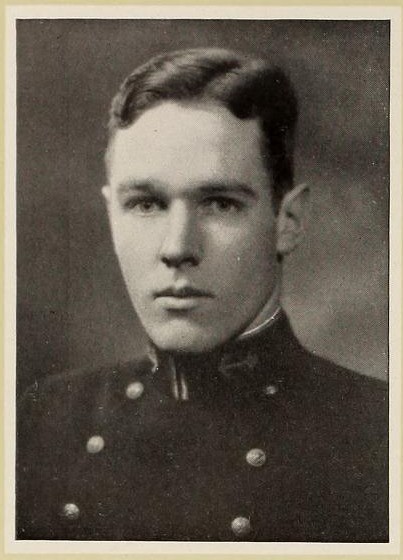
The yearbook is classmate prose, written to be clever, and it should be read that way. The nicknames over the sketch are Pete, Maj-Maj, and Demon. The paragraph says the boy who wanted any chance at "high, wide and handsome whoopee," and who resented being asked to leave it, "changed noticeably into the man when Pete cast his lot with the Navy." "The Demon takes the Navy seriously." They gave him "a passion for the impossible" and "the indubitable tendencies of a home-wrecker," which in that slang is a man who broke up other people's evenings with women, not a man who broke up a household. They said he seemed a saint when he most played the devil, that he believed the soul of a man was in his clothes, except for the striped bathrobe of youngster year, and that hard study at sea, "trycocks and steam valves," kept him from literary jobs he might otherwise have taken. They joked that his Noxema would cure anything from lazy legs to a dull mind. "The beauty of a lovely woman is like music," they wrote, "and Pete hath always been an ardent admirer of good music." The tag they left him is a blessing, not a quotation from his mouth: "May the lines fall unto you in pleasant places, Pete. You have a goodly heritage."
The jobs the book actually records are narrower than the joke. On the Lucky Bag staff page he is P. H. Brady, associate editor. The class crest committee list, in the optical text, prints his surname with O'Handely, Phillips, Ostroai as chairman, and Patten. The index sends Brady, P. H., to pages 43, 334, 350, and 164. Page 164 is the biography. Page 350 is the crest committee. Page 43 is the battalion organization. A transcription of that organization page places P. H. Brady as battalion adjutant in the second battalion, ahead of the third battalion's adjutant. The scan used here dropped that line in its own optical text, so the adjutancy rests on the yearbook page as transcribed elsewhere, not on a clean local reading. Page 334 was not identified. No varsity letter was recovered from a credit line that can be trusted as his. The registers do not give his class standing.
The qualification number that does sit on a register line is 22-f. The key printed in the Register of 1 July 1944 says 22-f is a completed postgraduate course in naval engineering, operating, as distinct from 22-e, naval engineering, design. His commanders' line in that register carries 22-f. The books do not say where the course was taught, or whether he asked for it. They do say that before he commanded a destroyer he had finished the operating engineer's course. That is the schooling behind the billet the Navy Directory gives him in 1940.
The sea duty that can be dated comes from the Register and the Directory, which are snapshots of orders, not cruises.
On 1 January 1931 he was an ensign on Cincinnati. The directory of 1930 already has Ensign Parke H. Brady, USS Cincinnati. The ship then in commission under that name was the Omaha-class light cruiser CL-6. The books do not give his billet. They do not say he made any particular cruise. They keep a new ensign on a cruiser. He was not her captain.
On 1 July 1936 the Register lists him among the lieutenants (junior grade), signal number 4485, present duty "Naval Academy (instruction)." The date-of-rank column on his own line is not clean. A neighbor in the same grade is printed at 5 or 6 June 1933, the ordinary three-year point for the class. His own day as lieutenant (junior grade) was not recovered as a clean numeral. He was a junior lieutenant, and he was teaching, or at any rate ordered to instruction, at Annapolis in the summer of 1936. The register does not say which department.
By the Navy Directory of 1 June 1940 he was a lieutenant, USS Ellet, engineer officer. The alphabetical line reads "Brady, Parke H., lt, u s s Ellet, eng," and the index repeats "Lt. P. H. Brady, eng." Ellet then in commission was the destroyer DD-398, commissioned in 1939. He was her engineer. He was not her captain. Between the Academy line of 1 July 1936 and the Ellet line of 1 June 1940 he had become a lieutenant. No register line with the exact day of that promotion was recovered. A secondary list says 1 January 1938. That day was not found printed beside his name. It is not used here.
The next rank that is printed in a section heading, rather than borrowed from a neighbor, is lieutenant commander. The Register of 1 July 1943 places him in the lieutenant commanders, signal number 3297, the optical text reading "Park llowle Brady," born on a line the scan nearly loses, entered 22 June 1926 on the same scrambled row as Edward Clark Renfro's dates. By 1 July 1944 the same man, now read as "Iarke liowle Brady," is in the commanders, signal number 3069, qualification 22-f, born 7 October 1907, entered 22 June 1926, with date of rank and permanent rank both dittoed. Hailey was commissioned between those two registers, and the ship's history styles him commander on the day he took her. The promotion to commander falls in that gap. The day itself is not on a register line that was read.
War years
What the official books say he commanded is one ship, and they say it once. Hailey (DD-556), a Fletcher-class destroyer, was launched 9 March 1943 at Seattle-Tacoma Shipbuilding, sponsored by Mrs. Claude S. Gillette, and commissioned 30 September 1943, Commander Parke H. Brady in command. That sentence is the Dictionary of American Naval Fighting Ships. DANFS then follows the ship and does not name him again.
A commanding-officer list on NavSource, and the same dates on uboat.net, run his command from 30 September 1943 to 26 January 1945, and name James Robert Payne as the next captain. NavSource misspells him Parker Howle Brady and tags the Naval Academy class of 1930, which the yearbook and the registers support, and the spelling Parker, which they do not. The relief date is not in DANFS, not in a deck log read here, and not in an action report. It is used as the best reported end of the command, and it is labeled as that. It is not treated as a log entry.
Inside that reported window, DANFS gives the ship's movements, not his. After shakedown out of San Diego she left Seattle on 13 December 1943 for Pearl Harbor. On 19 January 1944 she sortied screening part of Admiral R. K. Turner's Southern Attack Force for the Marshalls, worked off Kwajalein with the transport screen and her five-inch guns, and on 15 February sailed with the Eniwetok expedition. Through April and May she was on antisubmarine patrol, barge interception, and daily fire support for the Army in New Guinea. On 16 May, Destroyer Division 94, Haggard, Franks, Hailey, and Johnston, was east of Green Island when Haggard made a sonar contact. The contact was the submarine I-176. The destroyers attacked, heard a heavy underwater explosion, and the next evening picked Japanese debris out of an oil slick miles long. DANFS does not say which ship made the attacks, and it does not say who was on Hailey's bridge. In June she screened and patrolled east of Saipan. On 1 July she sortied from Eniwetok with Admiral Weyler's battleship division for the bombardment of Guam, then joined Admiral Conolly's Southern Attack Force for the capture of Guam, and retired to Eniwetok on 9 August. Through the rest of August and September she screened escort carriers at Peleliu, Angaur, and Ngesebus. On 12 October she left Seeadler Harbor, Manus, with Admiral F. B. Stump's "Taffy 2," the center escort-carrier group off Leyte Gulf. DANFS puts that formation in the fight off Samar on 25 October 1944, when Kurita's center force came down on the escort carriers, and then moves her to Halsey's fast carriers, strikes on Formosa, and a fueling group. In February 1945, still without naming a captain, DANFS puts her with Mitscher's Task Force 58 for Okinawa and the home islands through June.
If the secondary list is right, and he left on 26 January 1945, the Okinawa and home-island strikes are the next captain's cruise, not his. Payne's name on that list begins the day the list says Brady's ended. The Formosa strikes and the fueling-group duty sit in DANFS between Leyte and February 1945, with no date that pins them to one side of 26 January. They are not folded into his story. What can be said without borrowing the ship's later war is that he took a new destroyer out of Seattle in the last months of 1943 and, if he was still in her through the autumn of 1944, he had her for Kwajalein, Eniwetok, the New Guinea gunfire, the night I-176 was killed, Guam, the Palaus, and the escort carriers off Samar. None of those sentences is a deck-log extract with his name on it. No letter, no fitness report, and no award citation was found that says what he did on any of those nights, or what he thought of them.
The other wartime command in the secondary lists is older and smaller. NavSource's officer list for Allen (DD-66) gives Lieutenant Commander Parke Howle Brady from 28 September 1942 to 28 May 1943, between Daniel Byrd Miller and Homer Howard Nielson, and notes that he was later a rear admiral. uboat.net prints the same window. DANFS for Allen does not name him. It says the ship was at Pearl Harbor on 7 December 1941, undamaged, and stayed in the Pearl Harbor Defensive Sea Area until August 1945, screening sorties, patrolling the Oahu picket line, and running gunnery and antisubmarine exercises. If the list is right, his months in her were that duty, in a ship launched in 1916 and kept on because she was still useful inside the harbor approaches. It was not a campaign. It is not narrated here as one.
No decoration was found. A search of the Hall of Valor under his name returned nothing that could be tied to him. Hailey received six battle stars for the Second World War. Those are the ship's stars. They are not a citation with his name, and they are not divided here into the actions before and after 26 January 1945.
Cost
The cost that can be documented is absence, not a wound. From the summer of 1940 he was an engineer on a destroyer. By the autumn of 1943 he was in the Pacific in command of another. The Washington house was still the address the family is remembered by. Nothing read here says whether Elinor and the children stayed at Valley View through the war, or whether any child had been born yet. Washington Life says that while the Bradys traveled they rented the house, and names Richard King Mellon, Dwight Davis, and Marjorie Merriweather Post with Joseph Davies among the tenants. The magazine does not date those leases, and it does not say the tenants were there because he was at sea. A rented house is not a war diary.
What the yearbook had predicted, pleasant lines and a goodly heritage, is not the same thing as a record of how he behaved when a submarine contact or a Japanese battleship line was the problem in front of the ship. Classmates in 1930 thought he had put the whoopee away and taken the Navy seriously. The Navy, for its part, sent the operating engineer to sea as engineer of Ellet, then gave him a new Fletcher. That is a career moving the way a destroyer career moved. It is not a character witness from 1944. No one in the sources used here describes him under fire. The gap is the gap.
After
He came home to a captain's commission and, in the family's later usage, to a flag officer's title. The Register of 1 July 1947 places his name in the captains' list, signal 2339. The men of his class on that page are carried as permanent lieutenant commanders from 30 June 1942, with a temporary-rank date of 15 November 1945, which is the date repeated down the page for that year-group. His own numerals are scrambled by the scan. The 15 November 1945 date is the pattern of the page, not a clean reading of his line, and it is not quoted as his personal date of rank. The Register of 1 January 1950 is clearer about the grade even where the optical text is not. The page is headed captains, line. His line, misread as "Brady Parks Howle" and as CDR, carries the date 23 May 1949, the birth date 7 October 1907, and 5 June 1930. The index of the same volume spells the rank captain. The Register of 1 January 1955 prints it without the scramble: Brady, Parke Howle, captain, date of rank 23 May 1949, born 7 October 1907. That is the captain's date used here.
The Register of 1 January 1959 still has the name, badly read as "bRADY PARkE HOWLES," in the block of his classmates. The registers of 1 January 1960 and 1 January 1961, searched for the name, did not yield it. Optical failure can hide a man, so the absence is not treated as proof he had left the active list. A secondary list says he retired as a rear admiral on 1 November 1959. That day was not found in a register. It is not used. What the later public record does say is the title. The 1970 case caption calls him Admiral Parke H. Brady. The 1993 Post calls him Rear Admiral Parke H. Brady. His daughter's obituary calls him the late Admiral Parke H. Brady. None of those is a retirement order. Together they are how his family and the press styled him after the captain's registers.
The land case is a caption, not a story that was read through. United States v. 365.0 Acres of Land, More or Less, Situate in Augusta County, Virginia, Elinor Ryan Brady and Admiral Parke H. Brady, 428 F.2d 459, was decided by the Fourth Circuit on 29 June 1970. He and Elinor were the landowners and the appellants. The opinion itself was not in hand. Nothing here describes the acreage, the price, or what the taking was for, beyond the caption's statement that the land lay in Augusta County. Elk Mountain, where Elena died in 2013, is in Nelson County, not Augusta. The two Virginia places are not assumed to be the same farm.
Valley View outlived him in the real-estate pages. The Post in November 1993 offered the seventeen-acre Foxhall Road tract, the Georgian house in a steep valley of poplar, hickory, and oak, as one of the last large estates in Washington, and tied it to Elinor and to him. Washington Life says she died in June 1993, that the house was the National Symphony Orchestra Decorators' Show House in 1994, and that it sold in 1996. The children named in her survivor list and in Elena's obituary are what the printed record says he and she left: Peter, Elena, Anne Clarke, and Christopher. Elena's daughter, his granddaughter, gave the family papers to Georgetown in 2018 and is the Sister Maria Theotokos of the finding aid.
The day and place of his death were not established in a register, an obituary, or a cemetery record read here. uboat.net says 2 January 1973 at Palm Beach, Florida, aged sixty-five. That entry was not corroborated. It is not narrated as the death. By 1970 he was still named, alive, in a federal case. By 1993 the Post wrote of the couple in the past tense and did not say when he had died. By 2013 his daughter called him the late admiral. The death sits somewhere in that span. The date does not.