Ships
- USS Farragut (DD-348) Captain, 15 May 1937 – 5 June 1938
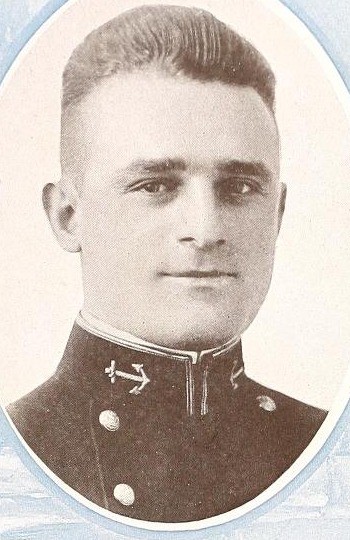
Peter Kalsh Fischler was born in Wellsboro, Pennsylvania, on 10 September 1895, the son of Peter Fischler and Lillie Stricklen Fischler. He finished Wellsboro High School in 1913. The next year he entered the Naval Academy, appointed from Pennsylvania's Fifteenth District. War shortened the course for the Class of 1918, and he was commissioned an ensign in June 1917.
His first ship was the cruiser Tacoma, then with the Atlantic Fleet. Late in 1917 he served briefly in the receiving ship at Boston, and in March 1918 he joined the fitting-out crew of the battleship New Mexico. He stayed aboard from her commissioning on 30 May 1918, through her Atlantic Fleet duty in the last months of the war, until October 1919. From then until June 1922 he commanded, in succession, the destroyers Meredith, Breckenridge, Bell, and Robinson. In September 1922 he reported to Putnam as executive officer and later became her commanding officer, leaving in February 1924.
He taught seamanship at the Naval Academy until June 1926. That summer he went to the Asiatic Station as executive officer of the gunboat Sacramento. His early service also earned the World War I Victory Medal with Atlantic Fleet clasp, the Second Nicaraguan Campaign Medal, the Yangtze Service Medal, and the Navy Expeditionary Medal.
On 15 May 1937, as a lieutenant commander, Fischler became captain of Farragut (DD-348). She was the lead ship of a new destroyer class, commissioned at Quincy, Massachusetts, on 18 June 1934 under Elliott Buckmaster. By the spring of 1937 she was with Destroyer Squadron 1 on the West Coast. Fischler relieved Edward Paul Sauer and kept the ship through a peacetime round of fleet training, gunnery, and tactics until 5 June 1938. He was promoted to commander on 23 June 1938. In the war that followed, Farragut went on under other captains, among them George Washington Welker, George Porter Hunter, Henry Dirk Rozendal, and Edward Franklin Ferguson.
From January 1941 to August 1942 he planned movements for the Service Force in the Atlantic, a period when new bases were opening and overseas shipments were growing. He was credited with keeping supply ships, minelayers, tenders, and transports working so that fleets and bases stayed supplied, and with helping set the plans used when large Army and Marine forces were first trained for amphibious landings. In August 1942 he joined the staff of the Commander in Chief, United States Fleet, and remained there until February 1944. He was advanced to captain during 1942 and appointed rear admiral to rank from 11 May 1943.
On 8 February 1944 he was sent to fitting-out duty in the large cruiser Alaska and took command when she was commissioned on 17 June 1944. He left her on 27 January 1945 to command Battleship Division Five. From 16 February to 7 March 1945, during the assault and capture of Iwo Jima, he led a fire-support unit and received the Bronze Star Medal with the combat V. From March through May 1945, off Okinawa, he commanded a battleship division, a task group, and a fire-support unit. The Legion of Merit with the combat V recognized the condition of those ships and the gunfire he directed against Japanese positions through that long campaign. He also received a commendation ribbon, the American Defense Service Medal with Fleet clasp, the Asiatic-Pacific Campaign Medal, the World War II Victory Medal, and the Philippine Liberation Ribbon.
On 3 July 1947 he became Commander, Training Command, Amphibious Forces. In March 1948 he took command of Amphibious Group One, Pacific Fleet, with additional duty as Commander, Transport Squadron One. On 3 January 1950 he assumed command of the Amphibious Force, Pacific Fleet. Rear Admiral Fischler died at the Naval Hospital in San Diego on 14 July 1950, after a short illness.