Ships
- USS Jenkins (DD-447) Captain, 29 December 1943 – 8 July 1945
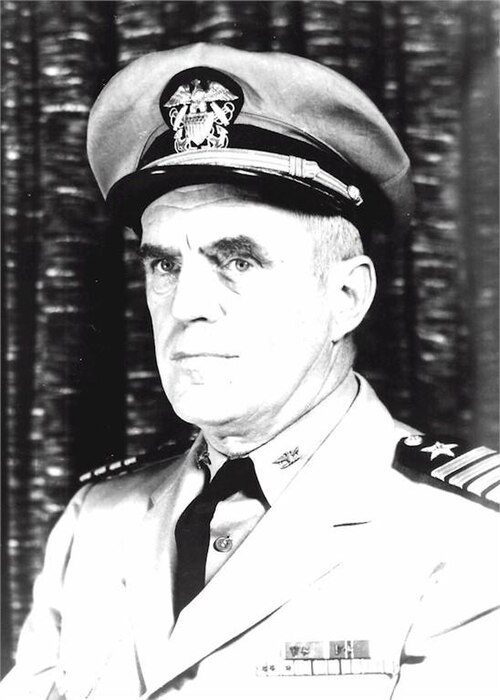
Philip Daly Gallery was born on 17 October 1907. His father, Daniel Vincent Gallery, was a Chicago lawyer, and his mother, Mary Onahan Gallery, was a writer. He graduated from the United States Naval Academy with the class of 1928 and made his career in the United States Navy. Two brothers, Daniel V. Gallery and William O. Gallery, followed the same path, and all three rose to rear admiral.
In the first years of the Second World War he was ashore at Dam Neck, Virginia. From December 1941 into January 1944 he organized and administered the Anti-Aircraft Training and Test Center, training gun crews and pressing the trial of new equipment. That work earned him the Legion of Merit.
On 29 December 1943 Gallery took command of the Fletcher-class destroyer Jenkins, relieving Madison Hall. The ship had already been through the North Africa convoy of 1942 and the Solomons fighting of 1943 under Harry Fanker Miller and then under Hall. Early in Gallery’s tour Jenkins was on the Pacific coast, and in January 1944 she was photographed off Mare Island before heading back to the war.
His command ran through the Marshall Islands, the New Guinea landings, the Philippine campaign, and the Borneo operations of 1945. Jenkins screened larger ships, stood radar picket and fighter-direction duty, patrolled against submarines, and fired on shore targets. Off Luzon in December 1944 a shore battery hit the destroyer, and she remained in the combat area. In April 1945, with Destroyer Squadron 21 supporting the landing at Tarakan that was meant to cut Japanese oil, Jenkins struck a mine in a channel that had already been swept. One man was killed, and the damage sent the ship toward repair in the United States. For this command Gallery received a second Legion of Merit and two Bronze Stars. He left Jenkins on 8 July 1945, turning the ship over to Gene Thomas Shirley.
After the war he commanded Destroyer Division 72 and the fleet oiler Passumpsic. In 1950 he became officer in charge of the Gunfire Support School at Little Creek, Virginia. From June 1953 to December 1954 he commanded the heavy cruiser Pittsburgh. He later led the Surface Anti-Submarine Development Detachment and served on the staff of the Operational Development Force of the Atlantic Fleet. He retired in 1958 as a rear admiral.
In retirement he was associated with the Florida Institute of Technology in Melbourne. He died on 29 November 1973 and was buried with full military honors at Arlington National Cemetery. The guided-missile frigate Gallery was named for him and his two brothers.