Ships
- USS Daly (DD-519) Captain from 10 March 1943
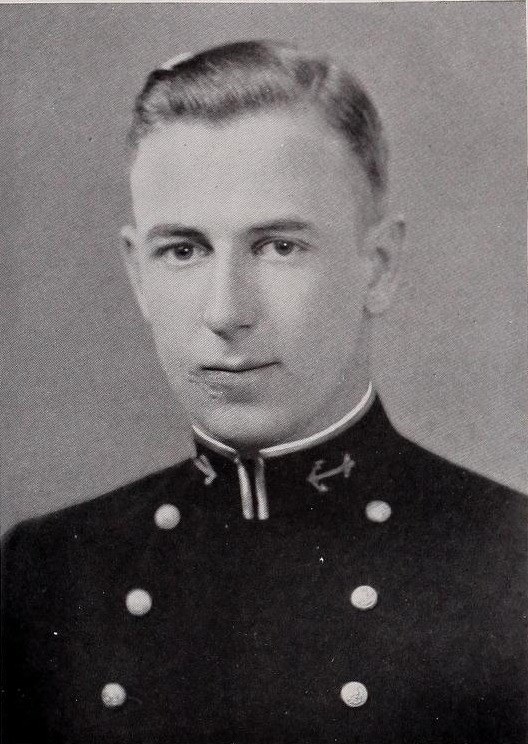
R. G. Visser was born Richard Gerben Visser in Garfield, New Jersey, on 19 November 1906, the son of Gerben Dirk Visser and Effie Kundersma Visser. He attended Hopedale High School in Hopedale, Massachusetts, where he was president of his class and of the high school athletic association, and he received his appointment to the United States Naval Academy from Massachusetts. He entered the Academy on 11 July 1925 and graduated with the class of 1929. He was promoted to lieutenant in 1937 and to lieutenant commander in 1942.
In December 1941 he reported to the headquarters of the Commander in Chief, United States Fleet, in Washington, and spent the first year of American participation in the war in the Convoy and Routing Section. Early in 1943 he was ordered to a new Fletcher-class destroyer building at Bethlehem Steel on Staten Island. On 10 March 1943 he took command of Daly as the ship was commissioned.
Through late spring Daly screened the carrier Ranger during exercises and patrol off Argentia, Newfoundland. She then left New York escorting Lexington, reached San Diego on 4 August 1943, and sailed the next day for the Aleutians. From Adak she covered transports for the occupation of Kiska in mid-August, then patrolled and escorted between Kiska and Attu until November, when she went on to Pearl Harbor.
In December 1943 Visser brought Daly to Milne Bay, New Guinea, and into the drive along the New Guinea coast and into the Philippines. At Cape Gloucester, New Britain, on 26 December, the destroyer stood with the landing craft, shot down two Japanese bombers, and took 168 survivors from the sinking destroyer Brownson after exploding depth charges from that ship briefly cut Daly's power. Over the months that followed he fought her guns against shore positions under repeated air attack during the landings at Hollandia, Wakde, Biak, Noemfoor, Morotai, and Leyte, and during bombardments in the Admiralty Islands and at Wewak, Hansa Bay, and Wakde-Sawar. For his command from 25 December 1943 to 24 October 1944 he received the Legion of Merit with the combat distinguishing device.
On the night of 24–25 October 1944 a Japanese force of battleships, cruisers, and destroyers came up Surigao Strait toward Leyte Gulf. Visser took Daly into the crowded night battle and fought her with guns and torpedoes. The destroyer put three torpedoes into a Japanese battleship and, with gunfire, left the cruiser Mogami crippled; American aircraft sank that cruiser the next morning. He was awarded the Navy Cross for the action.
He left Daly in November 1944 and joined the staff of the Commander, Amphibious Forces, Pacific, as assistant operations and plans officer. From 5 December 1944 to 17 May 1945 he helped plan the invasions of Iwo Jima and Okinawa and, while Japanese aircraft struck during the assault phases, assisted in directing the joint expeditionary force. A Bronze Star Medal with the combat device recognized that duty. He was made a temporary captain on 30 March 1945. Detached from the staff in October 1945, he commanded the oiler Manatee from December 1945 until April 1947 while she supplied occupation forces in Japan, China, Korea, and the Philippines.
The following year he commanded Destroyer Division 122 and spent four months with the Sixth Fleet in the Mediterranean. From July 1951 to August 1952 he served as assistant chief of staff for operations and plans to the Commander, Destroyers, Atlantic. He was a student at the National War College in Washington from August 1952 to June 1953, then became assistant chief of staff for administration on the staff of the Commander in Chief, Atlantic Fleet. He retired as a rear admiral. Visser died on 2 November 1998, at the age of ninety-one.