Ships
- USS Nevada (BB-36) Captain from 2 October 1937 · Relieved on 10 May 1939
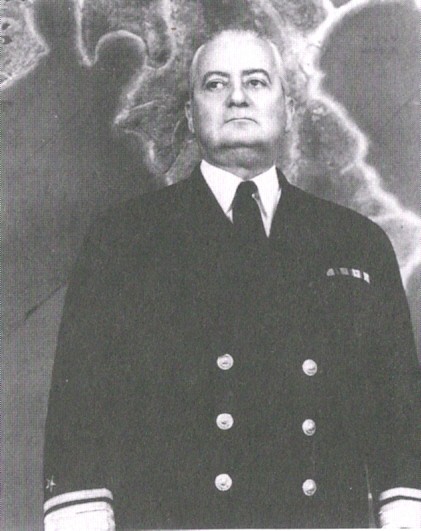
Robert Alfred Theobald was born in San Francisco on 25 January 1884. He graduated from the United States Naval Academy in 1906 and remained in the Navy through both world wars, advancing from ship command as a captain to flag rank as a rear admiral. His name is tied to the battleship Nevada in the late 1930s, to the naval defense of Alaska in 1942, and to a postwar book on Pearl Harbor that most historians have rejected.
In the First World War he served in destroyers. In the years after the armistice he added staff duty to sea service and passed through the Naval War College, whose teaching in that generation still carried the mark of William Sowden Sims: begin with the forces actually on hand, and do not write a plan the fleet cannot execute. Those habits followed him into the Pacific assignments of the 1920s and 1930s, as the Navy shifted its main strength toward a possible war with Japan.
On 2 October 1937 Theobald became captain of Nevada. She was an older battleship that a deep modernization had kept in the Battle Force, and for the next nineteen months he had her in the fleet’s ordinary hard work: gunnery practices, formation steaming, and the large exercises that tested how the battle line would operate across the Pacific. He was relieved on 10 May 1939. The tour produced no single famous action. It did give him command of a first-line battleship while the Navy was measuring itself for a Pacific war.
Promotion to rear admiral brought a wider task than one ship. In 1942 he was ordered to command the North Pacific Force, the naval command responsible for Alaska. The map was enormous and the means were thin. Weather closed harbors and airfields for days at a time, distances ran in the hundreds of miles between useful bases, and the ships and aircraft under his hand were a light screen along the Gulf of Alaska and the Aleutian chain.
Early in June 1942 Japanese carriers struck Dutch Harbor. Within a few days Japanese troops occupied Kiska and then Attu, and the North Pacific Force could not stop the landings. For the rest of that year Theobald held the approaches farther east, covered the shipping that supplied the Alaskan bases, and argued over the timing of a counterstroke. He and Major General Simon Bolivar Buckner Jr., the Army commander in Alaska, differed on when a landing would be more than a gamble in fog and short supply. Admiral Chester W. Nimitz wanted the islands cleared on a faster schedule. In January 1943 Nimitz relieved Theobald and gave the North Pacific command to Rear Admiral Thomas C. Kinkaid. The assault that retook Attu in May 1943, and the occupation of Kiska in August after the Japanese had already left, were Kinkaid’s operations.
Theobald closed his naval service in shore duty and retired as a rear admiral. In 1954 he published The Final Secret of Pearl Harbor. The book argued that President Franklin D. Roosevelt and senior officers in Washington had known a Japanese blow was coming and had kept a clear warning from Admiral Husband E. Kimmel and Lieutenant General Walter C. Short so that the attack would unite the country for war. Study of the intercepted traffic, the Hawaiian duty logs, and the Washington files has left that charge with little support. His wartime record stands instead on the constrained defense of Alaska in 1942, and on a relief that came before the Aleutians were recovered. He died on 13 May 1957.