Ships
- HMAS Hobart (D63) Captain from 8 November 1944
Vice Admiral Sir Roy Russell Dowling, KCVO, KBE, CB, DSO (28 May 1901 – 15 April 1969) was a senior officer of the Royal Australian Navy. He served as Chief of Naval Staff from 1955 to 1959 and as Chairman of the Chiefs of Staff Committee, the forerunner of the Chief of the Defence Force, from 1959 to 1961.
He was born on 28 May 1901 at Condong, on the Tweed River in northern New South Wales, the sixth child of Russell Dowling, a sugar-cane inspector, and Lily Jane (née Ingram). In 1915 he entered the Royal Australian Naval College at Jervis Bay. Academically undistinguished, he was a natural sportsman, became Chief Cadet Captain, and graduated in 1918 as King's Gold Medallist for character and officer-like qualities.
Sent to Britain in 1919 as a midshipman, he was present at the scuttling of the German High Seas Fleet at Scapa Flow on 21 June 1919, and the following year took part in operations in the Bosporus and the Sea of Marmara against Turkish nationalists. After courses at Greenwich and Portsmouth he returned to Australia in 1922, joined the cruiser Adelaide, and was promoted lieutenant in March 1923. Adelaide sailed with the Royal Navy's Special Service Squadron from Australia to England in 1924.
He specialised in gunnery, completing the long course at Portsmouth, and served as flotilla gunnery officer in the destroyer depot ship Platypus and the destroyer Anzac, then as an instructor at the gunnery school at Flinders Naval Depot. On 8 May 1930, in the chapel of Melbourne Grammar, he married Jessie Spencer; they had five children, including two sets of twins. From 1931 he was gunnery officer of the light cruiser Colombo on the Mediterranean Station, then squadron gunnery officer in Canberra from 1933 to 1935. Rear Admiral Wilbraham Ford called him an officer of outstanding ability. Depression-era stagnation delayed promotion; he became commander only on 31 December 1936.
In January 1937 he took command of the new sloop Swan, which did squadron work and independent cruises, including carrying the Governor-General, Lord Gowrie, on part of a tour of Papua and the mandated Territory of New Guinea. By late 1939 he was standing by the anti-aircraft cruiser Naiad, building in Britain, and became her executive officer when she commissioned in 1940. He was not her captain.
Naiad served with the Home Fleet, then transferred to the Mediterranean in May 1941. Off Crete she was bombed and badly damaged; Dowling helped get her into harbour. After repairs she escorted Malta convoys, flew the flag of Rear Admiral Philip Vian, and took part in the First Battle of Sirte in December 1941, in which British cruisers and destroyers drove off a stronger Italian force. On 11 March 1942, about 50 nautical miles off the Egyptian coast, Naiad was torpedoed by U-565 and sank in a little over twenty minutes, with 82 men lost. Dowling survived, remaining in the water for about an hour and a half before rescue.
In July 1942 he became Director of Plans at Navy Office, Melbourne, during a period of heavy RAN losses. In September 1943 he was made acting captain, and the rank was made substantive in June 1944. He was Deputy Chief of Naval Staff. He helped plan the post-war navy, including a carrier force so the RAN could operate more independently in the Pacific and Indian oceans.
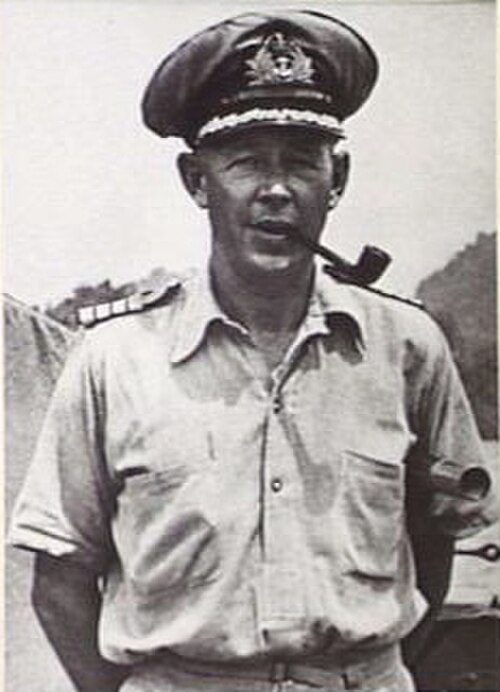
On 8 November 1944 he took command of the light cruiser Hobart as she emerged from a long refit after being torpedoed in the Solomons in 1943. In 1945 Hobart supported the landings at Cebu, Tarakan, Wewak, Brunei and Balikpapan. For outstanding courage, skill and initiative in those operations he was awarded the Distinguished Service Order, gazetted on 6 November 1945. Hobart was present at the Japanese surrender in Tokyo Bay on 2 September 1945 and then became flagship of the Australian Squadron. Dowling remained her captain, and was flag captain and chief of staff to Commodore John Collins, until February 1946.
After leave to recover from wartime strain, he was Director of Naval Ordnance, Torpedoes and Mines from May 1946. When the officer senior to him for carrier command was medically unfit for sea, Dowling went to England and in December 1948 commissioned HMAS Sydney, the RAN's first aircraft carrier. That carrier was a new ship. She was not the cruiser Sydney lost on 19 November 1941. The carrier and her air group quickly reached a high standard. He left her in April 1950 and in June became Chief of Naval Personnel, with the rank of commodore first class. During the Korean War and a tight labour market he worked on pay and conditions, recruited former Royal Navy personnel, and expanded the women's service. He was appointed CBE in the 1953 New Year Honours and attended the Imperial Defence College in London that year.
Promoted rear admiral on 8 July 1953, he assumed command of the Australian Fleet in December. After the Korean armistice he had to cut operations under government economy measures, but in 1954 he escorted the royal yacht Gothic during Queen Elizabeth II's tour of Australia.
He succeeded Collins as Chief of Naval Staff on 24 February 1955, was promoted vice admiral, and was appointed CB in June. His term was dominated by tight budgets and the navy's low priority among the services. He fought to keep the Fleet Air Arm and the carrier HMAS Melbourne, leaned on advice from the First Sea Lord, Earl Mountbatten, and pressed for an offensive capability, at one point canvassing tactical nuclear weapons for the Sea Venoms, while holding that the RAN's main alliance role should remain anti-submarine warfare. He was an early advocate of an Australian submarine force and saw the RAN College return from Flinders to Jervis Bay in 1958. He moved his office to Canberra in 1959. He was knighted KBE in the 1957 New Year Honours.
He expected to retire at the end of his term, but in March 1959 he was offered the chairmanship of the Chiefs of Staff Committee. He accepted, was relieved as Chief of Naval Staff on 22 March, and took the chair the next day. The post had little executive power. His attempt, encouraged by Mountbatten, to give it status closer to that of Britain's Chief of the Defence Staff made little progress, and he had to preside over cuts that included a decision, later reversed, to abandon the Fleet Air Arm.
He retired on 27–28 May 1961 and stayed in Canberra. A devout Anglican, he was active in church affairs and was chairman of the Canberra division of the Australian Red Cross Society from 1962 to 1967. In July 1962 he was chosen to plan the next royal tour. In March 1963 the Queen invested him KCVO, and in November he was appointed permanent Australian Secretary to the Queen, a post he held until his death.
He died of a coronary occlusion on 15 April 1969 in Canberra Hospital, was given a naval funeral at St John's Church, and was cremated. He was survived by his wife, two sons and three daughters.
The life is taken from the Sea Power Centre – Australia, which draws on the Australian Dictionary of Biography, and from the service record summarised by the Australian War Memorial. The day he took Hobart, 8 November 1944, is the Sea Power Centre list of her commanding officers.