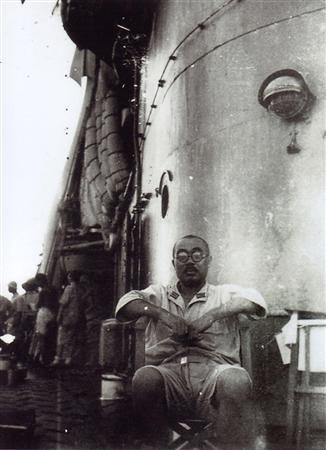
Ships
- IJN Ikazuchi Captain from 1 November 1940
Shunsaku Kudo was born on 7 January 1901 at Yashiro, in the Higashiokitama district of Yamagata, now part of Takahata, the second son of the farmer Shichirobei Kudo. He entered the Imperial Japanese Naval Academy with the 51st class in 1920 and graduated in 1923. His first sea duty was in the light cruiser Yubari, and in the autumn of 1924 he joined the battleship Nagato. He was commissioned that December.
He spent the next decade in the torpedo branch. After duty in the light cruiser Tama and the advanced course at the Torpedo School, he served as torpedo officer in the destroyer Momo, the heavy cruiser Chokai, the destroyer Sagiri, and the light cruisers Kuma, Tama, and Isuzu. Promoted lieutenant commander in 1937, he took command of the destroyer Tachikaze the following year. In 1940 he came ashore as an instructor at the Naval Gunnery School and as a judge of the Yokosuka naval court. On 1 November 1940 he returned to sea as captain of the destroyer Ikazuchi.
Ikazuchi, a Fubuki-class ship of Destroyer Division 6, was still under his command when the Pacific War began. With her division mate Inazuma she served in the Second China Expeditionary Fleet and took part in the blockade of Hong Kong. She then joined the eastern support group of the Southern Force, formed around the battleship Haruna, and went south for the campaign against the Dutch East Indies.
On 1 March 1942, north of Surabaya, Japanese ships caught the last Allied cruisers and destroyers trying to get out of the Java Sea. In that action the British heavy cruiser Exeter, the British destroyer Encounter, and the American destroyer Pope were sunk. Ikazuchi was one of the ships in the fight. That same day Inazuma picked up several hundred men from Exeter. On 2 March, while Ikazuchi was patrolling, her lookouts sighted another large body of men in the water, survivors of Encounter and Pope. Many had been adrift for about twenty hours. Fuel oil coated them, and some could no longer see.
Kudo stopped his ship and ordered the rescue. Ikazuchi hoisted the international signal that she was engaged in rescue work, and he reported that he was taking the survivors aboard. For about three hours the crew pulled men from the sea with lines, ladders, and poles, while the destroyer lay stopped where a submarine might still be waiting. They brought aboard 422 men, close to twice her own company, and the crowd on deck left her in no condition for a fight.
Kudo had the British officers assembled on the foredeck. He came down from the bridge, saluted, and spoke to them in English. He said they had fought bravely, that they were now honored guests of the Imperial Japanese Navy, that he respected the British navy, and that their government had been foolish to make war on Japan. The men were given a chance to wipe off the oil and were fed. One of them was Sam Falle, a junior gunnery officer from Encounter, who later became a British diplomat. He remembered bracing for machine-gun fire and then seeing the rescue flag instead. On 3 March Ikazuchi turned the prisoners over to the Dutch hospital ship Op Ten Noort at Banjarmasin. They remained prisoners for the rest of the war.
After the Java Sea operation Ikazuchi was sent to the Philippines and then to the First Fleet for the passage home. In May 1942 she came under the Fifth Fleet for the seizures of Attu and Kiska. Kudo left her in August 1942 to command the destroyer Hibiki, and in November he was promoted commander. In Hibiki he escorted the carrier Taiyo on three voyages between Yokosuka and Truk. By December he was ashore, assigned to the Naval Facilities Department and to the administrative section of the Yokosuka Naval District. In 1943 he served on the board that examined candidates for the naval reserve student course.
Kudo kept the rescue to himself. He died on 12 January 1979. The story reached a wide public only afterward, through Falle's account of that day on Ikazuchi and through later Japanese retellings in print and on television. The men taken from the Java Sea remembered a lieutenant commander who had stopped a destroyer in dangerous water and treated beaten enemies as guests.