Ships
- USS Perkins (DD-377) Captain, 12 October 1941 – 12 December 1941
The Register of Commissioned and Warrant Officers prints Stephen Ray Bedford, without a "Jr.," in 1925, 1927, 1934, and 1941, and the death list of 1 July 1942 prints Stephen R. Bedford. The Lucky Bag of 1924 heads his page the same way, Stephen Ray Bedford, Chowchilla, California. He is not Stonewall Bedford Stadtler, not Andrew Bedford Galatian, Jr., and not, later, Joseph D. Bedford.
Captain, on the command line, is the billet. The rank, if he had Perkins on those dates, is lieutenant commander, and it is the rank he still held when the 1942 register listed him among the dead. The dates themselves are not in any register read for this essay. They are the dates on the Hechler and Reeves commanding-officer list at NavSource, and on uboat.net, which agree with one another and cite no deck log. No muster, no log, and no Navy Directory names him as commanding officer of Perkins. What the Navy's own lists do show is where he was before that autumn, and that he was dead the following May.
Origins
He was born on 16 January 1904, in New Mexico. The Register of 1 January 1934 and the Register of 1 July 1941 both put that day on his line, printed as 16 Jan. 04, and both name the state New Mexico. In the 1941 book the digit in front of "04" is broken in the scan and comes out as a bracket; the 1934 line is clean, and the two lines carry the same day, the same state, and the same date of entry. The registers do not print a town. Uboat.net adds Las Vegas, New Mexico. That town is not in the registers, the Academy annual registers, or the Lucky Bag, and it is not used here as fact.
The home he claimed as a midshipman was in California. The Lucky Bag of 1924 puts Chowchilla under his name and calls him a mule-skinner from the wilds of Chowchilla. The Annual Register of the Naval Academy for 1920–21, in the fourth-class list, appoints him from California, admits him on 7 August 1920, and gives his age at admission as 16. Sixteen years and some months before 7 August 1920 is January 1904. The age and the birth date agree. They do not say when the family left New Mexico, or whether Chowchilla was a ranch, a railroad town he passed through, or the address on an appointment paper. Nothing read here names a father or a mother.
Formation
He entered the Naval Academy on 7 August 1920. That is the admission date in the fourth-class list, and it is the date of entry the later Navy registers print, with the class asterisk that means commissioned ensign on 5 June 1924. The eightieth Annual Register, for 1924–25, still has him appointed from California and admitted on 7 August 1920. On the merit roll of the graduating class he is number 248. The roll is headed as the class of 1924, 525 members, of whom 522 graduated. Two hundred forty-eighth is the middle of a large class. The book prints year scores beside the number. They are not recited here. The standing is the fact that matters: he was not the anchor, and he was not near the top.
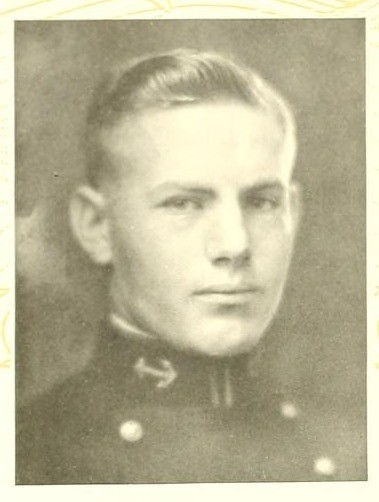
The Lucky Bag is a roast, and it should be read as one. The page is a photograph of a serious, narrow face in a midshipman's high collar, and then the joke the classmates wanted. On his first seamanship drill Steve's oar went overboard, and someone told him, "Mister, you won't graduate." The book says the wild-eyed mule-skinner from Chowchilla fooled them all. It gives him a plebe answer about an unmade bed: the bed was not his, only the bedclothes. It says the outcome was not fit for print, and that he learned the ways of a plebe anyway. He "took charge" of Hundredth Night. It remembers a fight with a man named Baker over the merits of a town in Iowa, enjoyed by the ground deck, after which Steve saw daylight with one eye in an hour and with the other two weeks later. The town is not named. Which Baker is not said. A black eye in a yearbook is not a conduct report, and none was found.
The sentence about his private life is the one the class dresses up as policy. After eluding matrimony with one of the daughters of Norway, "with the alibi that he had a wife and seven kids, he has decided upon the policy of no entangling alliances." The wife and the seven children are the alibi. They are not a family. A second-class summons to the Main Office is played as a woman wanting something. That is the yearbook's idea of him: a boy from Chowchilla who would talk back, who would fight about a town, and who got out of a joke engagement by inventing a household. The italic line under the sketch reads as class soccer in the fourth-class, third-class, second-class, and first-class years, and numerals in the second-class year. The class index lists him with the Buzzards. No conduct grade, no demerits, and no turn-back appear in the registers. He finished with the class he entered with.
On 5 June 1924 he was commissioned ensign. The 1 January 1925 Register has him, signal 4621, in Oklahoma, with 1 July 1924 in the column for the start of present shore duty, leave, or cruise, and the previous cruise column dittoed to August 1923, the class cruise still printed above him. Oklahoma was a battleship. The register does not give his billet. He was an ensign on someone else's ship. The 1 January 1927 Register still lists him an ensign, signal 4175, and the ship on his line is Macleish, the spelling that book uses. The cruise column on that line is again 1 July 1924. The column is not a clean "reported aboard" date. He can have moved from Oklahoma to MacLeish inside a cruise the register still dated from the summer he was commissioned. MacLeish (DD-220) was a flush-deck destroyer. By the Navy Directory of 1 January 1928 he is a lieutenant (junior grade), still in MacLeish. The day he made lieutenant (junior grade) is not printed on a line read here. Uboat.net gives 5 June 1927, the ordinary three years from his ensign date. That day is the compiler's, not a figure set in type beside his name in the registers in hand.
Schools, a yard, and other men's ships
On 1 January 1930 the Directory has moved him ashore: lieutenant (junior grade), under instruction, Naval Academy, Annapolis. It does not say what he taught. On 1 January 1931 the same rank is under instruction at Columbia University, New York. The Directory does not name the course.
The Register of 1 January 1934 is the book that says what the schooling came to. He is a lieutenant, signal 3252. The special-course figures on his line are 22 and 33. In the key those numbers kept in these registers, 22 is a completed postgraduate course in mechanical engineering, and 33 is a completed short course in optics. The register does not say that Columbia was the school, or that the Academy year was part of the same course. It says that by New Year's Day 1934 the courses were done. His date of rank as lieutenant is a ditto. On that page the last date printed above him, on Virginius Randolph Roane's line, is 30 June 1933, and every officer between Roane and Bedford is dittoed. Six months of sea service in the rank, which the same book credits him, fits a lieutenant's rank from the end of June 1933 to the first of January 1934. Total sea service on that line is 7 years 8 months. The birth line that carries 16 January 1904 and New Mexico is the same row, and the 1941 register repeats the birth and the entry, which is how the row was checked.
The station on the 1 January 1934 line is Dobbin, the destroyer tender. The Directory does not leave him there. On 1 July 1934 he is a lieutenant at the Navy Yard, Puget Sound, Washington, and on 1 January 1935 he is still at that yard. The Directory of 1 January 1936 is a bad optical text at his name. The two lines under Bedford, Stephen, read "PUGET 3D WASH," which is the same "Puget Sd" abbreviation the 1934 and 1935 directories print when they mean the yard, with the "S" mangled. It is used here as a probable third year at Puget Sound, not as a clean line.
Perkins was building in that yard while he was there. She was laid down at Puget Sound on 15 November 1934, launched on 31 December 1935, and commissioned on 18 September 1936. The Directory never says he was assigned to her, or to any new-construction hull. A lieutenant at a navy yard in the middle of a building program can be in a shop, a planning section, or a receiving ship, and the paper does not choose. The later command of Perkins is not evidence that he stood over her keel. The courses are the evidence of what the Navy had trained him to be: a mechanical engineer who had also finished a short course in optics, sent to a yard and then back to sea in the engineering department.
On 1 January 1932, between Columbia and Dobbin, the Directory has him engineer officer of Barry, still a lieutenant (junior grade). On 1 January 1933 he is engineer officer of Herbert. Both were old destroyers. The billets are the alphabetical lines. They are the first time the Navy's own directory gives him a job and not only a ship.
Cushing, then the engineer of a battleship
Cushing (DD-376) was a new Mahan-class destroyer, a sister of the Perkins still on the ways when he was at Puget Sound. On 1 January 1937 the Directory has Lieutenant S. R. Bedford as engineer officer. The ship's roster in the same book lists Commander E. T. Short in command and Lieutenant A. E. Uehlinger as executive officer. On 1 January 1938 Bedford is the executive officer, and Short is still in command. On 1 January 1939 he is still the executive officer. The commanding officer on that roster is Lieutenant Commander E. P. Forrestel, and Commander T. L. Gatch is listed as commander of Destroyer Division 4. The alphabetical line agrees: lieutenant, Cushing, executive officer. No deck log says when he moved from the engine rooms to the exec's cabin. The directories only say that the move had happened by the first day of 1938, and that he was still there a year later.
On 13 February 1939 he became a lieutenant commander. The Register of 1 July 1941 prints his date of rank as a ditto. On that page the last date set in type above him is Allen Phillip Calvert's, 13 February 1939, and every officer from the next line through Bedford is dittoed, Bedford included. The next man, John Daniel Hayes, breaks the chain with 1 March 1939. The ditto is the Navy's way of not repeating a class date. It is the best day that register gives, and it is the day uboat.net also prints.
He left Cushing sometime after 1 January 1939. The next station the Directory actually prints is West Virginia. On 1 November 1940 he is a lieutenant commander in that ship. On 1 April 1941 the alphabetical line is the same, and the ship's roster is specific: Lieutenant Commander S. R. Bedford, engineer officer, under Captain H. T. Markland, commanding, and Commander B. R. Alexander, executive officer. The ship is flagship of Battleship Division 4, Battleships, Battle Force, Pacific Fleet, with Rear Admiral W. S. Anderson. The 1 July 1941 Register does not print the ship. It prints the cruise. Present duty, in the column for shore duty, leave, or commencement of cruise, began on 1 June 1940, and the previous sea tour expired in June 1939. That June 1940 date is the nearest thing in the registers to the day he joined West Virginia. Between the end of the Cushing cruise, if June 1939 is that cruise, and June 1940, the paper is blank.
The same 1941 register credits him with 2 years 3 months of sea service in his rank and 11 years 11 months of sea service in all. From a commission in June 1924 to the summer of 1941 is seventeen years. Nearly twelve of them were at sea. The rest were the Academy, Columbia, the yard, and whatever the blank year was. The special-course figures have grown. Beside 22 and 33 he now carries 18 and 18-a: the Naval War College correspondence course in strategy and tactics, and the correspondence course in international law. An engineer who had also done the War College by mail. No medal letter is printed on his line. No command-at-sea mark either. In the spring of 1941 he was the engineer of a battleship, not her captain.
He was off her before she was sunk. The Directory of 1 April 1941 is the last official station found. The attack on Pearl Harbor was eight months later. West Virginia was sunk there. Her commanding officer, Captain Mervyn S. Bennion, is in the same 1942 death list, dated 7 December 1941. Bedford's name is not in the Pearl Harbor reports read against this career, because no report was found that places him on board, and the compiled Perkins dates put him in another ship from 12 October. The battleship's morning is not his. Attaching him to it would be a story about a ship he had already left.
Two months, and then a blank
The compiled list, NavSource, and uboat.net give him Perkins (DD-377) from 12 October 1941 to 12 December 1941, as lieutenant commander. The lists say he relieved Timothy Francis Wellings and was relieved by Walter Chilcott Ford. NavSource spells the relief Chilcot. The spelling is the compilers' problem. The dates are the problem that matters, because they are not in a log read here.
If the dates are right, the war he commanded was an overhaul. The ship history carried by Destroyer History, in the wording of the Dictionary of American Naval Fighting Ships, says Perkins was at Mare Island on 7 December 1941, reported for convoy escort on the 15th, and was en route to Pearl Harbor on the 17th. She came back to Mare Island on 15 January 1942 for radar. None of that narrative names a commanding officer. Set beside the compiled dates, it means Bedford was her captain on the morning of Pearl Harbor, in a yard, and was gone five days later, before she sailed. The Coral Sea, Tassafaronga, the New Guinea landings, and the collision with Duntroon that sank her off Ipoteto Island on 29 November 1943 belong to other captains. Four battle stars on the ship's record are not his. He was dead before she earned them.
Why the command lasted two months is not in the paper. A man can be ordered in to take a ship through a yard and ordered out when she is ready for sea. A man can be sick. A man can be found wanting. The registers do not say which. There is no letter of reprimand in anything read here, and there is no citation. The 1 July 1942 Register does not list him among the living at all.
It lists him among "Deaths on active list." The heading does not separate combat deaths from the others. On the line, Stephen R. Bedford, lieutenant commander, 5 May 1942. He was thirty-eight. The register does not give a place, a cause, a hospital, or a ship. Uboat.net says Bethesda, Maryland. A private compilation of Navy burials at Arlington calls him Stephen Ray Bedford, Jr., and says he died in a Washington hospital in 1942. Junior is not his name in any register or in the Lucky Bag. Bethesda and a Washington hospital are not the same sentence, and neither site was treated as an official death certificate. The National Naval Medical Center at Bethesda was new in 1942. That is context, not proof that he died there. No obituary was found. No widow is named. No child is named. The yearbook's wife and seven children remain a plebe's lie, told to get out of a joke.
What he left, the records do not say. There is no will, no pension file, no letter, and no grave that was opened and confirmed in the work for this essay. The Arlington list claims him for that cemetery and was not checked against the cemetery's own roll. If there was a household in Chowchilla, or in a navy yard town, or in an apartment near the Naval Academy, it is not in these pages.
The shape that is in the pages is plainer than a hero's life and thinner than a tragedy with a last scene. He came out of New Mexico, was appointed from California at sixteen, and graduated in the middle of the class of 1924 after a yearbook had already decided he was the boy who lost an oar and graduated anyway. The Navy made him an engineer: Columbia or somewhere like it, a short course in optics, Puget Sound while destroyers were building, engineer of Barry and Herbert, engineer and then executive officer of Cushing, engineer of West Virginia in the last year of peace. The War College courses by correspondence are the only sign, on paper, that he was also studying how a fleet is fought and what the law of it was. Then, on the lists the compiled list trusts, he had a destroyer of his own from 12 October to 12 December 1941, almost all of them before the war, the last of them in a ship that had not yet left the yard. On 5 May 1942 the active list closed his name. The Navy printed the day and the rank. It did not print why.