Ships
- HSK Kormoran Captain from 9 October 1940 · In command when she was scuttled, 20 November 1941
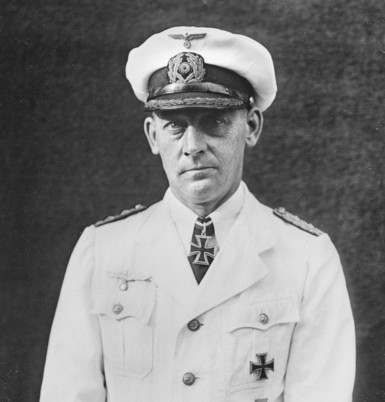
Theodor Anton Gunther Detmers (22 August 1902 – 4 November 1976) was a German naval officer who commanded the auxiliary cruiser Kormoran, a converted Hamburg-America Line freighter sent out as a disguised commerce raider, from her commissioning in October 1940 until he scuttled her off the coast of Western Australia shortly after midnight on 20 November 1941. On the afternoon and evening of 19 November Kormoran, under Dutch colours and posing as the merchant ship Straat Malakka, was overhauled and questioned by the Australian light cruiser HMAS Sydney; when the cruiser had come to within about a mile on a parallel course, Detmers threw off the disguise, hoisted the German ensign and opened fire. Both ships were destroyed. Sydney was lost with all 645 of her company, what the Australian War Memorial calls "the most grievous loss suffered by the Royal Australian Navy", and because no Australian survived, every account of the action came from Detmers and his men. He spent more than five years as a prisoner of war in Australia, most of them as senior German officer at the officers' camp at Dhurringile in Victoria, from which he escaped through a tunnel in January 1945 and was recaptured a week later. A stroke in captivity ended his naval career. Before going into the war he had been a destroyer captain in the Norwegian campaign; after it he lived quietly in Hamburg, published an account of his cruise in 1959, and died there at the age of seventy-four. His name has been bound ever since to the long Australian argument about how Sydney was lost, an argument that the discovery of both wrecks in 2008 and a Commission of Inquiry in 2009 went a long way towards settling.
Detmers was born on 22 August 1902 at Witten, an industrial town on the Ruhr in the Prussian province of Westphalia. His full name, Theodor Anton Gunther, is recorded on the service and casualty form opened for him by the Australian military authorities in December 1941; the same form names his father, Anton Detmers, as his next of kin, living at that time at Brahmsallee 34 in Hamburg, and records his religion as Protestant ("Evangelist"), his hair as light brown and his eyes as blue. Newspaper descriptions circulated after his escape in 1945 gave his height as six feet.
Beyond these bare facts, almost nothing about his childhood and family has been found in the sources examined. His father's occupation, his mother's name, whether he had brothers or sisters, his schooling, and what drew a boy from the coal and steel towns of the Ruhr to the sea are not recorded in the published Australian or German references. He was twelve when the First World War began and sixteen when it ended in defeat, revolution and the scuttling of the German fleet at Scapa Flow; nothing he is known to have written connects his choice of career to those years. The gap is real, and it is better left open than filled.
He joined the navy of the Weimar Republic, the Reichsmarine, on 1 April 1921, at eighteen, as an officer candidate. It was a small service, held by the Treaty of Versailles to a handful of old battleships and cruisers and some 15,000 men. According to the career summary published by the Australian War Memorial, he served first in the old battleships Hannover and Elsass, trained in the sail training ship Niobe, and then went to the cruiser Berlin. A German compilation of his promotions, drawn from the standard reference works on holders of the Knight's Cross, records his rating as Matrosengefreiter and officer candidate on 1 April 1922, Fähnrich zur See on 1 April 1923, Oberfähnrich in 1925 and Leutnant zur See on 1 October 1925. In that month he joined the new light cruiser Emden, named for the raider of 1914 that the first HMAS Sydney had driven ashore at the Cocos Islands, a coincidence the Memorial's biographers did not fail to note.
After a year in Emden he spent two years ashore, and was promoted Oberleutnant zur See on 1 July 1927. In October 1928 he was posted to the torpedo boat Albatros. From October 1930 to October 1932 he served on the naval staff, and he then joined the light cruiser Köln, in which he made an overseas training cruise that brought him to Australia for the first time in 1933, a visit noted by both G. Hermon Gill, the Australian official naval historian, and the Memorial. He was promoted Kapitänleutnant on 1 December 1933.
From 1934 his career ran almost entirely through the torpedo boats and destroyers. The 2009 Commission of Inquiry into the loss of Sydney found that he took command of the torpedo boat G 11 on 28 September 1934, and that he "appears to have gained considerable experience in torpedo attacks through exercises"; in 1936 he was first lieutenant of the new destroyer Leberecht Maass. He was promoted Korvettenkapitän (commander) on 1 October 1937 and spent the following year in the personnel division of the naval staff. On 26 October 1938 he took command of the destroyer Hermann Schoemann (Z 7). Apart from a spell of about two months in 1939, when he worked with the Naval War Staff, he kept her until July 1940.
The war found him in that ship. He received the Iron Cross Second Class on 29 November 1939. In June 1940, at the end of the Norwegian campaign, Hermann Schoemann was one of the destroyers with the German battle group sent north in Operation Juno, which ran into the Allied evacuation from Norway. The Commission's account, drawing on published German and British sources, records that the force intercepted and sank the tanker Oil Pioneer, the trawler Juniper and the empty troopship Orama, and that it stopped the hospital ship Atlantis and let her go on to England, as the Geneva Convention required. An enthusiast history of the ship credits Hermann Schoemann herself with finishing off Oil Pioneer with a torpedo; that detail has not been confirmed from a primary source here. He was awarded the Iron Cross First Class on 16 June 1940 for his part in the operation, and in October the destroyer war badge.
These were the years that made him: nineteen years in a small, exacting service, a torpedo specialist's training, a staff officer's knowledge of how the navy worked, and command of fast ships in which a captain's judgment of range, angle and timing decided everything. Nothing in the record before 1940 marks him out as exceptional, but the navy's choice of him for a raider suggests that it thought him so. When he was appointed to command the new auxiliary cruiser in July 1940 he was still a commander; the Commission noted that the appointment was "somewhat unusual", since most raider captains were a rank or two senior.
The ship he was given had been built at Kiel by Krupp's Germaniawerft for the Hamburg-America Line and launched in September 1938 as the Steiermark, a fast diesel-electric cargo liner of about 9,400 tons intended for the East Asia trade. Requisitioned in 1940 and designated Ship 41, she was, in Gill's words, "the most modern of the German raiders". She was armed with six 15-centimetre guns concealed behind hinged plates and in the holds, smaller guns, torpedo tubes, two aircraft, and some 300 mines, and she carried 5,200 tons of diesel fuel, enough for a year at sea. During her conversion a passage was cut the length of the ship so that men could reach their action stations unseen, and the holds were partitioned so that each man had his own bunk, table and cupboard; according to evidence given to the Commission, Detmers thought this important for the morale of his crew. Accommodation was built for prisoners. She was commissioned at Hamburg on 9 October 1940, survived an air raid at Kiel a week later, and spent a month working up in the Baltic from Gotenhafen. On 20 November Grand Admiral Raeder inspected her and addressed the crew, and, according to one of her officers, it was then that she was given her name, Kormoran.
She carried a wardroom of twenty-six officers, fourteen of them regulars and twelve reservists, and about 375 men, many of them conscripts. Nearly a hundred had come from the Hamburg-America Line, among them every man in the engine room, and her navigating officer had been due to command Steiermark as a merchant ship before the war intervened. Two propaganda men, a war reporter and a cameraman, joined after Raeder's visit. In his book, Detmers later said that he regretted having been talked into taking them, because with them on board "you weren't as free as you would like to be".
Her orders, which the Commission set out in full, made clear what sort of war he was to fight. The purpose of the cruise was to force the enemy to convoy and protect shipping in distant waters, to frighten neutrals off the British trade, and to tie down warships; "a long term restriction and harassing of the enemy is more important to the success of the operation than a high record of sinkings accompanied by a rapid deterioration of the auxiliary cruiser." Action with enemy warships, even armed merchant cruisers, was to be avoided. "If, however, an encounter is unavoidable, every attempt to destroy the enemy by means of camouflage, by unexpected and ruthless use of all weapons should be made." Consideration for the crews of merchant ships was to be "subordinated to the demands of the Navy". Detmers summed up his own understanding of the task in his book: to "appear as often as possible where we were least expected", to sow confusion in the shipping lanes, and never to look for trouble with warships, "because we were only passengers or merchant ships fitted out as warships, and not real warships."
Kormoran sailed from Gotenhafen on 3 December 1940, slipped through the Denmark Strait into the Atlantic ten days later, and entered her operating area before Christmas. The habits of her captain emerge from the evidence of his officers and men and from the records of the cruise. He insisted on lookouts, with an officer always aloft. He drilled his gunners twice a week against the clock and in special exercises for meeting a destroyer or light cruiser, and he questioned the crews afterwards about their targets, particularly the crew of the starboard 3.7-centimetre gun, whose task in action was the enemy's bridge. The crew practised throwing off the disguise, and the men detailed to hoist the German ensign at the moment of unmasking were trained, as one survivor put it, to "hoist a flag within seconds". He kept his own counsel. By his own account in his book no one on board but himself knew the date of departure until the night before, when only his first lieutenant and chief engineer were told.
Over the next ten months Kormoran sank ten merchant ships and captured an eleventh. The Commission listed them: the Greek Antonis on 6 January 1941; the British tanker British Union on 18 January; the British Afric Star and Eurylochus on 29 January; the British tanker Agnita on 22 March and the tanker Canadolite, taken intact on 25 March and sent to France as a prize; the British Craftsman on 9 April and the Greek Nicolaos D. L. on 12 April; the Yugoslav Velebit and the Australian Mareeba, both on 26 June in the Bay of Bengal; and the Greek Stamatios G. Embiricos on 23 September, between the Maldives and the Seychelles. German reference works put the total sunk at about 57,000 gross tons, with the prize of a little over 11,000 tons in addition. Between attacks she met the supply ship Nordmark, to which she handed 170 prisoners in February, the raiders Pinguin and Atlantis and the pocket battleship Admiral Scheer, before rounding the Cape into the Indian Ocean at the beginning of May. He was promoted Fregattenkapitän on 1 April 1941.
The method was patience followed by sudden violence. Detmers would shadow or converge on a ship slowly, in whatever disguise suited the waters (in the Bay of Bengal Kormoran was painted as the Japanese Sakito Maru), until he was within gun range without having raised suspicion, and then order her to stop and not to use her wireless. The Commission, which worked through the war diary entry for every encounter, found that if the order was obeyed he did not fire, and that if it was disobeyed he did, and kept firing until the transmissions stopped or the ship was stopped. It found that in every case survivors were picked up, wounded prisoners received medical treatment on board, and that he never knowingly abandoned survivors nor fired on men in boats or in the water. Agnita's master, taken prisoner with his crew, later recalled that they were fed what the raider's crew was fed, "mainly bean soup and sauerkraut, black bread and ersatz coffee."
The same records show what the method cost. When the tanker British Union was attacked at night in January, seventeen of her crew, including her first and second officers, were lost and twenty-eight were saved. The war diary noted that her men had behaved in the water with "good esprit de corps", that their boats were holed by gunfire and floating only on their buoyancy tanks, that a man of the raider's crew had gone into the sea after an exhausted wireless operator, and, with a touch of dry humour, that the survivors had brought their monkey with them: "As long as he does not introduce any diseases, they may keep him." Eleven days later Eurylochus kept transmitting after she was hit, and Kormoran went on firing, with her main guns and with machine guns at her bridge, until the wireless stopped. The ship's master, Captain Caird, wrote afterwards that the machine-gunning continued while his men were getting away, that two of his boats were blown to pieces, and that "it was a murderous attack and I now marvel how any one of us really did get away"; he believed there had been two raiders. The Commission found that the firing had been directed at the ship and her wireless while she was transmitting, which was permitted under the laws of war, and that there was no evidence that boats or men in the water had been attacked. Five men were killed by shellfire in Craftsman. Of Velebit's crew of thirty-four, Detmers found only nine in a boat; others who had stayed aboard the burning ship drifted with her to the Andaman Islands and were later rescued. Captain Skinner of Mareeba, whom Gill describes as "patriotic, courageous, learned in the ways of the sea", broadcast a raider warning the moment he was challenged, and Kormoran destroyed his wireless room with her first salvos; all forty-eight of his crew were taken aboard, one of whom died of a heart attack. Skinner and twenty-five of his men did not come home. They were among the prisoners later passed by way of the supply ship Kulmerland to the blockade runner Spreewald, which was sunk by a German submarine in the Atlantic at the beginning of February 1942.
The war diary also catches a less guarded voice. When the crew of the Greek Stamatios G. Embiricos took to the boats in September and one boat went missing in the dark, Kormoran searched until she found it. "I will not give the 1st officer the satisfaction of getting away from me," the diary records. Every man of that crew, from more than a dozen countries, was picked up unhurt.
After rounding the Cape the cruise turned lean. Kormoran had no success for nearly two months, then, after the double sinking of 26 June, spent a fortnight overhauling her engines in an empty stretch of ocean south of Ceylon and changed her disguise once more, in a phrase Gill quotes, to "the best disguise of all—insignificance". For weeks she cruised between the Australia Station and the north-western Indian Ocean. On 13 August, some 200 miles west of Carnarvon, she sighted her first ship in seven weeks, but Detmers, suspicious of the way she was behaving and believing she might be a decoy, did not attack. He considered laying mines off Geraldton and Carnarvon and decided it was not worthwhile. On 26 August his men saw land for the first time in 258 days, a mountain peak on Enggano off Sumatra. The diesel-electric engines were a constant worry. Between 16 and 24 October Kormoran met Kulmerland about 1,100 miles west of Fremantle, took on fuel and stores for operations until mid-1942, transferred her remaining prisoners except four Chinese seamen from Eurylochus who had been kept on as laundrymen, and sent home the last of the war diaries, its final entry dated 24 October. After an engine refit he intended to lay a minefield off Fremantle at the new moon, but a German signal reporting a convoy leaving under the escort of the cruiser HMS Cornwall turned him away. He decided to look instead at the coast off Shark Bay, and in the middle of November Kormoran was steering north-east towards it.
At about four o'clock in the afternoon of 19 November 1941, some 150 miles south-west of Carnarvon, the lookout reported a sail fine on the port bow. It was soon seen to be a warship, a cruiser of the Perth class, and Detmers turned away into the sun and called for full speed. One of the diesels chose that moment to fail, and for half an hour the ship could make only about fourteen knots. The cruiser, which was HMAS Sydney under Captain Joseph Burnett, returning to Fremantle from escort duty, turned and overhauled her from astern, repeatedly flashing the letters NNJ, a signal the Germans did not understand and did not answer. When Sydney ordered her to hoist her signal letters, Kormoran hoisted the call sign of the Dutch Straat Malakka on a stay where the funnel partly hid it, and Sydney had to ask for it to be shown clearly. At about five o'clock Kormoran broadcast a "suspicious ship" message in the name of Straat Malakka, giving her position; fragments of it were picked up ashore and by a tug, though no one recognised it for what it was. Sydney came up on the starboard side, closed to about a mile or less, and drew almost abeam on a parallel course. She asked "Where bound?" and was told "Batavia". She then made a two-flag hoist that the Germans could not read; it was, Gill wrote, part of the genuine Straat Malakka's secret call sign, and the fact that the prisoners later quoted it correctly was itself corroboration of their story. Then Sydney signalled, in plain language, "Show your secret sign."
Detmers had no secret sign to show. The notes of his interrogation on 1 December 1941 record his answer in the third person: "Did'nt know so had to fight, although his orders were to take prizes and his ship was not equipped to fight warships." At 5.30 by his clock he gave the order to unmask. The Dutch flag came down, the German ensign went up, and Kormoran opened fire at about 1,000 to 1,500 metres with her 15-centimetre guns, her anti-aircraft guns and her 3.7-centimetre gun trained on Sydney's bridge, and fired two torpedoes. The first salvos hit Sydney's bridge and director tower and set fire to the aircraft on her catapult. One torpedo hit her forward, near her foremost turret. Her forward turrets fell silent, but her after turrets hit back, putting shells into Kormoran's funnel and engine room, where fires broke out that could not be fought because the fire mains had been wrecked. Sydney turned towards the raider, passed close under her stern, and fired four torpedoes, which Kormoran turned to avoid. Detmers's own coded record, written later in captivity, has the moment the engines died: revolutions falling rapidly, no communication with the engine room, four torpedo tracks passing close under the stern, the report that engines and all fire-fighting equipment were completely out of action. Kormoran went on firing at the burning cruiser as the range opened, and loosed one more torpedo, which missed. At 6.25 she fired her last shot, at about 10,000 metres. Sydney was last seen heading slowly south-south-east, burning from the bridge to the after funnel; for some hours afterwards a glow could be seen on the horizon, and before midnight it was gone.
What happened on Kormoran's bridge in the minutes before the decision has come down only at second hand. The Australian officer who first questioned Detmers at Carnarvon recorded a story going round among the prisoners that as the cruiser closed he turned to his first officer and asked "Shall we scuttle or fight," and was told, "We can only die once, Captain." It was reported, not witnessed, and Detmers himself is not recorded as telling it.
His own ship could not be saved. She was dead in the water and burning in the engine room, with, by Gill's count, some 200 mines still on board. As darkness came on he ordered the boats and rafts out and sent away all but about a hundred men, keeping almost all his officers on board to man the guns in case Sydney returned, while two large boats were dug out of a hold without power, which took about three hours. Scuttling charges were laid. His coded account records the last entries: at midnight, the ship placed out of commission, the flag lowered, the charge fired, the last boat away "with Captain", casting off at ten minutes past midnight; the explosion of the mines; the ship sinking rapidly by the stern. Of Kormoran's complement of 393, Gill gives the losses as seventy-eight, about twenty killed in the action and the rest drowned when an overloaded raft capsized, together with two of the four Chinese laundrymen. Of Sydney's forty-two officers and 603 ratings, no one survived.
The survivors drifted for days in a rising sea. Some were picked up by the troopship Aquitania and the tanker Trocas, some came ashore on the coast north of Carnarvon, and late on 26 November the merchant ship Centaur found two boats carrying sixty-two men, among them Detmers, and, fearing that the Germans might try to seize her, took them in tow rather than aboard and brought them into Carnarvon the next afternoon. In all 315 Germans were saved.
The interrogations that followed are the foundation of everything known about Sydney's end. The prisoners were questioned in separate groups at Carnarvon, at Fremantle and at the camps near Perth by different officers: among them Rear-Admiral John Crace, Captain Harold Farncomb, Commander Emile Dechaineux, Commander Ramage, Lieutenant-Commander Rycroft and an army intelligence officer, Captain Hehir. Detmers was questioned four times: by Rycroft on 27 November, by Crace on 1 and 2 December, and by Major McQuie, with Hehir present, on 7 January 1942. At first he would not talk about the merchant ships he had sunk and denied that Kormoran carried aircraft. His accounts of the battle were short, and they varied in detail, but they agreed in substance with what the separated groups of his men were saying. In the January interview, as recorded, he said that when Sydney turned broadside on "I realised she was a first class cruiser, and I quite expected to be sunk as I could not escape her." He described looking back for her before he left his own ship: "I looked for SYDNEY but she had gone. All was blackness. I could do nothing to save them. There was a very rough sea. It had been so for two days, and the saving of my own ship's company was causing me anxiety." He did not think there could have been any survivors. Hehir wrote in his diary that day that Detmers "told him the full story of the sinking and the action and I, for my part, believe he told the truth." The summary report forwarded to the Admiralty in February 1942 by F. B. Eldridge of the Naval College said that the story "was frankly told by the Captain, Fregatten Kapitan Detmers and other prisoners, and the story as told seems to ring true, though there is no explanation on the surface as to why the 'Sydney' came so close." Not every interrogator was satisfied: Rycroft thought the ratings he questioned had been told by their officers to give false answers, and in March 1942 the Chief of Naval Staff told the Advisory War Council that Burnett had taken a risk in closing the raider and had not followed his orders. Evidence later given by Kormoran's officers was that Detmers gave no instructions before abandoning ship about what the men should say if captured.
The officers were sent by sea to Melbourne in December 1941 and then, with the men, to the prisoner-of-war camp at Murchison in northern Victoria, where his record shows him taken on strength on 20 December. The officers were moved soon afterwards to Dhurringile, a large homestead about ten miles away that had been turned into a camp for German officers; some sixty officers of the army and the Luftwaffe, most of them from the Afrika Korps, were already there. On 4 December 1941, while he was already a prisoner, he was awarded the Knight's Cross of the Iron Cross; and on 1 April 1943 he was promoted Kapitän zur See, a promotion duly entered in red ink on his Australian record. As the senior officer at Dhurringile, he became camp leader, responsible with the Australian authorities for the running of the compounds. The naval writer Ken Wright, who studied the camps, wrote that he did the job efficiently and was respected by guards and prisoners alike. In Wright's judgment Australia took its obligations under the Geneva Convention seriously, and the German prisoners in Victoria were, by the standards of the war, decently treated. The burden of captivity was boredom, distance and helplessness: no news from home for long stretches, and men of different services and politics crowded together.
Detmers did not stop fighting the war in the one way open to him. Within weeks of being reunited with his officers he set out to preserve a true record of the action for his own navy, one that his captors would never see. One of his officers, Lieutenant Messerschmidt, told the Commission in 2008 that Detmers "marshalled the officers together for the purpose of remembering what had happened and to prepare a report", and dictated the log of the battle to him. The result was written down in at least three hidden forms. One was dotted, letter by letter, in pencil beneath the words of a two-volume Cassell German–English dictionary published in 1939, so faintly that the marks are barely visible until they are pointed out; it was probably done early in 1942 with his first lieutenant, Lieutenant-Commander Foerster, and it travelled home with him undetected. A second was committed to memory by the assistant surgeon, Dr Siebelt Habben, who was due to be repatriated in a medical exchange; Habben's son later told the Commission that Detmers tested him on it every day in the camp. Habben reached Germany in 1943, and his account was printed in December of that year in the German Navy's confidential series on operations and tactics, in the booklet on Ship 41, for the instruction of other officers. A third, enciphered in a Vigenère system in a small notebook, Detmers carried with him when he escaped. A fourth, typed, was confiscated from the survivors in 1947 when they landed in Germany.
The escape was the most successful from the camp. Over some six months twenty prisoners dug a tunnel from a small crockery room in the old mansion, the one ground-floor room without an inspection trapdoor, down fourteen feet into the sandy soil, under the compound and the wire and some forty metres beyond it, about 120 yards in all, ventilated through water pipe and jam tins by a hand bellows and a beer pump from the canteen. On the night of Wednesday 10 January 1945, in a storm, seventeen officers and three batmen went out through it in two groups over several hours. According to the Memorial's account, Detmers had asked his guard that evening what the weather was going to do. The escape was not discovered until the seven o'clock roll call the next morning. Detmers went north with a companion, Oberstleutnant Helmut Bertram, walking by night and lying up by day, carrying a hand-drawn map in two pieces that centred on Sydney; he was forty-two, roughly twice the age of most of the other escapers. By 17 January only four men were still at large, Detmers and Bertram among them. The next day, near Tallygaroopna, north of Shepparton, with Bertram's ankle injured and their food gone, Bertram went into a store while Detmers waited nearby. The storekeeper recognised him from the photographs in the newspapers. Two local constables took both men without a struggle; at the police station, the Melbourne Argus reported, they ate a loaf of bread and a pound of cheese. The notebook with the enciphered battle report was taken from Detmers on his recapture and was deciphered later that year by the Fleet Radio Unit in Melbourne.
He was sentenced to twenty-eight days' detention for escaping. One account says he served it in the old Melbourne Gaol, then in use as a military detention centre; another says he served it in solitary confinement in the camp. His record shows that on 15 March 1945 he was admitted to the military hospital at Heidelberg, near Melbourne. He had suffered a stroke, which left him paralysed. Wright attributed it to the strain of running the camp, heavy smoking and the exertion of the escape; that is a reasonable reading, not a diagnosis. He was in hospital for more than three months, and when he returned to the camps at the end of June he was partly paralysed and could no longer act as camp leader; Bertram took his place. In July he was transferred to Tatura, where he spent the rest of his captivity, with a further stay in hospital in October 1945.
The war in Europe ended while he was still recovering, and for him and the other prisoners another eighteen months of waiting followed. On 21 January 1947 the Kormoran survivors, with some 2,500 German and Italian prisoners and internees, embarked at Port Melbourne in the liner Orontes; Detmers travelled in the ship's hospital. Lying across the pier, Gill noted, was the Dutch merchant ship Straat Malakka. The ship reached Cuxhaven at the end of February, where the typed battle report was taken from the survivors. He was released from British custody at Munster in May 1947.
He came home to a defeated, divided and largely ruined country, partly crippled and in his mid-forties. The stroke ruled out any return to sea or service, and when the Federal Republic raised a new navy in the 1950s he was not part of it. He lived in Hamburg for the rest of his life; German sources place his home in the suburb of Rahlstedt. He was single when he was captured; afterwards he married, and Wikipedia, citing no source, states that in the early 1950s he married Ursula Reinhardt, the daughter of a Protestant pastor, and that they had no children. That he left a widow is confirmed by the Commission's account of what became of the dictionary; her name and the date of the marriage have not been confirmed from a primary source. Wright wrote in 2005 that former members of his crew often visited him and his wife in Hamburg, and a German archive catalogue lists invitations to annual reunions of Kormoran's former crew among papers filed under his name.
In 1959 he published, with the naval writer Jochen Brennecke, Kormoran: Der Hilfskreuzer, der die "Sydney" versenkte, which appeared in the same year in London, translated by Edward Fitzgerald, as The Raider Kormoran. It is the only book-length account of the cruise by a man who took part in it, and its title in German put Sydney at the centre. He wrote it, he said, from his war diary. It is a vivid, readable book written for a popular audience, and it has to be read for what it is: a captain's defence of his ship, his crew and himself, composed eighteen years after the events, after defeat and captivity and in full knowledge of the doubts raised in Australia. When the Commission compared it with the war diary, which Detmers had written day by day for his superiors and had no reason to falsify, it found differences of substance in several encounters. In the book the firing on British Union is one continuous action that ended when the tanker stopped transmitting, where the diary records two separate bursts of fire, and the diary's note of an SOS signalled from the sinking boats does not appear in the book. In the book, too, the torpedo that finished Eurylochus was fired only after the survivors had been taken aboard, and a lifeboat appears in the searchlight just as the torpedo strikes; the war diary gives a different sequence and makes no mention of that lifeboat. In each case the book's version is the less harsh. The Commission relied on the diary.
The book also contains passages that bear directly on the arguments about Sydney. "As soon as my Chief Signalman reported 'War flag flying'," he wrote, "I gave the order to open fire," and the first shot came "within six seconds of the order to de-camouflage". He wrote that he had expected to face an Australian court martial "over the business". A reviewer for the Naval Historical Society of Australia, writing in 1999, found him "a very able and shrewd Captain", "a master of deception", but also "excessively secretive and somewhat devious", and pointed to slips: he recalled seeing Sydney or her sister ships in Australia during Köln's visit in 1933, years before any of them had arrived; he passed over the work of his wireless and cipher officer and the ship's intelligence-gathering almost in silence; and he professed ignorance of the British challenge-and-reply procedures. Wartime secrecy about signals intelligence may account for some of that reticence; the Commission's comparison with the war diary shows that the book cannot be taken as a straightforward record.
He died in Hamburg on 4 November 1976, at the age of seventy-four. The cause of death and the place of burial have not been established from the sources examined. His widow later gave the dictionary to a nephew, Dr Hans Jantzen, who passed it to the Australian researcher Barbara Poniewierski, who had written about the action under the name Barbara Winter; in 1991 she presented it to the Western Australian Maritime Museum. Captain Peter Hore, a retired Royal Navy officer, transcribed and translated the dots. Read alongside the notebook taken from him in 1945 and the report confiscated in 1947, rediscovered in 2003 in the Admiralty Library in London, it showed that the three secret versions agreed in substance with one another and with what Detmers had told his interrogators in 1941, and that some of the apparent contradictions on which later theories had been built were errors of decipherment and translation. It also contained the line, for 8 November 1941, recording his intention to be off Perth at the new moon.
The argument his name became attached to began quietly. During the war the account obtained from the prisoners was accepted by the Naval Board, and in 1957 Gill wrote in the official history that "no room was left for doubt as to its accuracy"; why Burnett had closed the raider without using his aircraft or his speed were, he wrote, "questions that can never be answered". From the 1980s, as books, inquiries and campaigns multiplied, many Australians found the German account impossible to accept. It required them to believe that a modern cruiser under an able captain had steamed to within point-blank range of an unidentified merchant ship and been crippled by her in the first minute. Theories were put forward that Kormoran had fired while still under Dutch colours, or under a Norwegian or white flag; that she had been helped by a Japanese submarine; that Sydney's survivors had been machine-gunned in the water; and that Detmers had lied about the position of the action so that the wrecks would never be found. The historian Tom Frame called Detmers "an advocate in his own cause" whose word "cannot be accepted as truthful at face value", and the least reliable witness among the Kormoran's crew. Others, notably Wesley Olson and Barbara Winter, concluded that the Germans, with contradictions and lapses, had substantially told the truth. A parliamentary committee reported in 1999, pleading for an end to the "dialogue of the deaf".
The wrecks settled the most concrete of the questions. Searching in the area derived from Detmers's accounts, a team led by the shipwreck investigator David Mearns for the Finding Sydney Foundation found Kormoran on 12 March 2008 and Sydney a few days later, about twelve nautical miles apart, close to the position Detmers had always given. The Commission of Inquiry that followed, under Terence Cole QC, heard seventy-seven witnesses, interviewed eleven German survivors, and examined the photographic evidence of the wrecks, and reported in July 2009. It found that with one exception, the German statement that Sydney had fired her torpedoes from her starboard tubes, the damage to the wrecks confirmed the German account of the battle; that there was no reason to doubt its general accuracy as to the approach and the signals; that Kormoran had flown the German ensign before she opened fire; and that none of the theories of fraud, conspiracy or illegal ruse had any substance. It dissented explicitly from Frame's approach to Detmers, which it described as resting on assumptions that he would lie and break the law. It also found, contrary to Gill, that Sydney had not been at action stations as she closed, and that Burnett, who had not expected any merchant ship in those waters, should have treated the stranger as suspicious. Not everyone accepted all of its conclusions, particularly about Sydney's state of readiness, and critics of Detmers's character have never been fully answered or fully silenced. One former shipmate was quoted in 1999 as saying he had been a Nazi; a prisoner held aboard Kormoran wrote of seeing him drunk while lecturing his crew. Neither claim has been tested against independent evidence, and nothing in the official records examined here bears on his politics either way.
What remains of Theodor Detmers is less a character than a set of acts, recorded with unusual completeness by his enemies and himself. He was a professional of a small, hard-trained navy who was given a merchant ship, a crew of conscripts and merchant seamen, and orders to stay hidden for a year, and who kept her at sea for some 350 days. He took eleven ships, killed men in them when they defied him, and picked up every survivor he could find. When a cruiser he could neither outrun nor outfight came alongside asking for a signal he did not have, he fired first and fought both ships to destruction in half an hour, then got most of his own crew away in a rising sea. In captivity he made his officers remember, hid the record in a dictionary, a doctor's memory and a cipher, and at forty-two crawled out under the wire and walked north towards a coast he had once visited as a young officer in a German cruiser. The stroke that followed took his career and much of his health. The account he gave in 1941, doubted for two generations, was found in the end to be true in its essentials. The 645 men of Sydney left no account at all.