Ships
- USS North Carolina (BB-55) Captain, 5 December 1942 – 27 May 1943
Wilder D. Baker was born in Topeka, Kansas, on 22 July 1890. He graduated from the United States Naval Academy in the class of 1914 and, during the First World War, worked on antisubmarine methods in the Atlantic. The Navy then kept him with submarines. As a lieutenant in 1923 he commanded S-11 and afterward S-13, and he later commanded the destroyer Kidder.
Promoted to captain in 1941, he took Destroyer Squadron 31 that October. The squadron included Reuben James, which a German submarine sank on Neutrality Patrol before the month ended. In February 1942 he was given the Atlantic Fleet Antisubmarine Warfare Unit. He urged the Navy to gather the training and direction of antisubmarine forces under one authority, and in a memorandum of 24 June 1942 he warned that the Atlantic campaign was slipping away from the Allies. He was also among the officers who brought civilian scientists into the daily work through the Antisubmarine Warfare Operational Research Group.
On 5 December 1942 Captain Baker relieved George H. Fort in command of the battleship North Carolina. He took the ship on patrol off Guadalcanal in the Solomon Islands and in March 1943 brought her back to Hawaii. Frank P. Thomas relieved him on 27 May 1943. Baker left North Carolina for flag duty as a rear admiral.
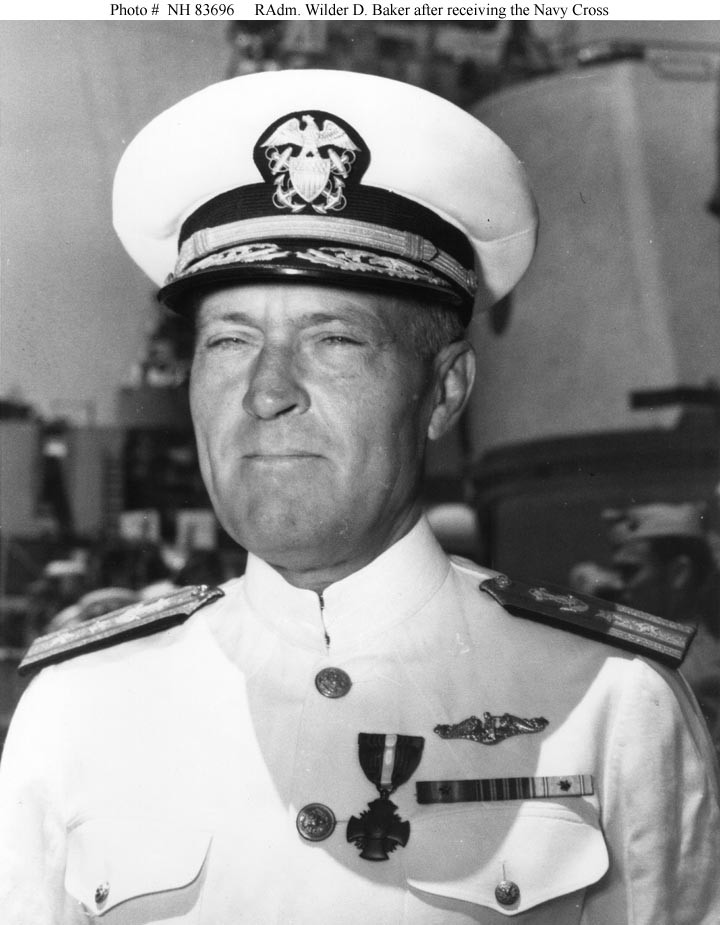
His first flag command was Cruiser Division One, with the added duty of commanding Task Force 94 in the Aleutians. From June 1943 into March 1944 he kept his ships at sea in severe weather, carried out the first surface bombardment of the Japanese home islands at Paramushiro in the Kurils, and led the first offensive surface operations into the Sea of Okhotsk. The Navy Cross followed that command. In April 1944 he moved to Cruiser Division 14 and took part in the amphibious attack on Saipan.
On 11 August 1944 Baker became chief of staff to Vice Admiral John S. McCain in the Second Fast Carrier Task Force, and he served in that post through 25 January 1945. The carriers he helped direct struck from the Palau Islands into the Philippines. For the fighting off Formosa on 13-15 October 1944 he received the Silver Star, and the Legion of Merit covered the whole tour as chief of staff. With Captain John S. Thach, McCain's operations officer, he worked out a defense that put radar picket destroyers ahead of the carriers and held fighter patrols over those pickets, a way to meet Japanese suicide attacks. His wartime awards also included the Bronze Star.
After the war he commanded the Service Force of the Atlantic Fleet. On 14 February 1949 he became commandant of the Eleventh Naval District, and with that post he also commanded Naval Base San Diego and the Southern California sector of the Western Sea Frontier. He retired on 1 August 1952 as a vice admiral. Baker died in San Diego on 10 November 1975. A devoted golfer, he is remembered in the city by Admiral Baker Field, named in his honor.