Ships
- USS Iowa (BB-61) Captain, 25 August 1951 – July 1952
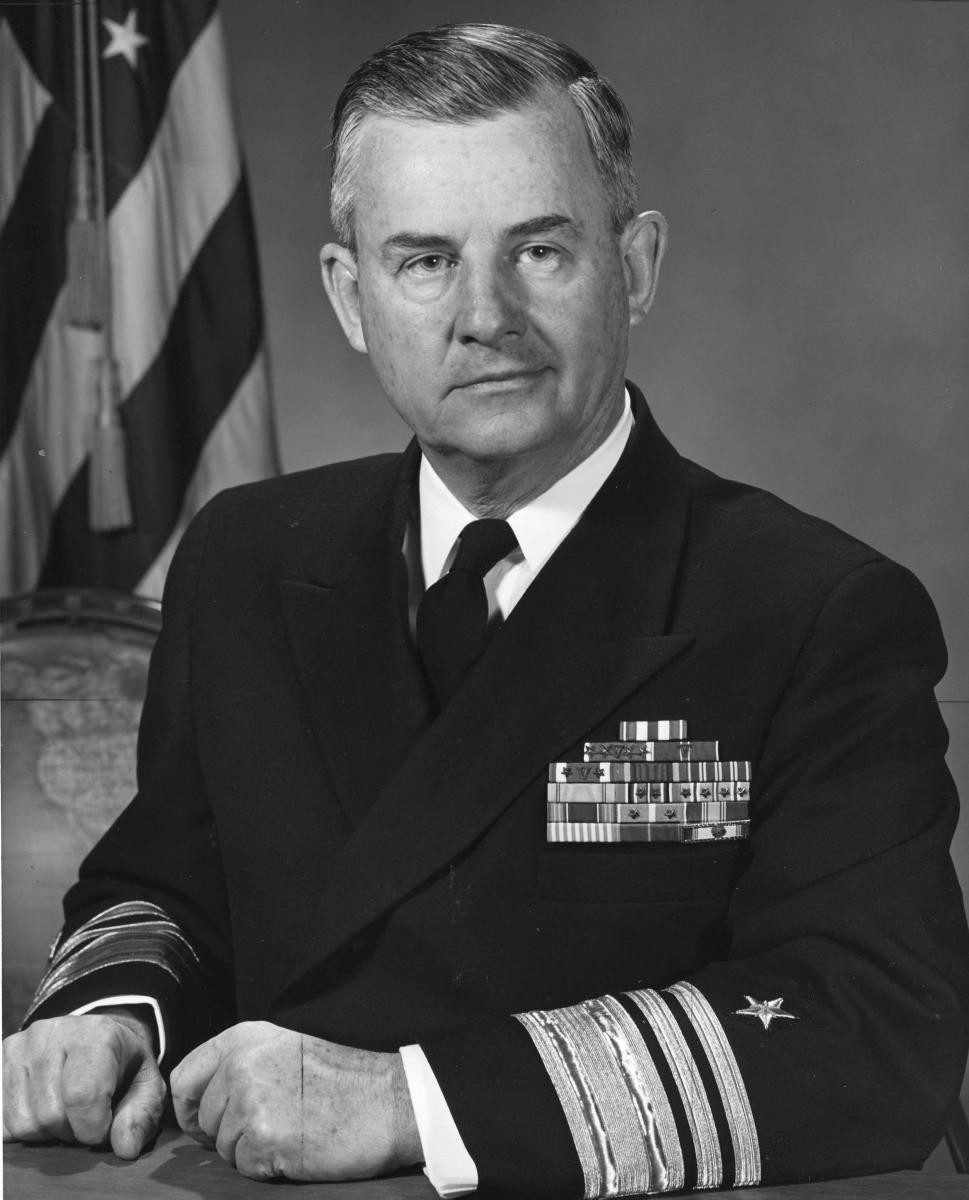
William R. Smedberg III was born on 28 September 1902 at Fort Grant, Arizona, the son of Army officer William Renwick Smedberg Jr., who later became a brigadier general. He entered the Naval Academy in 1922 and graduated with the class of 1926. His first duty afloat was a year in the battleship New Mexico. He then served three years in the destroyer Mullany and joined the heavy cruiser Northampton with her commissioning crew.
He completed the communications course at the Naval Postgraduate School in Annapolis and went to the staff of Commander Cruiser Division Three and Commander Cruisers, Battle Force, under Rear Admiral Harold R. Stark. When Stark became Chief of Naval Operations in 1939, he brought Smedberg to Washington as his aide. Smedberg remained in that post into 1942, beside the Navy's senior uniformed leader through the approach of war and the first year of fighting.
In the Pacific he commissioned and commanded the destroyer Lansdowne, and later the destroyer Hudson. Both ships operated in the Solomon Islands. He next served as chief of staff to Rear Admiral A. S. Merrill during the Solomons campaign, then reported to the staff of Admiral Ernest J. King, Commander in Chief of the U.S. Fleet, as a combat intelligence officer. He was the fleet's combat intelligence officer at the end of the war.
After Japan surrendered he was aide to Secretary of the Navy James Forrestal, commanded a destroyer division, and from 1948 to 1951 headed the Department of Electrical Engineering at the Naval Academy. The Korean War returned the battleship Iowa (BB-61) to service. Smedberg recommissioned her on 25 August 1951 and spent the following months working the ship up off the West Coast. Iowa had already fought through the Second World War under captains who included John L. McCrea.
In March 1952 he took Iowa to the western Pacific. From the end of that month until he left the ship in July, he commanded her in combat around Korea and also led task elements of Task Force 77. For part of that cruise Iowa flew the flag of the Seventh Fleet. Her heavy guns hit troop concentrations, supply areas, roads, gun positions, and industrial targets along the east coast, at the bombline and around Wonsan, Kojo, Songjin, and Chongjin, and she also fired at enemy-held facilities on the west coast. The ships he directed worked through waters that were often mined and tightly restricted. Shore batteries engaged them, and none of the ships in those task elements was hit. For his service from 31 March to 29 July 1952 he received the Legion of Merit with Combat V. He then became chief of staff to the commander of Destroyer Force, Atlantic Fleet.
While assigned to the Politico-Military Division on the Navy staff he was selected for rear admiral and rose to direct the division. From March 1956 to June 1958 he was Superintendent of the Naval Academy, where he pressed for a stronger faculty and better instruction and helped raise funds for a new football stadium. In February 1960 he became Chief of Naval Personnel. He retired in 1964 as a vice admiral, after thirty-eight years of commissioned service, and his decorations included the Navy Distinguished Service Medal.
In retirement he was president and chief executive of the Navy Relief Society, and in 1969 he served a term as president of the Retired Officers Association. He died of congestive heart failure on 5 October 1994 in Falls Church, Virginia, at the age of ninety-two. He was buried at Arlington National Cemetery beside his father. His son, Rear Admiral William R. Smedberg IV, was later buried there as well.