Ships
- IJN I-168 (I-168) Captain from 31 January 1942
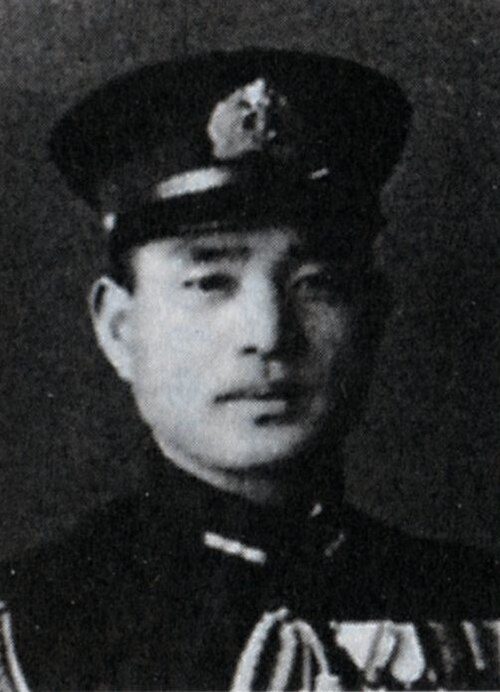
Yahachi Tanabe (1 January 1907 – 29 April 1990) was an Imperial Japanese Navy submarine officer, a graduate of the Naval Academy at Etajima in 1928, and the commander of the submarine I-168 when she sank the carrier USS Yorktown and the destroyer USS Hammann at the Battle of Midway on 6 June 1942. He was then a lieutenant commander. The attack, made in daylight and submerged, through a screen of American destroyers, accounted for the only American warships lost in the battle. Four months later, in a new boat, he torpedoed the heavy cruiser USS Chester in the Coral Sea, and in March 1943 he was severely wounded when American bombers caught his submarine unloading at Lae, New Guinea. He survived the war, retired in November 1945, and in 1963 wrote an account of Midway for the United States Naval Institute's Proceedings. He died in Omiya, Saitama, at the age of eighty-three.
The sources examined here give the date of his birth, 1 January 1907, and nothing about where or into what family he was born. His parents, siblings, schooling before the naval academy and place of origin were not found. The Japanese record that survives in English is the record of an officer's career, and it begins when he entered the Naval Academy at Etajima, on the island in Hiroshima Bay, in 1925, at the age of eighteen.
He completed his course at Etajima in March 1928, at twenty-one, in the class the Navy numbered 56. The naval record gives the steps of his early service in brief: sub-lieutenant second class by November 1929, sub-lieutenant first class in December 1931. In November 1934, aged twenty-seven, he volunteered for submarine service. He was a lieutenant by December 1938 when he entered the Navy's submarine school for officers, and in March 1939 was sent to the small submarine RO-58. From June 1939 to November 1940 he was communications officer in the submarine I-8; after that he served as communications staff officer on the staff of Submarine Squadron 2, and then took the command courses. On 15 October 1941 he was given his first command, the RO-59, a boat used in the Inland Sea to train officers and crews for the larger submarines.
His own account, written some twenty years later, stresses what that assignment meant on the night the war began. While nearly thirty other submarine commanders were deployed around Oahu, he wrote, he was "plodding our Inland Sea in RO-59." He and his crew knew nothing of the Pearl Harbor operation, though they suspected something was afoot from the heavy radio traffic and ship movements of November 1941. On 8 December, at Kure, there was one of the surprise drills the ships had been running; when every ship reported "manned and ready for sea," they were not told to secure, but told that they were at war with America. He remembered the disappointment of some officers at missing the first battle, and his own different feeling: "I felt that it would be a long war. Therefore, a highly-trained officer like myself, with six special service schools behind him, would eventually see his full share of sea action." That sentence is the closest the record comes to his character before Midway. It is the self-assessment of a man with confidence in his preparation, written afterward, and it should be read as his recollection and not as a contemporary record.
On 31 January 1942, thirty-five years old and a lieutenant commander, Tanabe took command of the I-68, which was renumbered I-168 in May. She was a Kaidai-type cruiser submarine built at Kure and commissioned in 1934, and she had taken part in the Pearl Harbor operation under her previous captain, Lieutenant Commander Otoji Nakamura, who had endured days of depth-charging southwest of Oahu in December 1941. Tanabe's boat was assigned to the scouting line for the Midway operation. In his words, she had "the simplest assignment of all—scouting," and "according to the basic plan, we were to see no action at all."
She left Kure on 23 May 1942 and came in sight of Kure Atoll on 31 May. On 2 June, according to the combinedfleet.com movement record, Tanabe made the first periscope reconnaissance of Sand Island and reported "unusually frequent patrol aircraft launches." In his own account he and his officers watched the Japanese carrier strike on Midway on 4 June from the periscope; his crew, he said, grew more excited as he described the action, and "a great cheer went up" when he described fuel tanks blown into the air. By nightfall the carriers Akagi, Kaga and Soryu were burning, and the fourth, Hiryu, followed. Tanabe's orders on the night of 4–5 June were to close Midway and shell it with his four-inch deck gun until cruisers should join him. He surfaced about 0130 on 5 June and fired six rounds before shore searchlights found him and he had to dive; the cruisers had in the meantime been recalled. A patrol vessel chased and depth-charged him briefly.
Then the orders changed. Scout planes had found the Yorktown, abandoned after the dive-bomber and torpedo hits of 4 June but still afloat, about 150 miles north-northeast of Midway. "Submarine I-168 will locate and destroy the American carrier," Tanabe quotes the message. He ran submerged in daylight and surfaced after dark; a patrol aircraft forced him down once. At about 0530 on 6 June his best lookout picked up the carrier, "a black shape on the horizon, about 11 miles distant." He called it "the easiest intercept a submarine commander ever made." The next seven hours were the hard part. He submerged, slowed to three knots as the range closed, and came up to periscope depth only for brief looks, a maximum of five seconds each, steering mostly by chart and sound. The Yorktown was under slow tow by the minesweeper Vireo, with the destroyer Hammann secured alongside to give her pumps power, and five other destroyers screening her.
His account of the final approach contains one of the few moments in the record where a decision of his can be seen. At about noon he raised the periscope and found the carrier and the destroyer beside her filling the lens, closer than 600 yards by his estimate. He ordered the helm over and took the boat around again. His officers were astonished. "What has happened, Captain? Aren't we attacking?" "We are going around again," he told them. "The range is too short! I'm going to open the range and try again. I want to be sure of this kill!" He planned to fire two torpedoes first and two in their wakes, on the same course, so that "I could achieve two large hits instead of four small ones." His torpedoes, he explained, were an older type with warheads of 446 pounds, against 991 pounds for the newer model. When the sound operator reported that the Americans had stopped transmitting, he told his crew with a light voice, as he remembered it, that "the Americans have interrupted their war for lunch. Now is our chance to strike them good and hard, while they are eating!"
The movement record gives the time of the attack as 1331: from 1,900 yards he fired two torpedoes, and two more three seconds later. The first torpedo struck Hammann, which broke in two and sank in about four minutes; her depth charges exploded as she went down, and the movement record says 81 of her 241 men were killed. The next two hit the Yorktown on the starboard side below the bridge, and the fourth passed astern. Tanabe heard the explosions, and a man shouted "Banzai!" He took the boat down to 200 feet, beneath the carrier, calculating that the destroyers would not risk depth charges while men were in the water. The calculation failed. American destroyers were on him within minutes. By about 1530, in his account, they had dropped sixty depth charges, and the last one, off his bow, put out the lights, sprang leaks and threatened to release chlorine gas from the forward battery. The boat carried ten gas masks for a crew of 104. His chief electrical officer, Lieutenant Gunichi Mochizuki, took a small group into the battery room, closed the door behind them, and began disconnecting the damaged batteries. Both doors of the number one torpedo tube had sprung, and the bow was filling. Tanabe had his men carry sacks of rice aft to trim the boat.
At sunset he surfaced to charge batteries, with pistols and rifles issued from the armory and the deck gun crew at the tower. Two American destroyers turned on him; at about 6,500 yards they opened fire and straddled the submarine. He remembered "the moment of the straddle most vividly": the lookouts looking at him with strained, pale faces, and the reports from below of the battery charge. He asked down whether there was enough air and power for short operations, and received "a reluctant 'Yes, sir.'" He dived into his own smoke, the destroyers overran him, and after a few more charges they broke off. According to the movement record he sent a message to the Combined Fleet that he had sunk the Yorktown; the carrier did not in fact sink until the morning of 7 June, rolling over at about 0458. The Yorktown and Hammann were the only American warships lost in the battle.
He reached Yokosuka on 19 June with nearly dry tanks. At Kure a large crowd met the boat, with music and speeches, and a special report of the exploit was made to the Emperor. In his recollection the welcome was shadowed by what the public did not know: "All the Japanese people thought we had scored another Pearl Harbor at Midway. They didn't know that four of our fighting carriers, together with hundreds of Japan's best planes and pilots, were gone forever. My sinking of the USS Yorktown was small revenge for that loss."
He did not stay with the I-168. On 30 June 1942 he was appointed to stand by the new submarine I-176, which was commissioned on 4 August with Lieutenant Commander Tanabe in command. Her first patrol took her south of Guadalcanal, and on 20 October 1942, in the waters between San Cristobal and Espiritu Santo, she sighted a column of American warships, which Tanabe took for battleships. At 2115 he fired six torpedoes at what he called a "Texas-class battleship." One struck the cruiser Chester in her number one engine room at about 2120. She lost power but was able to make eight knots by 2245 and reached Espiritu Santo; she was under repair into 1943. Tanabe was chased by destroyers for three hours and surfaced at 0230 to find the sea empty. He supposed correctly, the record says, that his target had escaped with heavy damage. In his memoir he wrote that with one torpedo he had knocked a heavy cruiser out for a year.
From December 1942 the I-176 worked the supply runs to the Japanese garrisons at Buna and Lae. On 17 March 1943 she left Rabaul on the first run to Lae, carrying ninety supply drums on her afterdeck, weapons, ammunition and twenty army passengers. On 19 March, at 1905, as she was unloading in Lae harbor, five B-25 Mitchell bombers attacked. Tanabe tried to conn the surfaced boat to open water. A bomb hit the drums of rice on her afterdeck. He was severely wounded by a metal splinter, and two helmsmen were killed. The boat could not hold her buoyancy and was grounded in shallow water by her torpedo officer for emergency repairs; landing craft from Lae finished unloading and evacuated the wounded. The movement record says that Tanabe returned to Japan aboard the Hikawa Maru and recovered in the naval hospital at Yokosuka. A new commander, Lieutenant Mitsuma Itakura, was appointed to the I-176 on 20 March. Tanabe was thirty-six.
The Japanese naval record in English summarizes the remainder of his service in a few lines. In July 1943 he became an instructor at the Submarine School. On 1 May 1944 he was promoted to commander. In June 1945 he was assigned to the Navy's Special Ordnance Section. After the surrender in August 1945, according to the biographical note in Proceedings, he acted as Imperial Naval Representative at Atsugi and made preparations for the arrival of General Douglas MacArthur. He retired from the Navy in November 1945, at thirty-eight.
His former boats did not survive him. The I-168 was sunk by the American submarine Scamp in July 1943 north of Rabaul under Lieutenant Commander Sakae Nakajima, with all hands. The I-176 was lost in May 1944, probably to depth charges from the American destroyers Franks and Haggard of Destroyer Division 94, with all 103 men.
In May 1963 the Naval Institute published "I Sank the Yorktown at Midway" over his name and that of Joseph D. Harrington, in Proceedings. The editors noted that he had been a graduate of Etajima in 1928 and entered the submarine service six years later; a footnote to the article records that the destroyer Tanabe thought he saw towing the carrier was in fact the minesweeper Vireo. The account ends not with the attack but with the public's ignorance of the loss of the four carriers.
He died at his home in Omiya City, Saitama, Japan, on 29 April 1990, at eighty-three, according to a biographical summary based on the work of the historian Peter C. Smith. His family, marriage and children were not found in the sources examined. Smith, as the same summary quotes him, wrote that "by his dogged perseverance and audacious and skilled attack, Commander Tanabe had achieved more than the entire kido Butai and main battle fleet combined had done," a verdict from a naval historian, not a Japanese official contemporary.