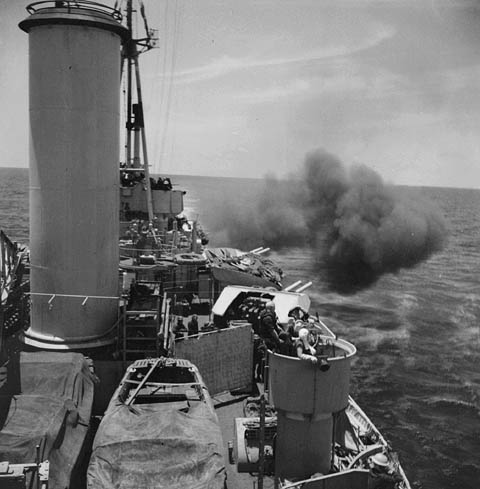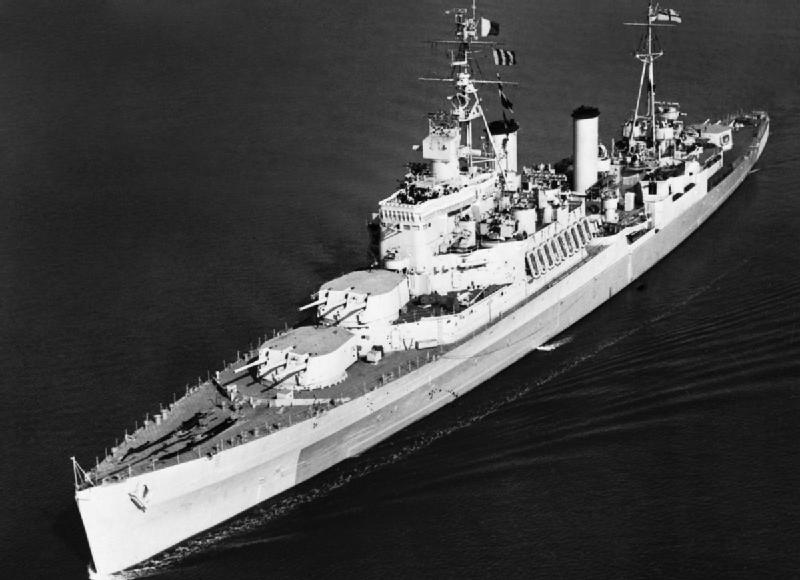
Uganda was a Fiji-class light cruiser, built by Vickers-Armstrong at Newcastle-on-Tyne. She was laid down on 20 July 1939 and launched on 7 August 1941. Captain Sir William Gerrard Andrewes was appointed on 19 September 1942. Uboat.net records that he commissioned her for trials at Newcastle on 17 December 1942, and that on 3 January 1943 she ran acceptance trials off the Firth of Forth and was accepted from her builders. Geoffrey Mason gives the same completion date and a commissioning for service in the 10th Cruiser Squadron. She worked up at Scapa Flow. In the spring she was on convoy defence in the South Atlantic and the South-Western Approaches. On 5 May she escorted Queen Mary, which was taking Winston Churchill to meet President Roosevelt. In June she was ordered to the Mediterranean. On 21 June she joined military convoy WS 31/KMF 17 in the Clyde, and on 26 June she went on to Algiers with the Mediterranean portion.
On 3 July she embarked Admiral Sir Andrew Cunningham at Algiers and landed him at Malta the next day. On 9 July she sailed to cover the Sicily invasion convoy, Operation HUSKY, with Orion, Mauritius, and Newfoundland. On the 10th she was off ACID beach, south-west of Syracuse, and rescued 36 survivors from the hospital ship Talamba after an air attack. On the 11th she bombarded Augusta. Through August she stayed on the Sicilian coast. On 9 September she covered the British X Corps landings at Salerno, Operation AVALANCHE, and was slightly damaged in a collision with Delhi during air attacks. On the 11th she was in the gunfire support line under sustained air attack. On the 13th, still firing in support of the troops, she was hit by an FX 1400 glider bomb. Mason records major damage and serious flooding. The United States tug Narragansett towed her to Malta. In November she sailed for the United States, and on 3 December she began repairs at the Charleston Navy Yard. Uboat.net ends Andrewes in early 1944, without a day, and lists Commander Duncan Lachlan Johnston from then until 15 August 1944, the months she was in dockyard hands. No events are filed under Johnston's name.
Captain Edmond Rollo Mainguy, Royal Canadian Navy, took command on 15 August 1944. The Department of National Defence records that she was commissioned HMCS Uganda at Charleston on 21 October 1944, and Mason says she was re-commissioned and manned by the Royal Canadian Navy that day, the name kept because of the colonial connection. She went back to the Tyne in November for radar work the American yard had not finished, sailed for the Mediterranean on 30 December, and worked up with the fleet in the eastern Mediterranean. In January 1945 she was under repair at Alexandria after a torpedo exploded during maintenance. On 14 February she sailed for Australia. On 2 March she was diverted, with Formidable, the Australian destroyer Napier, and Urchin, to search for survivors of a merchant ship torpedoed about 800 miles west of Fremantle. She joined the British Pacific Fleet at Sydney on 9 March.
Mason records that on 8 April she joined British Task Force 57 in the area called COOTIE, to cover carrier attacks on the Sakishima Gunto for Operation ICEBERG. On 11 April she covered Indefatigable's attacks on northern Formosa, with Gambia, Ursa, Urchin, and Whirlwind. She was at Leyte from 23 April. On 2 May she was back with Gambia, Euryalus, and Black Prince covering the carriers against Sakishima, and she bombarded shore targets at Nobara and Suknama with ships of the American Task Group 58. The force was under kamikaze attack. On 4 May she bombarded airfields on Miyako and was detached to shell an airstrip at Sukhamo, Mason's spelling. On the 5th and again on the 12th she was stationed out as a radar picket. On the 9th Formidable and Victorious were hit. She was released on 25 May and went to Sydney. The Department of National Defence awards her the battle honour Okinawa 1945 for Operation ICEBERG, and records bombardments of the airfield on Myako.
On 12 June she joined British Task Group 111.2 with Implacable, the escort carrier Ruler, Swiftsure, Newfoundland, and Achilles. On the 13th she covered Implacable's air attacks on Truk. On the 14th she bombarded the seaplane base at Dublon with those three cruisers, Operation INMATE. Mason notes that the shoot was not very successful, from inexperience and from technical problems. She was back at Manus on 17 June. On 6 July the British ships were redesignated Task Force 37. On the 16th she covered Formidable, Victorious, and Implacable, with King George V, Newfoundland, Achilles, Euryalus, Gambia, and Black Prince, during the joint strikes and bombardments off Japan. On 27 July HMS Argonaut relieved her in Task Force 37. Mason's note says this was because Canadian legislation prevented service in the Pacific by anyone who had not volunteered for the duty. On 4 August she was on passage to Esquimalt from Pearl Harbor and returned to Canadian control. The Department of National Defence says she left the fleet late in July and arrived at Esquimalt on 10 August for refit. She was not off Japan on 15 August. She was not sunk. She was renamed HMCS Quebec on 14 January 1952, paid off on 13 June 1956, and arrived at Osaka on 6 February 1961 to be broken up. Uboat.net dates the decommissioning to 15 June 1956. Mason dates the arrival at Osaka to 8 February 1961.
A note on sources. Completion on 3 January 1943, the Salerno glider bomb on 13 September 1943, the Charleston repair from 3 December, the Canadian re-commissioning on 21 October 1944, the join with Task Force 57 on 8 April 1945, the Miyako bombardment on 4 May, the Dublon bombardment on 14 June, and the relief by HMS Argonaut on 27 July are from Geoffrey Mason's chronology The Department of National Defence ship history gives the same completion and the Charleston commission, the Truk bombardment on 14 June, the late-July departure, arrival at Esquimalt on 10 August, the renaming on 14 January 1952, the pay-off on 13 June 1956, and Osaka on 6 February 1961. The battle-honour page, src/hmcs-uganda/canada-okinawa.txt, spells the yard Charlestown and the island Myako. Mason and the ship history spell Charleston, and Mason spells Miyako. Those two are followed. Uboat.net's pennant is 66. The ship history prints C66 / 31. Command dates are the uboat.net tables. Andrewes ends at "early 1944" and Johnston starts at "early 1944", with no day on either page. Mainguy's Canadian command runs to 4 July 1946 on uboat.net. The commission date used is the Royal Canadian Navy commission of 21 October 1944. Truk in June 1945 is Operation INMATE, not the February 1944 carrier raid, and there is no slug for it. She had already left Task Force 37 when hostilities ceased. Digitized copies of these pages were used. No photograph was downloaded.