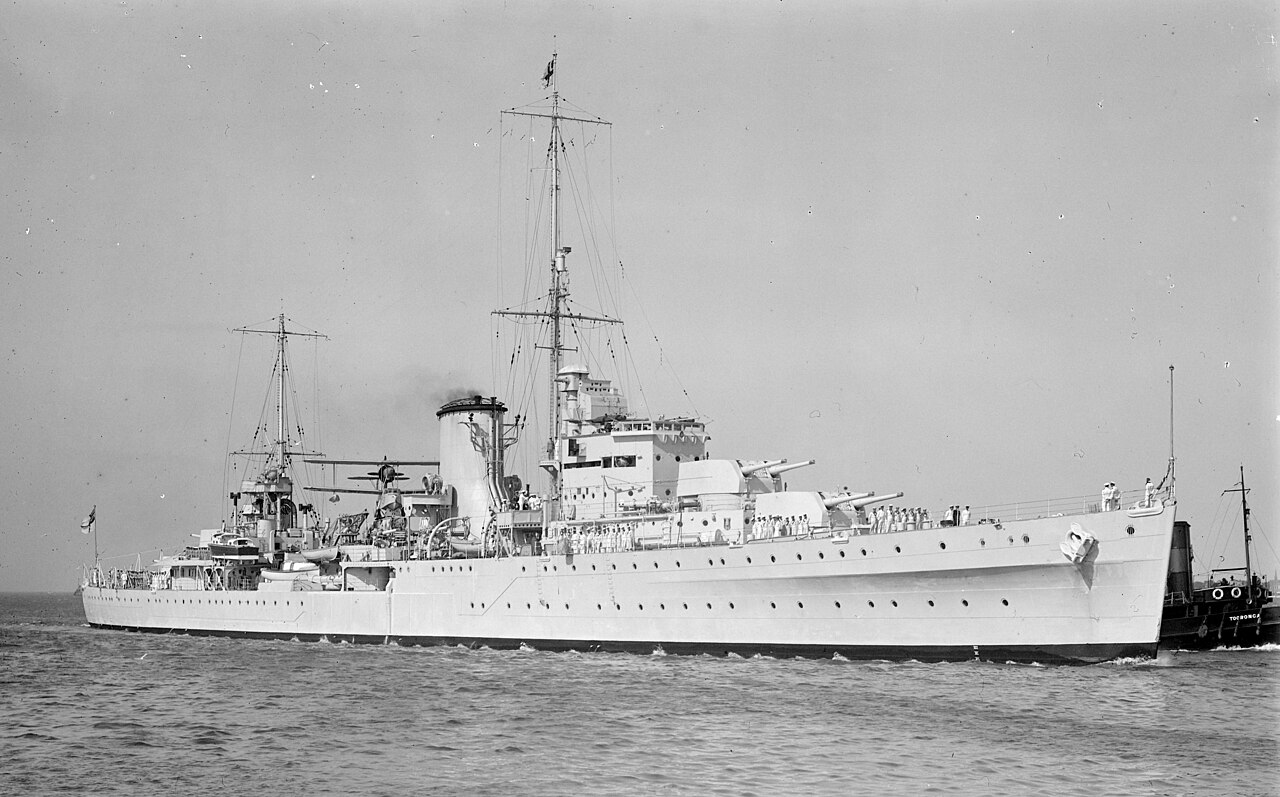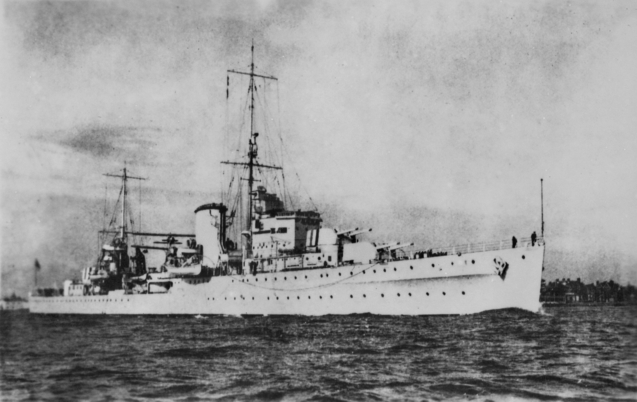
Achilles was a Leander-class light cruiser, ordered from Cammell Laird at Birkenhead on 16 February 1931. She was laid down on 11 June that year and launched on 1 September 1932. The naval-history chronology dates her completion to 10 October 1933, and uboat.net's history of the ship calls that the date she was commissioned for the Home Fleet. She was re-commissioned at Chatham on 31 March 1936 with a New Zealand crew from Diomede, worked up in the Mediterranean, and reached New Zealand in September 1936. In July 1941, when the Royal New Zealand Navy was formed, she was formally transferred and became HMNZS Achilles. Uboat.net prints her pennant as 70.
Captain Hugh Merriman Barnes had her from 15 October 1940, and he was still in command when Japan entered the war. On 8 December 1941 she was transferred to the Eastern Fleet and sailed from Suva for Port Moresby. An order to join the battleship Prince of Wales and the battlecruiser Repulse as part of Force Z was cancelled after those two ships were lost. She was released from the Eastern Fleet and returned to Auckland. Through 1942 she stayed in the South Pacific: escort between New Zealand, Fiji, Australia and the New Hebrides, a short time with the ANZAC Squadron and with American task forces, including a withdrawal from an air attack off Rabaul in February when high-speed manoeuvres burned down her fuel, and escort duty to Wallis Island in late May. In June she was guardship at Wallis Island. The National Museum of the Royal New Zealand Navy says that duty covered the occupation of the island by United States Marines. She refitted at Auckland from 20 September.
Captain Cecil Aubrey Lawson Mansergh relieved Barnes on 16 April 1942. On 30 December Achilles joined United States Task Force 67 at Espiritu Santo. On 3 January 1943 she escorted military convoys to Guadalcanal with that force. On the 4th she was off the Solomons and bombarded the airfield at Munda, on New Georgia. On the 5th, while giving naval gunfire support off Guadalcanal, she was hit on X turret in an air attack and badly damaged. The museum places the hit near Cape Hunter, on the south coast of Guadalcanal, after a bombardment of Munda, and counts thirteen men killed and eight wounded, the bomb having blown the top off the turret. She was patched at Espiritu Santo by the United States repair ship Vestal. The museum records that she holed Vestal going alongside. She then went to Auckland. Repair was arranged in the United Kingdom. She sailed on 19 February by way of the Panama Canal, called at Bora Bora and Bermuda, and paid off at Portsmouth on 22 March 1943.
Acting Captain William Gronow Davis had her from 4 February 1943, through that passage, until 19 May. Acting Captain Phillip Leonard Gunn had her from 19 May to 10 September, and Captain Neville Brevoort Carey Brock, on the retired list, from 10 September until 15 March 1944. The ship was in dockyard hands the whole time. On 22 June 1943 a violent explosion in an emptied fuel tank killed fourteen dockyard workmen and wrecked several compartments. Stoker First Class William Dale, Engine-Room Artificer William Vaughan and Stoker First Class Ernest Valentine went down into the smoke and got men out. Dale received the Albert Medal, and Vaughan and Valentine were mentioned in despatches. The refit took off the damaged X turret, so she came out with six 6-inch guns instead of eight, twin 4-inch mountings in place of the single 4-inch, more close-range guns, and new radar. Completion, first hoped for in September 1943, slipped to May 1944.
Captain Francis John Butler had her from 15 March 1944 and commissioned her for the Royal New Zealand Navy on 23 May. About nine-tenths of the ship's company were New Zealanders. She was ordered out of Portsmouth because the harbour was needed for the Normandy landings, sailed for Scapa Flow, and broke down on the way. She spent four weeks at Greenock making good defects, worked up with the Home Fleet, and was allocated to the 4th Cruiser Squadron in the Eastern Fleet. She left the Clyde on 16 August, embarked 300 troops at Gibraltar for Algiers, and was then sent on to the East. Three days after leaving Aden an oil-fuel fire in a boiler room was put out in about twenty-five minutes. She reached Bombay on 8 September 1944 and Trincomalee on the 13th, and the boiler-room damage was repaired there. The naval-history chronology dates her transfer to the British Pacific Fleet, on the fleet's formation, to 22 November. On 9 December she sailed from Colombo with escort carriers for Australia, and with Swiftsure went on to Fremantle and Hobart.
On 9 January 1945 she left Hobart with the Australian destroyers Quiberon and Quickmatch, escorting three liners, one of them carrying New Zealand troops, and was relieved by London on the 14th. At Fremantle on 17 January parties from the ship fought a fire in the steamer Panamanian, which was loading wheat. She then helped escort Rimutaka, with the Duke of Gloucester aboard, into Sydney on 27 January, and on 5 February arrived at Auckland with the battleship Howe. She refitted until 26 April, worked up off Sydney and Jervis Bay, and sailed for Manus on 11 May. On 22 May she joined Task Force 57 in the replenishment area Cootie, off Okinawa, and took her place with Gambia in the 4th Cruiser Squadron. The force flew its twelfth and last series of attacks on the Sakishima Gunto airfields on 24 and 25 May, five bomber strikes on Miyako and two on Ishigaki. Achilles went on to Manus with the main body and arrived on 30 May. She was not sunk.
She sailed from Manus on 12 June with Task Group 111.2 for Operation Inmate, a strike and bombardment of the bypassed base at Truk. The group was the carrier Implacable, the escort carrier Ruler, the cruisers Swiftsure, Newfoundland, Uganda and Achilles, and five destroyers. Aircraft from Implacable struck the atoll on 14 and 15 June. On the forenoon of the 15th the cruisers and destroyers bombarded the seaplane base on Dublon Island. Achilles fired 180 rounds of 6-inch high-explosive shell at a mean range of 21,000 yards, and flew battle flags, the one on the foremast being the New Zealand ensign. While the cruisers were withdrawing she opened fire with her 4-inch guns on two aircraft that came out of the clouds, and got off six salvoes before they were identified as Avengers. The group was back at Manus on 17 June.
She was in a floating dock at Manus when the British Pacific Fleet returned, and she rejoined the 4th Cruiser Squadron on 4 July. The fleet, now Task Force 37, sailed on 6 July and at daybreak on 16 July joined the American Task Force 38 off Japan. She was one of the cruisers in the screen through the carrier attacks on the Tokyo area, the Inland Sea and Kure. On 31 July she and Gambia were in the fuelling area and met the corvette Arbutus with the Fleet Train. On 11 August she was detached, with the carriers Formidable, Victorious and Implacable, the cruisers Euryalus and Argonaut, and eight destroyers, and sailed for Manus to await orders. The ships that stayed with the Americans, Gambia among them, were in the last strikes. Achilles was not.
She reached Auckland from Manus at the end of August 1945 and was docked. She sailed again for Japan to relieve Gambia, entered Tokyo Bay on 6 October, and spent nearly four months in Japanese waters, with cruises to Nagasaki, Sasebo, Kagoshima and Nagoya. She left Hong Kong on 15 February 1946, called at Subic Bay, and on the way home was sent toward a report of trouble at Menado and then toward a water-lighter aground near Biak. She reached Sydney on 8 March. Captain William E. Banks assumed command the next day and Butler went home. After a farewell cruise of New Zealand ports she sailed from Auckland on 17 July, arrived at Sheerness on 10 September, and paid off a week later, on 17 September 1946. She was sold to India, renamed Delhi, and the Indian Navy decommissioned her on 30 June 1978.
A note on sources. The movements follow the naval-history.net chronology of HMNZS Achilles by Lieutenant Commander Geoffrey B. Mason, and S. D. Waters, The Royal New Zealand Navy (Historical Publications Branch, Wellington, 1956), chapters 23 to 25, saved from digitized copies on the Internet Archive of the New Zealand Electronic Text Collection. The National Museum of the Royal New Zealand Navy ship page supplied the River Plate outline that is not retold here, the Cape Hunter placing of the January 1943 hit, the count of thirteen killed and eight wounded, the holing of Vestal, and the pennant C70. Uboat.net's ship page supplied the pennant 70, the first-commission sentence of 10 October 1933, and the commanding officers. Where those sources disagree, the official history is followed on the Dublon bombardment, which Mason dates to 14 June 1945 and Waters to the forenoon of 15 June, with the 180 rounds, and on Butler's relief, which Waters dates to 9 March 1946 and uboat.net to 8 March. Mason's July 1945 line says she was used for shore bombardment with the British Pacific Fleet. Waters names the ships that bombarded and does not include Achilles, and that account is followed. Mason dates the passage home to August 1946. Waters has her leaving Auckland on 17 July and paying off on 17 September, which matches the museum and uboat.net. The museum dates a Royal Navy commissioning to 5 October 1933 and completion to 10 October. Uboat.net's commissioned field is 24 March 1936, which its own history text calls the transfer to the New Zealand Division, against 31 March 1936 in Mason and the museum. Unithistories.com ends Barnes's command on 15 April 1942. Uboat.net ends it on 16 April. The 15 April date is the one used for his relief. The naval-history chronology says the June 1943 explosion killed several dockyard workers. Waters counts fourteen workmen killed.