HMS Argonaut was a Dido-class light cruiser, pennant 61, ordered from Cammell Laird of Birkenhead under the 1939 War Emergency Programme. Uboat.net dates the order 4 September 1939 and the laying down 21 November 1939. The naval-history chronology does not print a laid-down day. She was launched on 6 September 1941. The chronology says she was the third Royal Navy warship to carry the name, the first having been a prize dating from 1782, and that she was completed in August 1942 with the after funnel shortened and the original five-turret design retained. It commissions her for service on 14 July 1942, after a delay from a shortage of materials. Uboat.net dates the commissioning 8 August 1942. She worked up at Scapa Flow and was kept with the 10th Cruiser Squadron. After the loss of the cruiser Coventry, which Coventry had adopted in March 1941, HMS Argonaut became the replacement ship. The battle-honour line reads Arctic 1942, North Africa 1942, Mediterranean 1942, Normandy 1944, South France 1944, Aegean 1944, and Okinawa 1945. The motto on the page is printed Audax ominia perpeti.
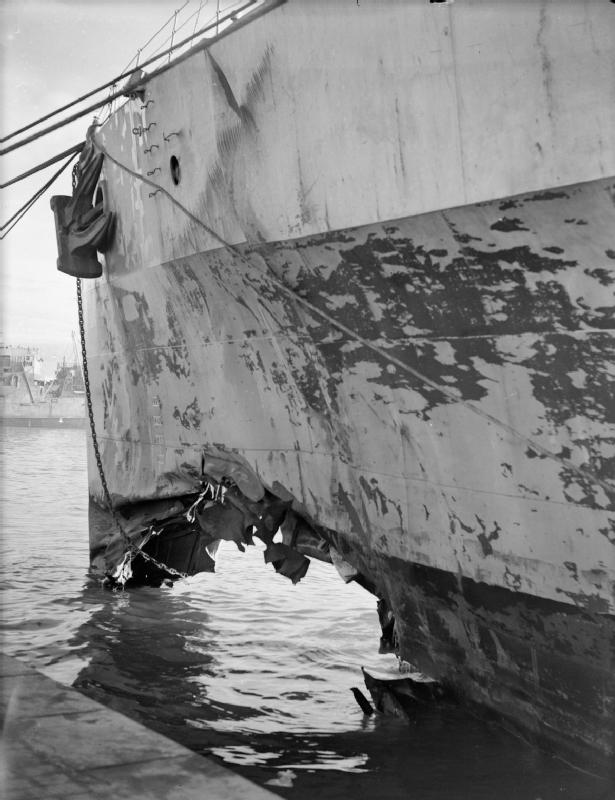
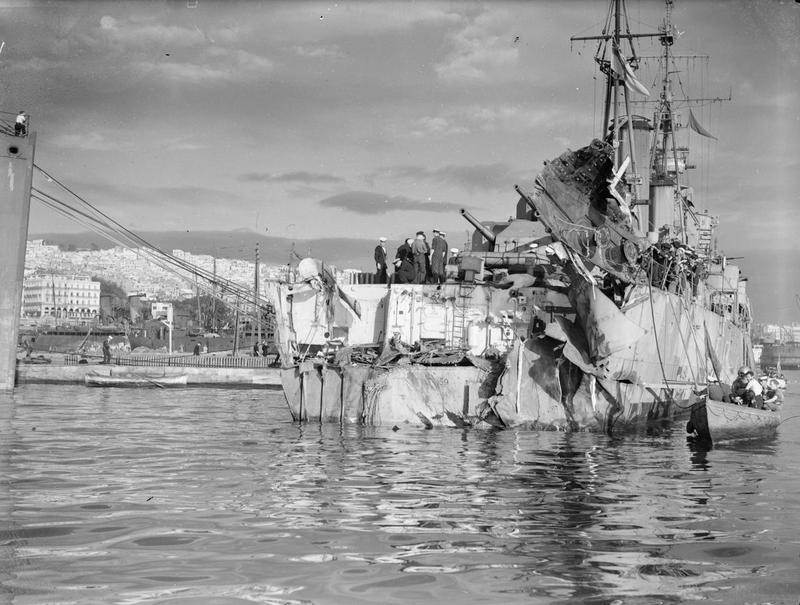
Captain Eric William Longley Longley-Cook had HMS Argonaut from 21 April 1942. The Navy List compilation ends that first command on 1 January 1943. Uboat.net ends it on 6 January. On 13 October 1942 she embarked an RAF medical unit and sailed for Murmansk with Intrepid and Obdurate. She was back in the United Kingdom on the 28th with RAF aircrew and ground staff who had gone out with the Hampden aircraft of PQ 18, and she called at Spitzbergen on the way. On the 30th she joined Duke of York, Nelson, Renown, Formidable, Victorious and Bermuda for the passage to Gibraltar in support of the North African landings, Operation Torch. She joined Force H on 6 November. On the 8th she was with Ashanti on a wireless deception. On the 15th she was in Force Q with Aurora, Charybdis, Scylla and Sirius, based at Bone, with Quentin and Quiberon as the screen. On 2 December Force Q sank four transports and the escorting destroyer Folgore from an Italian convoy north of Tunis. On the 14th, still with Force Q, HMS Argonaut was hit on the starboard side by torpedoes from the Italian submarine Mocenigo, west of Galita Island. The chronology says the bow and the stern structure were blown off, steering was unusable, and the after two turrets could not be used. She was taken to Algiers. Uboat.net and the Italian submarine page put the attack on the same day in 37°30'N, 8°13'E, and both say three men were killed. The Italian page says an officer and two ratings, and that Quality stayed with her.
She sailed for Gibraltar on 1 January 1943 and was taken in hand there on the 4th for temporary repair. Permanent repair was arranged in the United States. She sailed on 5 April, called at Bermuda, and was taken in hand at Philadelphia on 30 April. The repair and refit were completed in November. She reached the United Kingdom on 2 December and went to a Tyne yard on the 31st for work that had not been possible in America. Through January and February 1944 the upper forward turret, Q turret, was removed to lessen topweight and a quadruple pom-pom went into its place. The chronology lists 10-centimetre radars, Types 293 and 277, for surface warning and height-finding, fire-control radar for the forward close-range anti-aircraft guns, IFF, and a VHF direction-finding set. She was being fitted as an escort flagship, with facilities for the control of aircraft. Commander Frederick Stanley Walford had her from 6 January to 28 March 1943 and again from 27 July to 27 October 1943. Acting Captain Henry John Haynes is dated from 28 March to 27 July 1943 on uboat.net, and from 16 March to 27 July on the Navy List compilation. Longley-Cook resumed command on 27 October 1943 and kept HMS Argonaut until 10 January 1945. Both lists agree on that second span.
In March 1944 HMS Argonaut was nominated for Bombarding Force K, in support of British Force G at the Normandy landings, Operation Neptune. She joined the 10th Cruiser Squadron in April and trained for naval gunfire support. In May she joined Orion, Ajax and Emerald at Belfast. Her assigned batteries were at Vaux-sur-Aure. On 3 June she sailed from the Clyde with Force K in convoy G12, escorted by Grenville and Undine. The Dutch gunboat Flores joined in the Solent on the 5th. On the 6th she engaged the target batteries during the assault and later hit the battery at Longues, which Ajax had already silenced. On the 7th she was in the Eastern Task Force area for the build-up. On the 25th she bombarded batteries near Querqueville with Emerald, Enterprise (D52) and Glasgow, the American battleship Nevada, and the American cruisers Tuscaloosa and Quincy. On the 26th she fired with Rodney, the monitor Roberts, Belfast and Diadem during the British offensive in the Caen area. A shell from a shore battery hit the quarterdeck and failed to explode. The chronology prints the calibre as 150mn. She continued the gunfire support into July, went to Devonport to have the main-armament barrels relined, and resumed the role off Normandy. She was then nominated for the landings in the south of France.
On 4 August 1944 HMS Argonaut took passage to the Camel gunfire-support group in Task Force 87, under American command, for Operation Dragoon. On the 11th she sailed from Salerno with the American battleship Arkansas and the American cruisers Tuscaloosa, Marblehead and Brooklyn. She met convoy SF1A on the 14th. On the 15th she fired 394 rounds at batteries between Cannes and Antibes and on St Marguerite, and later bombarded targets in the Golfe de Frejus, under some return fire. On the 16th she bombarded troops and vehicles in the Camel area. She was released on the 22nd and returned to the Commander-in-Chief, Mediterranean. In September she was nominated for the British Aegean Force. On the 24th she was with Orion, Ajax, Royalist, Black Prince, Aurora and Ceylon for the re-occupation of the islands. On 16 October she intercepted craft evacuating German troops and sank two caiques. On 9 November she escorted a military convoy to Salonika. On the 22nd she was allocated to the British Pacific Fleet on its formation, and on the 25th she sailed from Alexandria for Trincomalee. She joined on arrival. On 13 December she was in Force 67, covering air attacks on the harbour, rail and oil installations at Belawan-Deli in northern Sumatra by Indomitable and Illustrious, with Newcastle and Black Prince. That was Operation Robson.
Captain William Patrick McCarthy took HMS Argonaut on 10 January 1945. Uboat.net lists him into mid-1946 and gives no closer end. On 2 January, still inside Longley-Cook's dates, she had been in Force 67 for the air attacks on the oil refineries at Pangkalan Brandan in Sumatra, Operation Lentil, and she was present during the flying on the 4th. On the 16th she sailed from Trincomalee in Force 63. On the 24th she was in the screen for Indomitable, Illustrious and Victorious during the attack on the oil refinery at Pladjoe, north of Palembang, Operation Meridian I. The ships refuelled in the place the chronology prints as Exmouth Bay. On the 29th she screened the attack on Soengi Gerong, which the page prints as Soengi - Gerong, Operation Meridian. She called at Melbourne on 4 February and arrived at Sydney on the 10th with Task Force 113. On 7 March she reached Manus. On the 15th American approval came for service with the United States 5th Fleet. On the 18th she sailed from Manus. On the 23rd she sailed from Ulithi to support the American landings on Okinawa, and the force was redesignated Task Force 57. The chronology prints that word as Redesigned. On the 26th she was with Task Force 57 against airfields in the Sakishima Group, Operation Iceberg, and acted as radar picket with Kempenfelt, 30 miles from the fleet. On the 28th she was radar picket to the refuelling group with Wager, under air attack. On 6 April she was radar picket with Urania while the carriers of Task Forces 57 and 58 continued Iceberg. On the 9th Task Force 57 was diverted to air attacks on Formosa, which the page prints as en Formosa, Operation Iceberg Oolong. On the 15th she returned to the Sakishima group, printed Sakashima Gunto, and the May line prints Sakishima Gunta. On the 20th she was briefly off Leyte with Illustrious, Wager and Whelp. On 4 May she sailed for Sydney with those three ships and was under refit from the 15th.
The Sydney refit of HMS Argonaut ran through June. In July she sailed to relieve the cruiser Uganda in Task Force 37, the old Task Force 57 after the transfer to the United States 3rd Fleet. The chronology's note says Uganda was manned by the Royal Canadian Navy and was withdrawn because of a Canadian Government ruling that only men who had volunteered were to serve in operations against Japan. On 27 July HMS Argonaut relieved her in the covering force for joint air operations against shore targets and shipping in Japan. On the 31st she was a relay ship between the refuelling group and the operational ships, with Illustrious, the escort carrier Ruler and Achilles. Fleet duty off Japan continued into August. On the 3rd she was with Task Force 37 and covered the carriers during flying. She was detached on the 10th. On the 12th she returned to Manus with the Task Force 37 ships that were not being kept in Japanese waters, the chronology says because of a shortage of fuel from the British support tankers. On 15 August she was transferred to British Task Unit 111.3, with the carrier Colossus, Bermuda, and the destroyers Tyrian, Tumult, Tuscan and Quiberon, to collect British prisoners of war from Formosa and the Chinese mainland. She was not sunk. After the surrender she went to Formosa and, after Belfast joined, to Shanghai to help American ships repatriate allied nationals. She stayed with the British Pacific Fleet and was based at Hong Kong for the rest of 1945. She returned to Portsmouth in 1946 and was reduced to reserve. She was not recommissioned. She went on the disposal list in 1955, was sold to BISCO for demolition by J. Cashmore, and arrived at the yard in Newport in November 1955.
A note on sources. The operations follow the naval-history.net service history by Lieutenant-Commander Geoffrey B. Mason That page is a digitized copy. It prints Bamett for Barnett, Audax ominia perpeti, Sustain for the December 1942 damage, 150mn for the Normandy shell, Redesigned for the Task Force 57 renaming, Sakashima Gunto and Sakishima Gunta, en Formosa, Soengi - Gerong, Pladjoe, and Exmouth Bay. It names no commanding officer. The officers and the uboat.net dates are the ship page. Longley-Cook's first command ends on 1 January 1943 in the Navy List compilation, and on 6 January 1943 on uboat.net. The command line uses 1 January. Haynes starts on 16 March 1943 on unithistories-haynes.html and on 28 March on uboat.net. Both end him on 27 July 1943. Walford, 6 January to 28 March and 27 July to 27 October 1943, is uboat.net only, so his first span overlaps the Navy List start for Haynes. Longley-Cook's return, 27 October 1943 to 10 January 1945, agrees. McCarthy from 10 January 1945 to mid-1946 is uboat.net only. No unithistories page was found for Walford or McCarthy. Commissioning is 14 July 1942 on Mason's page and 8 August 1942 on uboat.net. Launched, 6 September 1941, agrees. Laid down, 21 November 1939, is uboat.net. The Mocenigo hit is 14 December 1942 on Mason's page, west of Galita Island, and the ship was taken to Algiers. The uboat.net history and the Italian page saved as uboat-mocenigo.html give 37°30'N, 8°13'E and three dead. The uboat.net history says she got to Gibraltar. Mason's sale is November 1955 at Newport, to J. Cashmore for BISCO. Uboat.net dates the arrival at that yard 19 November 1955, and a return to Portsmouth on 6 July 1946. The Okinawa slug is the Task Force 57 deployment off the Sakishima Gunto. Robson, Lentil and Meridian have no slugs. She was not in the April 1942 Indian Ocean raid. She was not at Truk in February 1944.