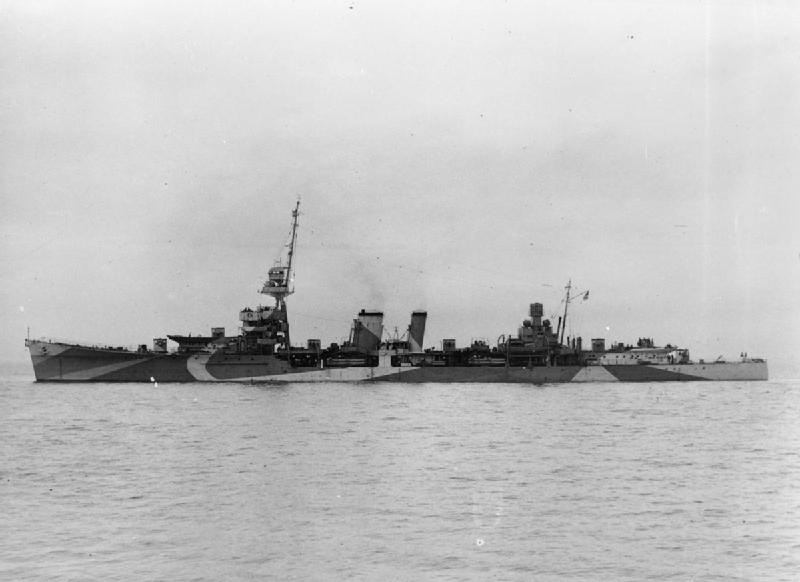
HMS Durban, pennant D99, was a Danae-class light cruiser. She was ordered from Scotts of Greenock in July 1917, laid down in January 1918, launched on 29 May 1919, and completed on 1 September 1921. Between the wars she spent most of her commissions on foreign stations, including China, and she was in reserve in 1936 before being brought forward again. In March 1942 the people of Finsbury adopted her. Captain Peter Grenville Lyon Cazalet had her from 13 October 1941. He was in command when Japan entered the war.
She was already east of Suez. In February 1941 she had taken convoy US9, including Queen Mary, Aquitania, Mauretania and the Dutch liner Nieuw Amsterdam, out of Fremantle, and had gone on with Queen Mary to Singapore. She spent the spring on trade defence in the Malacca Strait and the Dutch islands, refitted at Singapore from July to August, and on 18 November relieved the Australian cruiser Sydney as escort for the torpedoed troopship Zealandia from the Sunda Strait to Singapore. On 8 December she was transferred to the 5th Cruiser Squadron. On the 19th she escorted the troopship that was taking survivors from Repulse and Prince of Wales to Colombo. On the 20th she joined the China Force and went back to Singapore.
On 5 January 1942 she embarked naval staff at Singapore for Batavia and on the 6th joined the striking force. On the 8th she sailed with Exeter and the Indian sloop Jumna for Addu Atoll, to thicken the escort of convoy DM1, the first of the convoys bringing reinforcements to Singapore after the invasion of Malaya. The Dutch cruiser De Ruyter and the destroyers Encounter, Jupiter and Vampire joined on the 10th. She left DM1 at Singapore on the 13th. On the 19th she took another troopship out of Singapore with survivors from Repulse. The line does not name the port.
On 6 February she and Dragon relieved the Australian cruiser Canberra off Christmas Island, south of Java, as escort for convoy MS3 toward Palembang. On the 10th she sailed for Singapore with Jupiter, Stronghold and the auxiliary Kedah to take off Royal Air Force personnel, and on the 11th she was bombed on the way in. On the 12th she was escorting coastal steamers of evacuees out of Singapore and was bombed again, north of the Sunda Strait. A hit forward put a 6-inch mounting out of action. The chronology gives no count of killed or wounded. On the 16th she was withdrawn at Batavia, took a merchant ship part of the way to Colombo, and on the 17th was detached for Fremantle.
She was clear of the Java Sea fighting. On 13 March, on passage in the Indian Ocean, she intercepted the German ship Doggerbank, which was laying mines off Cape Town. The ship answered the challenge with the name of the British Leverbank and was allowed to go. Durban went on to the United States to repair the bomb damage, calling at the Azores, and on 9 April she was under repair in a United States Navy yard at New York. The work included preparation for radar. She worked up at Scapa Flow in September for the 5th Cruiser Squadron and the Eastern Fleet. On 4 October she joined military convoy WS23 in the Clyde as ocean escort, with Despatch and the armed merchant cruiser Queen of Bermuda. She was detached before Freetown and rejoined on 20 October for the passage to Durban, where she arrived on 5 November. She stayed on Indian Ocean trade defence and went into Bombay on 30 December for refit and repair. Cazalet had left her on 26 September 1942. Captain George Frederick Stevens-Guille had her from that day.
Stevens-Guille brought her out of the Bombay refit in March 1943. On 5 April she joined military convoy MS27 and on the 28th she was at Bahrein on Persian Gulf convoy defence, which continued through May. From June to September she was back on the Indian Ocean run from Kilindini. On 23 October she sailed from the Seychelles for home. She reached Portsmouth in November and in December was reduced to care and maintenance. He left her on 19 November 1943. Commander Peter Keith Wallace, retired, had her from 19 November to 28 December, and Commander Richard Charles Stokes, retired, from 28 December 1943 to 6 April 1944. She had been nominated, after a refit, to be sunk as part of Gooseberry No. 5 off Ouistreham. The main armament was kept, and 24 Oerlikon guns were fitted.
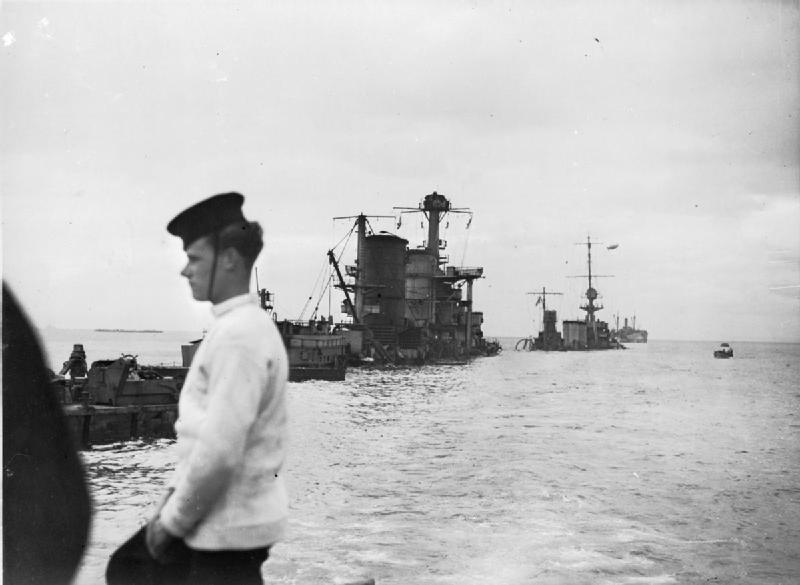
Acting Commander John Andrew Agnew took her on 6 April 1944. Uboat.net gives him no relief date. On 27 May she was at Oban with the blockships. She sailed for the Channel on 2 June, was held at Poole when the operation was put back a day, and on 9 June was sunk as part of Gooseberry No. 5 in the British assault area, the breakwater off Ouistreham. She was senior officer's ship for the Corncob blockships until the harbour was established. On 3 August the hulk was hit by a German torpedo during attacks on the beachhead. She had already been expended. She was not lost in action against Japan.
A note on sources. The East Indies convoy work, the February 1942 bomb damage, the Doggerbank interception and the Normandy blockship are from Geoffrey Mason's service history on naval-history.net, saved as a digitized copy. Uboat.net, saved with it, gives pennant D99, the Scotts builder, the launch on 29 May 1919, and the commanding officers. Mason dates completion to 1 September 1921. Uboat.net says she was commissioned on 1 November 1921 and completed by Devonport Dockyard. The September date is the one used. Uboat.net places the wreck at 49°21' N, 0°16' W, and also at 49°20'44" N, 0°16'08" W. Mason gives no position. The 12 December 1941 line prints Suda Strait, which is not used. The rest of that month on the same page is Singapore and Colombo. The convoy numbers U523 and W323 are printed as they stand. No figure for men lost to the February bomb or to the August torpedo was in these pages.