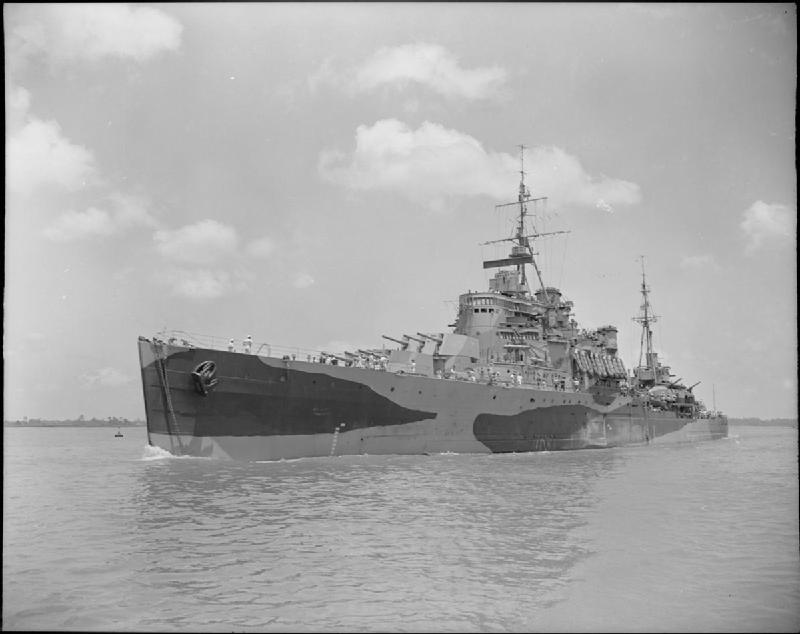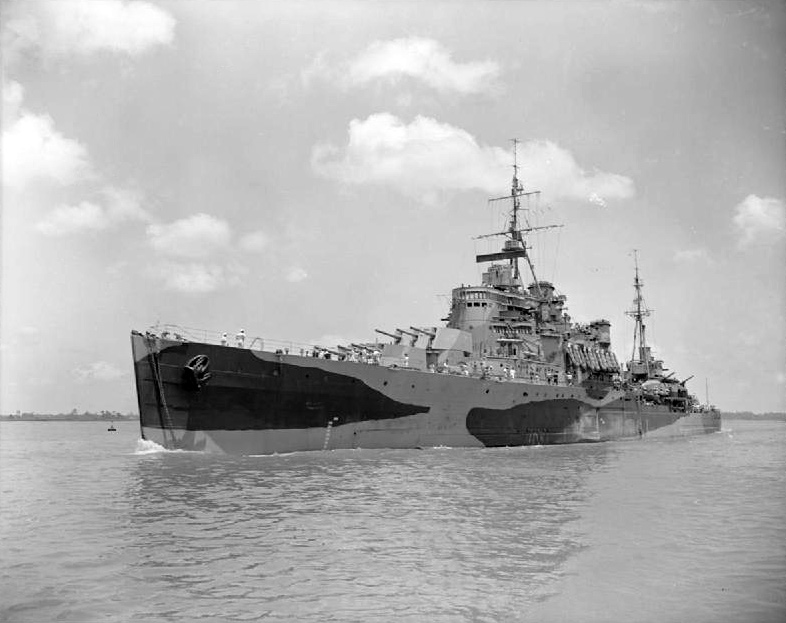
Nigeria was a Fiji-class light cruiser, pennant 60. Vickers-Armstrong at Newcastle upon Tyne laid her down on 8 February 1938 under the 1937 Estimates. Uboat.net dates the order 20 December 1937 and names Parsons as the engine builder. She was launched on 18 July 1939. The naval-history chronology gives build completion on 30 September 1940, when acceptance trials began, and work-up with the 10th Cruiser Squadron at Scapa Flow from 28 October. Uboat.net's ship page dates commissioning 23 September 1940, the day an event says she was accepted from the shipyard. An earlier event says she was commissioned at High Walker at 0900 on 3 September 1940, with Captain John George Lawrence Dundas. Ayrshire adopted her in 1942 after a Warship Week. The battle-honour line reads Atlantic 1941, Norway 1941, Arctic 1942, Malta convoys 1942, Sabang 1944, and Burma 1944–45.
Dundas had her from 18 June 1940 until 28 June 1942. Through 1941 she was on Atlantic and Home Fleet work: minelaying cover in the Northern Barrage, the Lofoten raid Claymore in March, and a Denmark Strait patrol with Fiji. On 28 June she intercepted the German weather ship Lauenburg with Tartar. The weather ship fired her scuttling charges. A boarding party from Tartar recovered the Enigma books before she sank. On 7 September, in a sweep off Norway with Aurora, she engaged a small convoy near the place the chronology prints as Porshanger Fjord and sank the German training ship Bremse. The troopships got away in the weather. Her bow was damaged. A note on the chronology says a post-war analysis suggested she may have detonated a mine. She repaired on the Tyne into November, and the work included a Type 284 fire-control radar for the forward 6-inch.
She was back with the 10th Cruiser Squadron in January 1942 and spent the spring on the Arctic convoys, including distant cover for PQ 17 with Duke of York, the American battleship Washington, Victorious and Cumberland, until the Admiralty scattered that convoy on 4 July. Captain Stuart Henry Paton relieved Dundas on 28 June 1942. In August she was detached with Nelson, Victorious, Kenya, Manchester and Cairo for Pedestal, the military convoy WS 21S to Malta. The chronology puts her in Force X at Gibraltar on the 10th. On the 11th the force was under submarine attack and Eagle was sunk. The chronology dates Nigeria's torpedo hit from the Italian submarine Axum on the 13th, while she was entering the Skerki Channel during air attacks. The damage was serious. She was detached with the escort destroyers Wilton, Bicester and Derwent and reached Gibraltar on the 15th for temporary repair. Permanent repair was arranged in the United States. She sailed on 7 October and was taken in hand at the Charleston Navy Yard on the 23rd. The refit note says the aircraft fittings came out, and that the yard prepared her for a later British fit of anti-aircraft fire-control radar, for replacing the Type 279 air-warning set with Type 281, and for replacing the Type 272 surface radar.
The Charleston refit runs on the chronology from October 1942 through August 1943. She came home in September. Chatham finished the refit and the alterations and additions in October to December, and she was nominated for the Eastern Fleet's 4th Cruiser Squadron. She worked up at Scapa Flow in January 1944 and was still with the Home Fleet in February. In March she took passage to Ceylon and joined the squadron on the 27th. On 16 April she sailed with Newcastle, Ceylon, Gambia and the Dutch cruiser Tromp, escorting Queen Elizabeth, Valiant and the French battleship Richelieu as Task Force 69. That was Operation Cockpit. The note says those ships covered air attacks on airfields and other targets at Sabang in Sumatra by Illustrious and the American carrier Saratoga. On 6 May she joined Newcastle and Tromp as escort for Queen Elizabeth, Valiant and Richelieu, Task Force 65, covering Illustrious and Saratoga against the oil refineries at Surabaya, which the chronology prints as Soerabaya. That was Operation Transom. She replenished in Exmouth Gulf on the 15th and screened the carriers during the attacks on the 17th. June was Indian Ocean patrol. In July she was with Kenya, Ceylon and Gambia, escorting Queen Elizabeth, Valiant, Renown and Richelieu for the bombardment of Sabang, Operation Crimson. On the 25th she was detached to escort the submarine depot ship Maidstone to Fremantle. August and September were convoy defence. She sailed from Fremantle for Trincomalee on 11 October. In November she joined the 5th Cruiser Squadron of the Eastern Fleet when the British Pacific Fleet was formed. On 1 December she was in Force 61 with Kenya, Newcastle and Phoebe for the Burma operations.
Uboat.net keeps Paton until 24 June 1944 and starts Captain Henry Alexander King that day. The Navy List compilation dates King from 1 May 1944, still in the ship in July 1945, with his next appointment on 1 April 1946. The January 1945 diary is the Eastern Fleet coast of Burma. On the 1st she was with the escort carrier Ameer, Newcastle, Phoebe and three destroyers for the 3rd Commando Brigade landing on the Akyab peninsula, Operation Lightning. The chronology says gunfire support was not required because the Japanese had left. On the 22nd she embarked Royal Marines at Akyab for Cheduba. On the 26th she landed them and supported the operation with Newcastle and Kenya, screened by Rapid and Paladin. That was Operation Sankey. On the 31st she re-embarked the Marines and bombarded the west coast of Ramree with Kenya and Newcastle. February was the passage to Simonstown. March was refit and rest. She was back at Ceylon on 3 May, having called at Durban. On the 13th she sailed with Roebuck, Racehorse and Redoubt as Task Force 62 to reinforce Force 61 in an operation to intercept Japanese evacuation craft, and she returned to Trincomalee on the 18th. On 5 July she joined Ameer and Emperor to cover minesweeping, with Roebuck, Eskimo and Vigilant. That was Operation Collie, preparation for landings on the Malayan coast. She bombarded Car Nicobar during the sweep and bombarded Nancowry on the 15th.
In August she prepared for operations in the Malacca Strait. On 15 August 1945 she joined Nelson and the escort carriers Attacker, Hunter, Shah and Stalker for the passage to Penang for the occupation. The landings were delayed on passage. The chronology gives the reasons as political pressure by the United States and the Python release scheme for South East Asia Command personnel. She returned to Trincomalee with Shah and Stalker on the 24th to refuel. She was not sunk. On 9 September, after the surrender, she covered the landings north of Port Dickson with Nelson, Richelieu, Ceylon, Cleopatra and the 21st Carrier Squadron, Operation Zipper. She remained in commission, came home from the East Indies in 1945, and from 1946 to 1950 was flagship on the South Atlantic Station at Simonstown. She paid off in 1951 and went into reserve. In 1954 she was sold to the Indian Government for £300,000. Cammell Laird at Birkenhead refitted her in 1955 and 1956. The chronology commissions her on 29 August 1957 as INS Mysore, flagship of the Indian Navy. Uboat.net says she was sold to the Indian Navy on that same day and renamed Mysore, and that the Indian Navy decommissioned her on 20 August 1985. Mason's later summary says she was a training ship after fleet duties and was then scrapped, and the year block 1975 to 1980 says she was sold for breaking-up.
A note on sources. The operations follow the naval-history.net service history by Lieutenant-Commander Geoffrey B. Mason That page is a digitized copy. It prints Scapa Flew, CA1RO, Soerabaya, OP13 for the returning Arctic convoy, Woodhead on the Malta Convoys citation, IS MYSORE in the summary and INS MYSORE on 29 August 1957, and a doubled radar-modernisation note for the Birkenhead refit. It names no commanding officer. Dundas, Paton and King, and the uboat.net command dates, are the ship page. Where those dates disagree with the Navy List compilation, the command lines follow unithistories.com: Dundas 18 June 1940 to 28 June 1942, which matches uboat.net; Paton relieved on 1 May 1944, where uboat.net says 24 June 1944; King from 1 May 1944, where uboat.net says 24 June 1944. Uboat.net ends King on 12 April 1946. Unithistories starts his next appointment on 1 April 1946. The Axum hit is the 13th on Mason's page, in the Skerki Channel, with no position and no casualty figure. The uboat.net ship event dates it 12 August 1942, one hit, in 37°26'N, 10°22'E. The Italian submarine page saved as uboat-axum.html dates it 12 August 1942 at 1955 in 37°36'N, 10°22'E, and says fifty-four killed or missing and two wounded. Commissioning is 23 September 1940 on the uboat.net header, the day she was accepted from the shipyard. The same site says she was commissioned at High Walker on 3 September 1940. Mason's completion date is 30 September 1940. Laid down, 8 February 1938, and launched, 18 July 1939, agree. An addendum on Mason's page, from Commander David Hamilton's midshipman's journal, dates the sailing for Fremantle, which it prints Freemantle, as 25 August 1944 with Maidstone, and the main diary detaches her to escort Maidstone on 25 July. No slug in the battle list is Cockpit, Transom, Crimson, Lightning, Sankey, Collie or Zipper. The April 1942 indian-ocean raid does not include her. She was in home waters, then from October at Charleston. She was not with Task Force 57 off Okinawa.