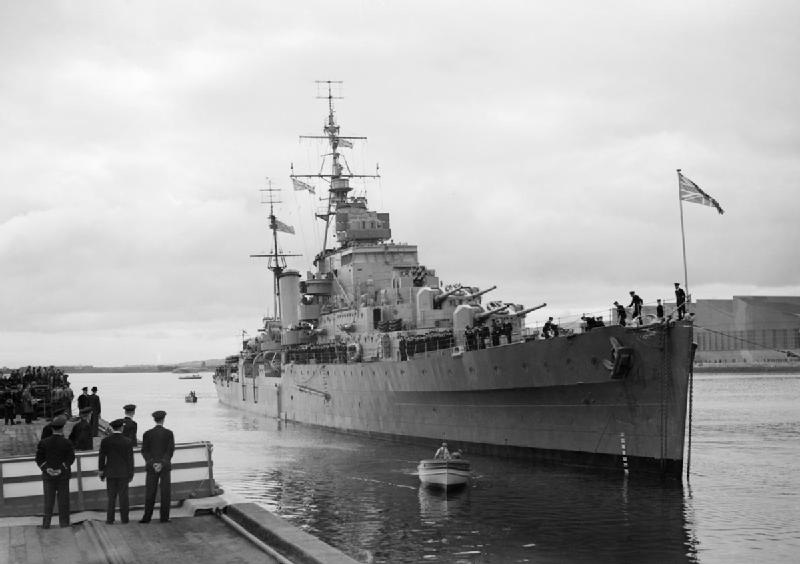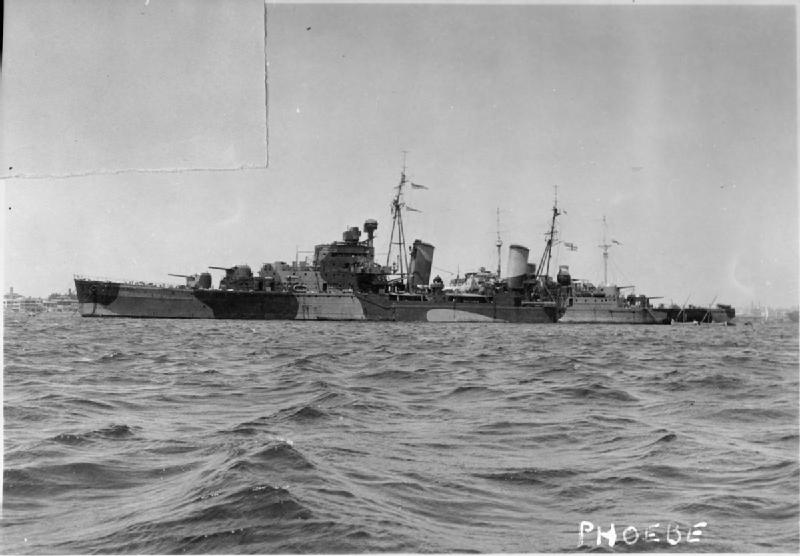
HMS Phoebe, pennant 43, was a Dido-class anti-aircraft cruiser, the seventh ship of the name. The Fairfield Shipbuilding and Engineering Company at Govan laid her down on 2 September 1937, launched her on 25 March 1939, and completed her in September 1940. The naval-history.net chronology dates build completion and the start of acceptance trials to 30 September. After a Warship Week she was adopted by Bournemouth. She was armed as an anti-aircraft cruiser and, late in the war, was fitted as a fighter-direction ship.
Her war against Japan came only after three years in other seas. On 27 August 1941, off Bardia, while she was on the run that kept the Tobruk garrison supplied, an Italian air attack put a torpedo into her starboard side forward. The hit flooded compartments. She was patched at Alexandria and sent to the United States for permanent repair. Commander Frank Arthur Ballance had her from 17 September 1941, so he was in command when Japan entered the war. She was then under repair, not in the East. Captain Charles Peter Frend relieved him on 10 March 1942.
Frend took her back to the fleet. In August 1942 she worked with the carriers in Exercise Berserk and then in Force 2 of Operation Pedestal, the Malta convoy, covering the ships as far as the Skerki Channel with Nelson, Rodney, Victorious, Indomitable and Eagle. On 23 October 1942, on passage to Freetown, she was hit abreast Q turret on the port side forward by a torpedo from U161 off Pointe Noire. The chronology records major structural damage and flooding, and all the forward turrets unusable. Sirius took her into Pointe Noire at six knots. B turret was taken out during temporary repairs. She was repaired at the Brooklyn Navy Yard from 15 January 1943 and then at Vickers-Armstrong, Barrow, where A turret was replaced and new radar was fitted. In January 1944 she was off Anzio with the cruiser bombarding force for Operation Shingle. In March she was nominated for the Eastern Fleet and converted at Alexandria for fighter direction.
She arrived at Trincomalee on 2 June 1944 and joined the 4th Cruiser Squadron. On 22 July she sailed with Valiant, the French battleship Richelieu, Renown and the squadron to cover Illustrious and Victorious in the air attack on Sabang, Operation Crimson. On the 25th she was in the screen for those two carriers, with the destroyers Roebuck and Raider, during the strike on the airfields, and she bombarded shore targets with the other Eastern Fleet ships when the aircraft were done. Frend left her on 4 August 1944, while she was under repair at Bombay. Captain Sidney Moffat Raw took her. She rejoined the squadron on 12 September.
On 17 October 1944 she was in Task Group 63.3 with Indomitable and Victorious and the destroyers Whelp, Wakeful, Wessex and Wager for air attacks on the Nicobar Islands, Operation Millet, a diversion for the American landings at Leyte. The strikes were flown on the 19th. On 17 November she joined Force 64 as the fighter-direction ship for the Arakan landings, Operation Avon. In December she was with Newcastle, Kenya and Nigeria in the 5th Cruiser Squadron of the East Indies Fleet, the name given when part of the Eastern Fleet went to the British Pacific Fleet. Phoebe stayed in the Indian Ocean.
In January 1945 she was in Task Force 61 for the Akyab landing with Newcastle and Nigeria. The Japanese had already gone, and the bombardment was not fired. On the 12th she directed fighters for the 3rd Commando Brigade between Akyab and Ramree. On the 17th she embarked troops at Chittagong for Ramree. On the 21st she was in the bombardment group with Queen Elizabeth, the destroyer Rapid and the sloops Flamingo and Kistna for the landings on the north of Ramree, the operation the chronology calls Matados. On the 24th she directed fighters for the escort carrier Ameer while Royal Marines landed on Cheduba, Operation Sankey.
On 30 April she sailed with Royalist and the 21st Carrier Squadron to cover the assault at Rangoon, Operation Dracula. On 1 May she was the fighter-direction ship off the beaches. On the 5th she was with that carrier squadron, Hunter, Stalker, Emperor and Pursuer, for attacks on Japanese positions along the Burma coast between Mergui and Victoria Point. On the 11th she supported Royal Indian Navy sloops hunting ships leaving the Andamans, then joined Force 69 and patrolled between the Andamans and Burma.
Through June and July she stayed on patrol and exercised with the East Indies Fleet for the planned Malayan landing, Operation Zipper, which was held back. In September she was in the Bay of Bengal covering the assault convoys when Zipper went ahead. She was not kept in the East Indies Fleet. She sailed for home during September and reached Chatham on 29 October 1945 for a refit. She later served in the Mediterranean and did not pay off into reserve until 1952. In 1956 she was sold to BISCO and arrived in tow at Blyth on 1 August to be broken up by Hughes Bolcow. She was not sunk.
A note on sources. The movements, the two torpedo hits, the Eastern Fleet operations and the 1952 reserve and 1956 sale are from Geoffrey Mason's service history on naval-history.net, saved as a digitized copy. Uboat.net, saved with it, gives pennant 43, the builder as Fairfield at Govan, the launch on 25 March 1939, and the commanding officers. It dates commissioning to 27 September 1940, and a separate entry says she was commissioned for trials on 9 September 1940. Mason's 30 September is the date used for completion. Uboat.net's header gives an end of service on 14 March 1951 and then says she was decommissioned on 14 March 1953. Neither date is used. Mason is followed for the reserve in 1952 and the arrival at Blyth. The name of the submarine is printed U161 on Mason's page and U-161 on uboat.net. Mason's 27 January 1945 line for Operation Dracula is rejected in favour of his own 30 April line, Royalist's 28 April line, and uboat.net's report that Phoebe anchored off Rangoon on 1 May 1945. Mason gives no casualty figure for either torpedo hit. Uboat.net's event for 23 October 1942 says forty-two of her company were killed off Pointe Noire. That figure is not used in the narrative.