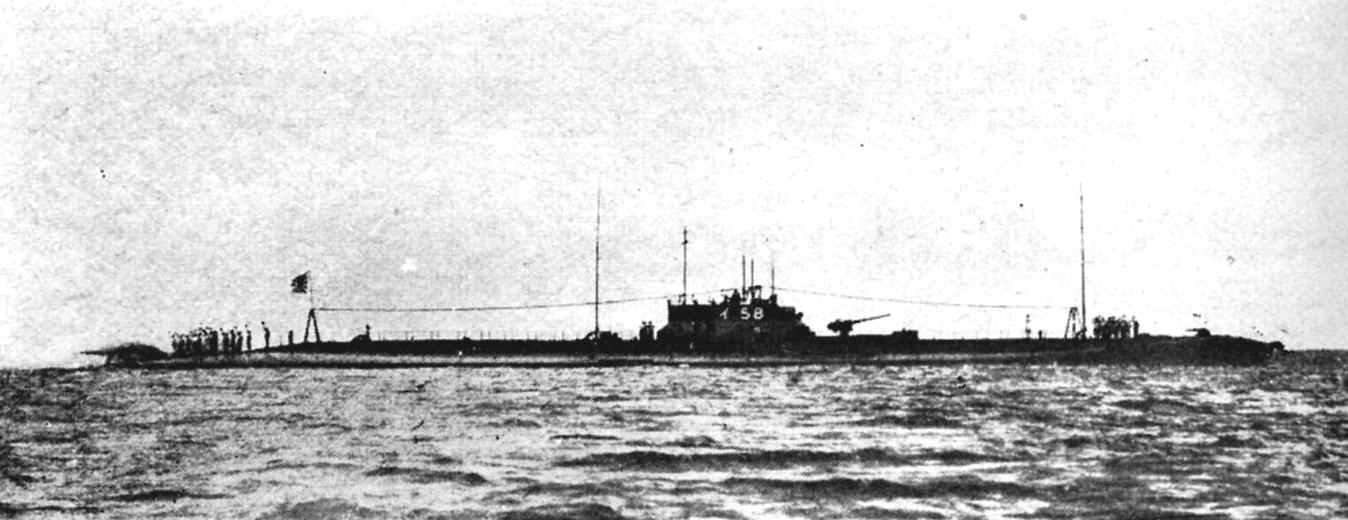
I-158 was a Kaidai cruiser submarine, built at Yokosuka as I-58. The keel was laid on 3 December 1924. She was launched on 3 October 1925 and commissioned on 15 May 1928. She is not the later I-58, the boat Mochitsura Hashimoto had in 1945 when he sank Indianapolis. This hull kept the old number until 20 May 1942. On 26 August 1940, south of Tokyo Bay, she started a crash dive on a night exercise and the bridge party did not clear in time. Signalman Masao Hirose shut the hatch from the outside so the boat would not flood, and he was killed.
Soshichi Kitamura took her on 31 October 1941. In December she was on the Malaya patrol line with other boats off Trengganu. Just after midnight on 10 December, about 140 miles east of Kuantan, her lookouts saw Force Z close aboard. She dived. Kitamura tried a full salvo at Prince of Wales. The outer door of the first tube jammed, and the battleship went by. He fired the rest at Repulse and missed. He reported the ships heading south-southwest at 24 knots. Sendai passed that report on. By dawn he had lost them. That afternoon shore-based naval aircraft sank Prince of Wales and Repulse. This boat did not.
The next two months were a commerce patrol in the Dutch islands. On 3 January 1942, northwest of Bawean, she torpedoed the Dutch merchant Langkoeas and finished the ship with gunfire. About ninety men got off. Some of the boats were machine-gunned. Three survivors were taken aboard, questioned by Kitamura, and put back in the sea. They reached Bawean. On 5 January a torpedo from a submarine she never identified grazed her side. On 9 January, west of Bawean, she sank the Dutch merchant Camphuys. Paul Jones picked up the survivors. On 22 February, between Cilacap and Padang, she sank the Dutch passenger ship Pijnacker Hordijk. On 25 February, south of the Sunda Strait, a Dutch escort drove her down before she could finish a gun attack on the Dutch merchant Boeroe. She came back and hit Boeroe with two torpedoes. All seventy of that crew got off. On 28 February she torpedoed the British tanker British Judge, ten miles south of the Sunda Strait, and did not sink her. She was back at Kure on 20 March.
She left Kure on 14 May 1942. On 20 May, still on the way to Kwajalein, she was renumbered I-158. She reached Kwajalein on 24 May and sailed on 26 May for the submarine line east of Midway, between 28°20′N, 162°20′W and 26°00′N, 165°W, with I-156 and the other old boats of the squadron. She made no attack. She was back at Kwajalein on 19 June and at Kure on 30 June. From 10 July she was a training boat for the Kure submarine school. Kitamura left on 25 July. One officer list puts that relief on 24 July. The captain appointed that day is Susumu Otsuka in the patrol account and Hiroshi Otsuka in the officer list. The class number is the same. Masahiko Morinaga had her from 25 November 1942.
Hashimoto took her on 16 March 1943, from Ro-31, for the same home-water work. The officer list dates that tour from 15 March to 24 July. The patrol account gives 16 March to 25 July, when Yoshitaka Takeuchi relieved him. She did not fight under Hashimoto. In January 1944 the next captain’s name is not the same in the two lists, Jun in one and Atsushi in the other, so he is not filed here. Seiji Masuzawa, the next man both lists name, had her from 30 April 1944. Yasuo Go followed on 14 October, and Takehiro Tateyama on 5 February 1945. Those three reliefs are a day earlier in the officer list.
On 17 March 1945, at the Mitsubishi yard in Kobe, B-29s damaged her lightly. While she was under repair she was fitted to carry two kaiten. She was back in service on 20 April. The crews trained to launch those boats against an invasion that did not come. No attack is recorded. She was at Kure on 2 September 1945 and surrendered there with the other boats still afloat. She was struck on 30 November 1945. In Operation Road’s End the tender Nereus towed her out of Sasebo, and she was scuttled on 1 April 1946 off the Goto Islands, at 32°37′N, 129°17′E, with the other large boats that had survived.