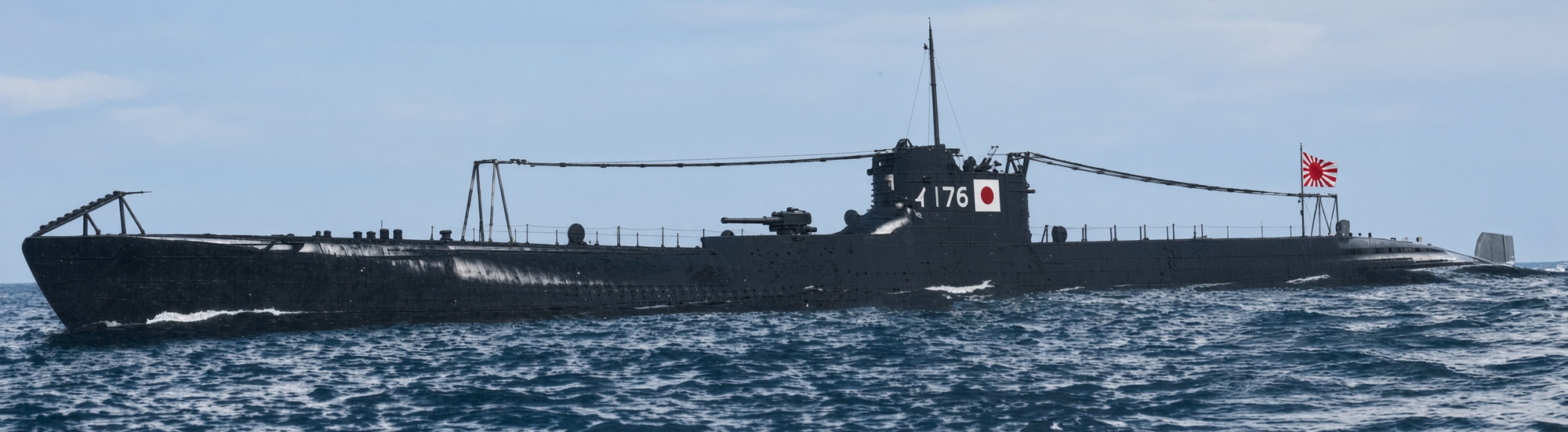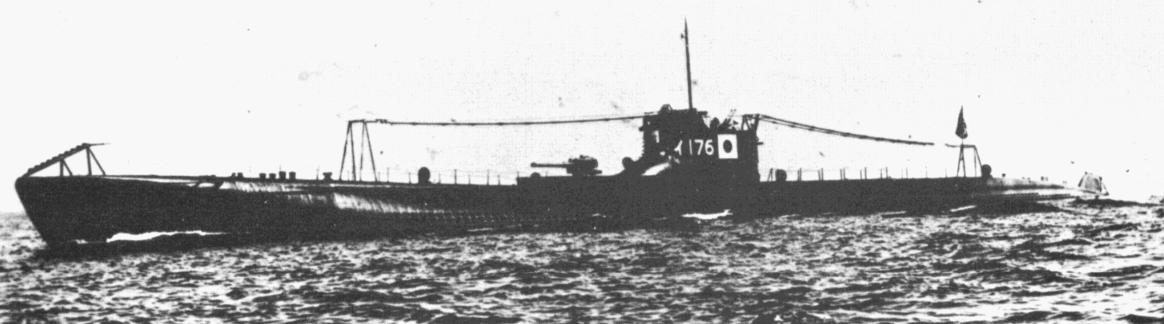
I-176 was a Kaidai Type 7 cruiser submarine, and the most successful boat of that class. She put a heavy cruiser out of the war for a year, made the first submarine supply run into Guadalcanal, and is the only Japanese submarine that sank an American one. American destroyers killed her off Buka in May 1944.
She was ordered in 1939 as I-76. Kure Naval Arsenal laid her down on 22 June 1940, launched her on 7 June 1941, and commissioned her on 4 August 1942. On 20 May 1942, before she was finished, the Navy renumbered the cruiser submarines and she became I-176. A KD7 was a fleet boat, not a coastal one: 1,630 tons surfaced and 2,602 submerged, 346 feet, two diesels on two shafts for 23 knots on the surface and 8 submerged, and a range of about 8,000 miles at 16 knots. Test depth was 80 meters, about 260 feet. She carried six bow tubes, twelve torpedoes, a 120 mm deck gun, and two 25 mm guns. Designed crew was 86.
She reached Truk in September 1942. On 13 October an American carrier group was sighted off the Solomons, and the submarines in the area were sent north. I-176 was the only one that hit anything. On 20 October, about 120 miles southeast of San Cristobal, she torpedoed the heavy cruiser Chester (CA-27) at 13°31′ S, 163°17′ E. The hit wrecked a boiler room. Eleven men were killed and twelve wounded. Chester patched up in Australia, then had to go to Norfolk. She was out of the war until September 1943.
After that she was altered for supply work. The deck gun came off, and fittings went on for a landing craft. In December 1942 she made the first successful submarine resupply of the Guadalcanal garrison. A second run in January failed. On 19 March 1943 she was unloading at Lae, on the New Guinea coast, when B-25s caught her. Machine-gun fire wounded her captain, Yahachi Tanabe, the officer who had commanded I-168 at Midway and finished Yorktown (CV-5). The pressure hull was punctured, the conning tower and radio room were holed, and a signalman and a petty officer were killed. Tanabe gave up command a few days later. She went home for repairs. From July to October 1943, under a new captain, she ran supplies into Lae, Sio, and Finschhafen and got away with it.
In November she was ordered to Truk. American codebreakers read the order and warned the submarines already working that water, Corvina, Drum, and Blackfin (SS-322) among them. On the way I-176 reported that she had taken a torpedo hit and was undamaged. The torpedo had almost certainly come from an American boat, and it had failed to explode. On the night of 16 November, about 300 miles south of Truk, Lieutenant Commander Kozaburo Yamaguchi was running partially flooded at 16 knots in bright moonlight. At 11:12 p.m. lookouts saw a dark shape to the northeast, 8,800 yards off. He closed. At 1:20 a.m. he fired three torpedoes. Two hit. The target was Corvina, on her first patrol, 82 men aboard. Yamaguchi surfaced, found oil and debris, and entered Truk on the 18th to a hero’s welcome. Corvina was the only American submarine sunk by a Japanese submarine in the war. The Navy did not announce the loss until 14 March 1944. Captured records after the war identified the killer.
She overhauled at Kure from the end of November 1943 to mid-March 1944, returned to Truk in April, and was sent to Buka, at the north end of the Solomons, for another supply run. A patrol plane spotted her. The report brought the destroyers Franks (DD-554), Haggard (DD-555), and Johnston (DD-557). On the night of 16 May, off Buka, Haggard gained sonar contact at 4°01′ S, 156°29′ E and started depth-charging. The other two joined. The attacks ran for hours. Haggard was shaken by her own charges. The next morning the three ships found a long oil slick, sandalwood, cork, a sandal, and paper with Japanese writing. There were no survivors. About a hundred men went down with her. Tokyo presumed her lost on 11 June and struck her on 10 July 1944.