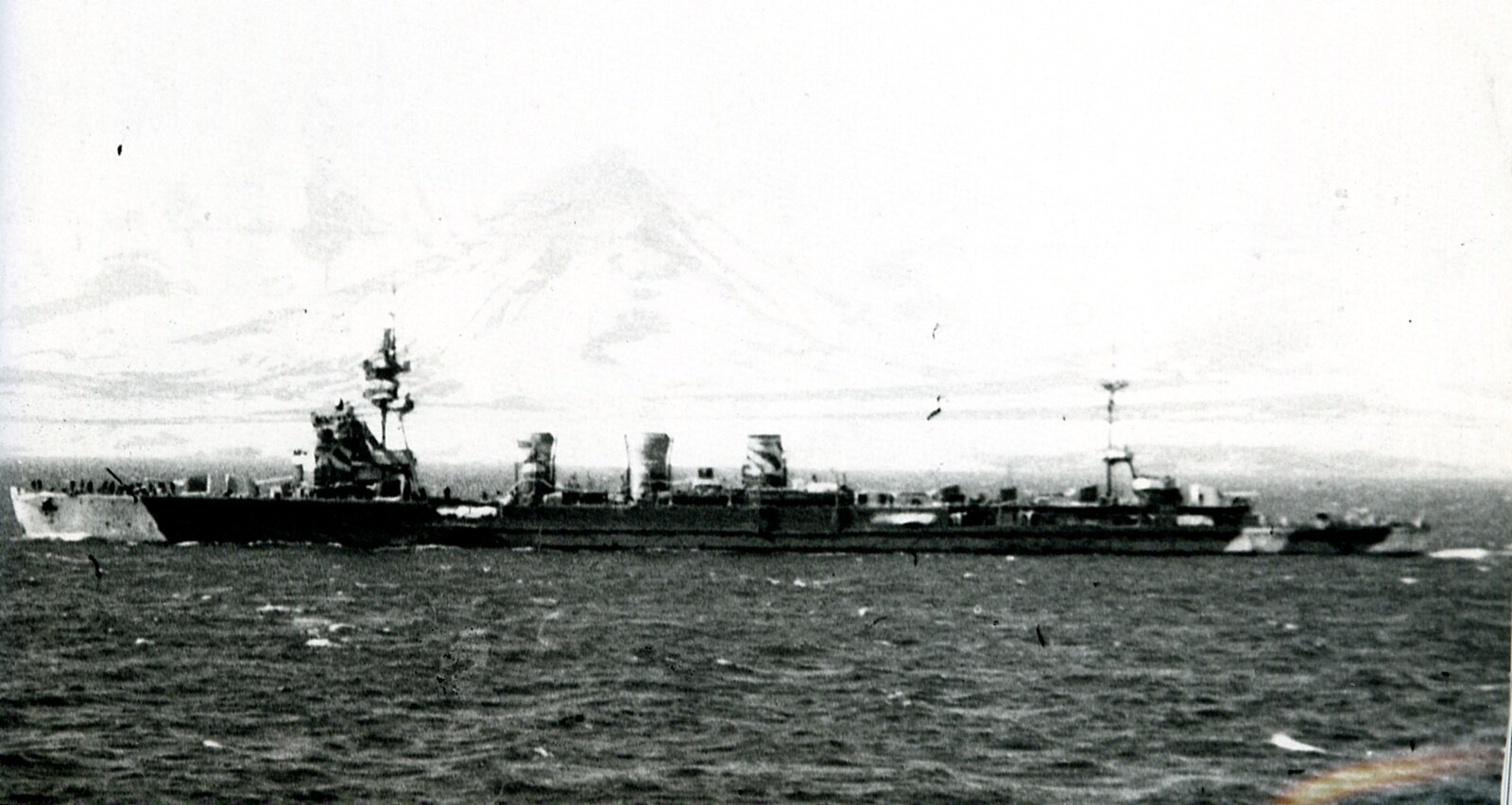
Kiso was the last of the five Kuma-class light cruisers and was named for the Kiso River in central Honshu. Mitsubishi at Nagasaki laid her down on 10 June 1919 and launched her on 14 December 1920, and she was completed on 4 May 1921. She differed from her sisters in carrying a hangar under the bridge and a flying-off platform forward for a landplane.
Captain Takeji Ono took command on 10 November 1941. She was in Cruiser Division 21 with Tama in Vice Admiral Boshiro Hosogaya's Fifth Fleet, which guarded the northern approaches to Japan. For the cold, both cruisers were painted with white patches on the bow, stern and upperworks. She was at sea in the Kuriles when the war began and was damaged by heavy weather. On 18 April 1942, after the Doolittle raid, she went out after Halsey's carriers and did not find them, and on the 19th she sank the damaged guardboat Nanshin Maru No. 26.
In June 1942 Captain Ono led the force that landed troops on Kiska. On 10 June six B-24s came over Kiska harbor below the overcast. The ships' antiaircraft fire hit the leading plane and it blew apart, and Kiso was not hit. For the next year she carried troops and supplies between Paramushiro, Attu and Kiska, often with Abukuma and the destroyer Wakaba. Captain Iwao Kawai took over on 20 September 1942. In January 1943 she was turned back short of Kiska when the Americans landed on Amchitka.
After Attu fell in May 1943, the Navy decided to take the Kiska garrison out. The first attempt in July was called off for weather. The second reached Kiska on 29 July, and the ships anchored off Kiska and embarked the garrison. Kiso alone took 1,189 men. The ships were back at Paramushiro by 1 August, and American and Canadian troops landed on an empty island on 15 August.
In the autumn she was sent south with Tama carrying troops of the 17th Division from Shanghai to Rabaul. In late October 1943, about 53 miles from Cape St. George on the way back, RAAF Beaufort bombers hit her in the starboard engine room with a 250-pound bomb. Tama took her in tow toward Rabaul. After temporary repairs she went home by way of Truk. In Japan she was rearmed for antiaircraft work, with two of her 140-millimeter guns replaced by a twin 127-millimeter mount and many more 25-millimeter guns. Captain Takeo Sawa had taken over in October 1943, and Captain Ryonosuke Imamura followed on 7 February 1944. In 1944 she carried troops to the Bonins and Chichi Jima.
In November 1944 she was sent to Manila with a convoy carrying ammunition for Admiral Kurita's battered fleet, and on the 10th she became flagship of Destroyer Squadron 1 in place of the lost Abukuma. On 13 November, as she got under way to carry Vice Admiral Kiyohide Shima and his Fifth Fleet staff to Brunei, Task Force 38 struck Manila Bay with more than 350 aircraft. Between 0800 and 0923 three bombs hit her on the starboard side, one in the bow, one near the boiler rooms and one near the after guns. She lost all power, and by 1330 her decks forward were awash. She settled in shallow water eight miles west of Cavite. Eighty-nine men were killed and 105 wounded, most of them from the Fifth Fleet staff. Captain Imamura and most of her crew survived. She was struck from the Navy List on 20 March 1945. A Japanese salvage company raised her wreck in December 1955 and broke it up at Manila in 1956.
A note on sources. This history follows the Tabular Record of Movement for Kiso by Bob Hackett and Sander Kingsepp at combinedfleet.com. The commanding officers come from that record and from the list of captains in the Japanese Wikipedia article on Kiso. The two agree on dates. The record spells the third wartime captain's given name Takeo; the Japanese list writes it 勇夫, which can also be read Isao. The date of the bomb hit near Cape St. George in October 1943 is not clear in the copy of the record seen here, so it is given only as late October.