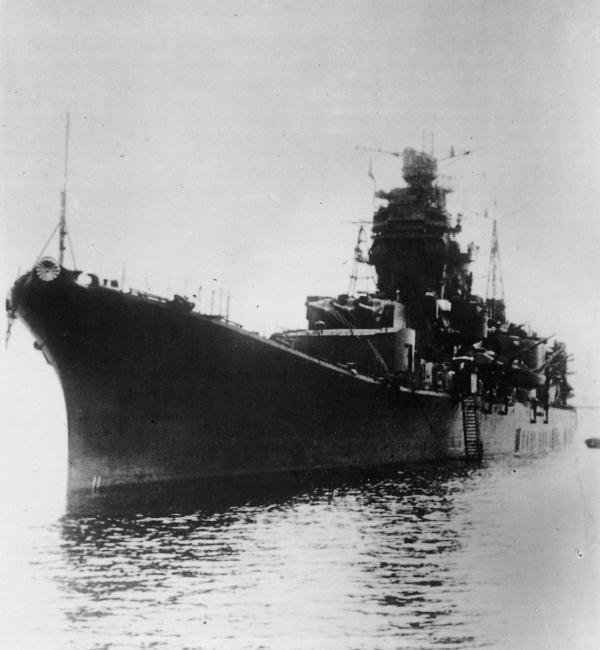
Oyodo was a light cruiser, and the only one of her design to be finished. A sister, Niyodo, was cancelled before she was laid down. She took her name from the Oyodo River. The Kure Navy Yard laid her down on 14 February 1941, launched her on 2 April 1942, and completed her on 28 February 1943. Captain Sadatoshi Tomioka had her at commissioning. She was drawn as a flagship for submarine squadrons. Two triple turrets of 155-millimeter guns stood forward, which left the stern free for a hangar and a long catapult meant for Kawanishi E15K floatplanes. She carried no torpedo tubes. Trials in February gave her 35.3 knots. The aircraft she actually carried were ordinary reconnaissance floatplanes, and the submarine-squadron job was already out of date when she joined the fleet.
She spent the spring of 1943 working up. In April the Kure yard fitted a Type 21 radar. In May she was in Tokyo Bay with the force that was to have gone north against the Attu landing, including Musashi, Zuikaku, and Agano. Attu fell before that force sailed. In July she went south carrying troops, with Zuikaku, Zuiho, Tone, Chikuma, Mogami, and Agano. Submarines sighted them on the passage. A spread from Tinosa was aimed at Zuiho and missed, and Pogy saw the ships without getting a shot. They entered Truk on 15 July unhurt. On 19 July she sailed again with Mogami, Tone, Chikuma, and Agano, landed troops at Rabaul on 21 July, and was back at Truk on 26 July. In September and October the fleet twice went out toward Eniwetok after American carrier raids and came home without a fight. She left a day behind the main body in September and caught up. On 24 October, southwest of Wake, she took aboard three men from a reconnaissance plane that had ditched.
On 30 December she left Truk for Kavieng with troops and guns. She got them ashore on the morning of 1 January 1944. Carrier aircraft caught her as she was leaving. A bomb struck and did not go off. Near misses hurt her. Two of the crew were killed and several were wounded, and the floatplane was too damaged to fly. On 2 January, northwest of Kavieng, she took 71 wounded men off the torpedoed transport Kiyosumi Maru and took that ship in tow. Both were at Truk on 4 January. After Kwajalein fell she left Truk on 10 February with Musashi, Admiral Mineichi Koga's flagship, and reached Yokosuka on 16 February. She loaded aircraft torpedoes and stores, put them ashore at Saipan on 22 February, and returned to Yokosuka on 26 February.
In March, at Yokosuka, she was rebuilt as flagship of the Combined Fleet. The hangar was turned into offices and berths for the staff. The long catapult came off and a shorter one went on. The Kawanishi floatplanes she had been designed for were never shipped. She received two Aichi E13A reconnaissance planes, more 25 mm guns, and a Type 22 radar. Work finished on 31 March. On 30 April Admiral Soemu Toyoda broke his flag in her. The staff lived aboard until 29 September. That day he moved them off the ship to a headquarters underground at Hiyoshi, on the grounds of Keio University near Yokohama. On 11 October she sailed from Yokosuka for the Inland Sea. On the night of 12 October Trepang fired six torpedoes at her. All missed. One hit Fuyutsuki.
On 25 October 1944 she was with Vice Admiral Jisaburo Ozawa off Cape Engaño, in the decoy force. She was the one ship in that force still carrying reconnaissance floatplanes. His flag started the day in Zuikaku. A bomb damaged a boiler room, and rockets hit her afterward. She took minor damage and was not sunk. The carriers around her were. After carrier aircraft crippled Zuikaku, he shifted the flag to Oyodo. During the night he turned back toward an American cruiser force and made no contact. On 27 October, in Sakawa Bay at Amami-Oshima, he shifted the flag again, to Hyuga.
Through November she moved between Manila, Brunei, the Spratlys, and Lingga, shifting troops and supplies. On 24 December she left Cam Ranh Bay with Ashigara and destroyers to strike the American beach at San Jose, on Mindoro. Bombers found the squadron on the night of 26 December. Two 500-pound bombs hit Oyodo. One failed to explode, and the other did only slight damage. She and Ashigara shelled the beach and a dump at the Kasuang River. Four transports were claimed. All four were still afloat. She entered Singapore on 1 January 1945 and stayed in repair there through 29 January.
Early in February she was sent north with the battleships Ise and Hyuga on Operation Kita, to bring cargo home from Singapore. She loaded rubber, tin, zinc, and mercury. Those stores came to 300 tons. Aviation gasoline added 70 tons, and 159 passengers came aboard. The ships left Singapore on the night of 10 February. Submarines caught them in the South China Sea. Torpedoes were fired and missed. One boat, still on the surface, was shelled by Hyuga and dived. On the morning of 20 February Oyodo arrived at Kure. She went to the Kure training force, and the floatplane crews were sent to Yahagi.
On 19 March 1945 carrier aircraft hit the fleet at Kure. Oyodo took three bombs. One exploded in the port engine room, set a fire, and wrecked boilers. Near misses split plating along the starboard side. She settled by the bow with a list of about fifteen degrees, and a tow beached her at Etajima. Fifty-two men were killed. Four of the boilers could not be put back. On 4 May she left the dock and was moored in Etauchi Bay, off Etajima, as a floating battery, partly camouflaged. On 24 July the carriers struck her again. Several bombs hit, near misses fell close, a fire started, and she took a slight list to starboard. She was still afloat. On 28 July the aircraft returned. Hits and near misses flooded her forward. At 1000 the starboard list became severe. Captain Masaichi Taguchi ordered the port spaces flooded so she might come upright. At noon she capsized to starboard in the shallows. Survivors abandoned her. Rockets hit the exposed hull later that afternoon. The attacks on 24 and 28 July killed 223 men and injured 180. That loss is not credited to one plane. She was taken off the Navy List on 20 November 1945. Raised in 1947, she was broken up at Kure in 1948.