Ships
- IJN Taiho Flag, not her captain, 19 June 1944
- IJN Zuikaku Flag, not her captain, 25 October 1944
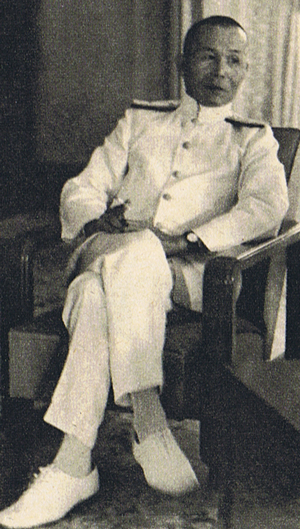
Jisaburo Ozawa was born on 2 October 1886 in rural Koyu County, Miyazaki Prefecture, on Kyushu. He graduated from the Imperial Japanese Naval Academy in 1909, forty-fifth in a class of 179, and started as a midshipman in the cruiser Soya, the battleship Mikasa, and the cruiser Kasuga. The torpedo was his specialty. He spent the next two decades in destroyers, on staffs, and as an instructor, and late in 1934 he was given the heavy cruiser Maya. The following year he commanded the battleship Haruna. On 1 December 1936 he was promoted to rear admiral.
In 1937 he served as chief of staff of the Combined Fleet. After that he led cruiser squadrons and headed the torpedo school, and from November 1939 he commanded the 1st Carrier Division. He pressed for the carriers to train and fight together as one air fleet instead of being split up among surface squadrons. Promoted to vice admiral on 15 November 1940, he had a short turn as head of the Naval Academy. On 18 October 1941 he took command of the Southern Expeditionary Fleet and the naval side of operations in the South China Sea.
Once the Pacific war began he covered the landings in Malaya and, in the opening months of 1942, the moves against Sumatra and Java. In April 1942 he led a raiding force built around the light carrier Ryujo into the Bay of Bengal, and the ships and aircraft under him sank more than twenty Allied merchantmen. On 11 November 1942 he relieved Chuichi Nagumo in command of the Third Fleet, the navy's carrier force, after the early carrier battles had already worn down Japan's trained aircrews. During part of that command Zuikaku was under Tameki Nomoto. Ichibei Yokokawa had been her captain at the time of the Pearl Harbor raid.
On 1 March 1944 Ozawa was given the First Mobile Fleet, the carrier force gathered for the defense of the Marianas. In April he moved his flag to the new armored carrier Taiho. He was not her captain. The ship was commanded by Tomozo Kikuchi, who had already captained Zuikaku. When American troops landed on Saipan, Ozawa brought the Mobile Fleet out for the Philippine Sea and sent its aircraft at long range against the United States Fifth Fleet. The strikes were broken up, and hundreds of Japanese carrier planes were lost.
On 19 June 1944 his flag was in Taiho. One torpedo from the submarine Albacore hit her. She stayed with the formation for hours while gasoline vapor spread below. That afternoon the vapor exploded, and Taiho sank. Ozawa left her and survived. His staff pressed him to transfer, and he went by destroyer to the heavy cruiser Haguro, then raised his flag in Zuikaku the next day. The same battle cost Japan the carrier Shokaku, sunk by another submarine, and what remained of her practiced carrier crews. Ozawa offered his resignation. It was not accepted.
In October 1944 the surviving Japanese carriers were sent to sea as a decoy. Ozawa's Northern Force, thin in aircraft and pilots, sailed to draw the American fast carriers north so that other Japanese squadrons could get at the invasion shipping off Leyte. On 25 October 1944 his flag was in Zuikaku, off Cape Engano. He was not her captain. Takeo Kaizuka commanded the ship. American carrier aircraft attacked through the day, and Zuikaku was sunk that afternoon. After her radios failed, Ozawa shifted his flag to the light cruiser Oyodo and came through the action. Kaizuka was lost with the carrier. Ozawa was not at Samar, not in the Sibuyan Sea, and not in Surigao Strait.
The carrier fleet he had commanded was finished as a fighting force. In November 1944 the Mobile Fleet was dissolved and Ozawa became vice chief of the Navy General Staff. In May 1945 he was appointed the last commander-in-chief of the Combined Fleet, by then mostly confined to harbor, and he held that post through the surrender. He remained a vice admiral, declining promotion to full admiral. He died in Japan on 9 November 1966.