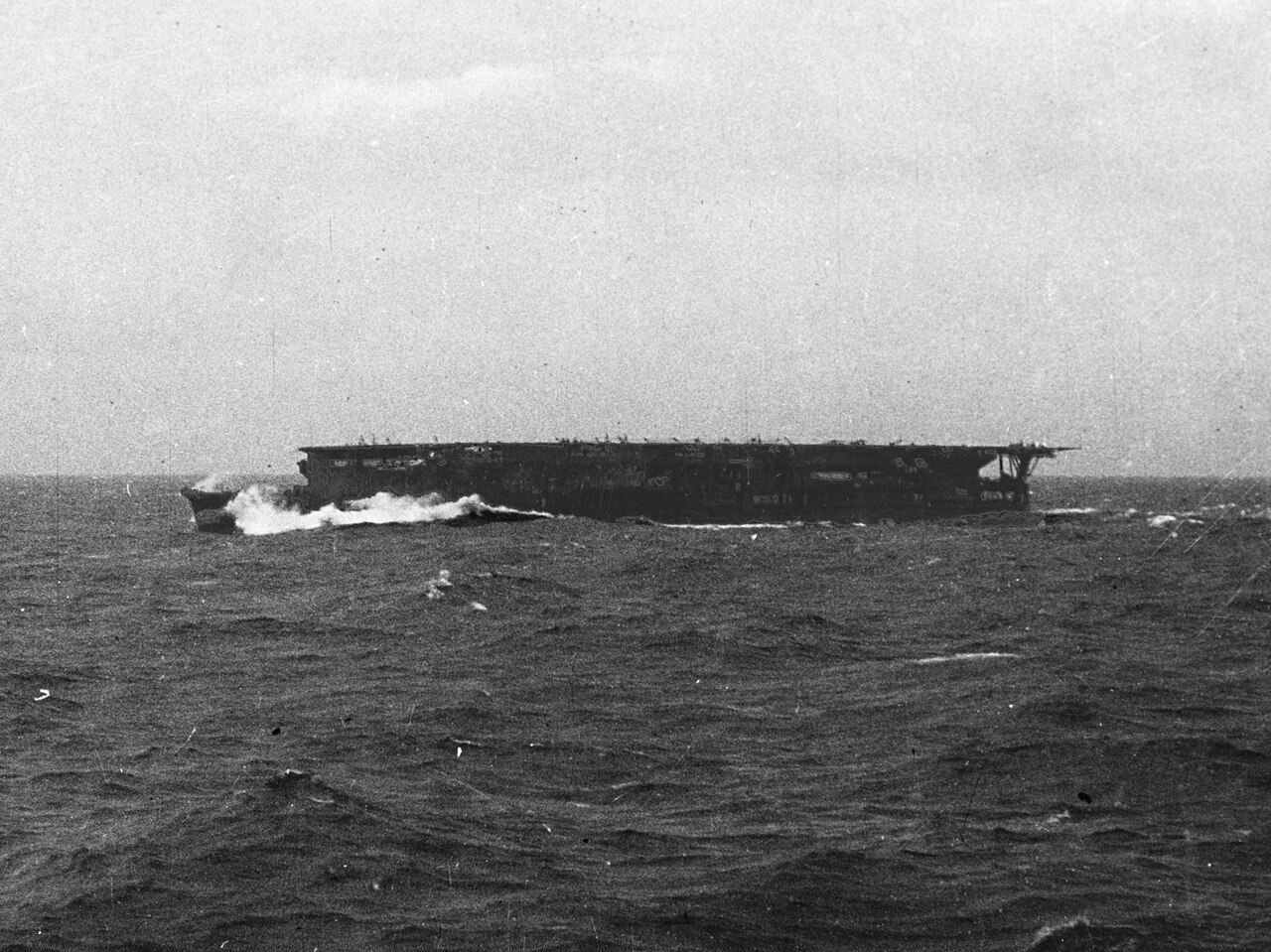
A carrier built around a loophole
Ryūjō was conceived as a small carrier of about 8,000 tons, light enough to slip under the Washington Treaty of 1922, which did not count carriers below 10,000 tons against a navy's carrier allowance. Her keel was laid at the Mitsubishi yard in Yokohama on 26 November 1929. While she was building, the London Treaty of 1930 closed the loophole, and she became the only Japanese carrier of her kind ever finished. She was launched on 2 April 1931, towed to the Yokosuka Navy Yard that month for fitting out, and commissioned on 9 May 1933 under Captain Matsunaga Toshio.
Her designers had first planned a single hangar on a low hull. Before she was launched, the Navy doubled her required air group to 48 planes, so a second hangar was stacked on top of the first. On a narrow hull that made her badly top-heavy. She had no island; her bridge sat in a long glassed-in gallery under the forward lip of the flight deck, which gave her a strange, open-bowed look. Her small after elevator would later prove a real handicap, because few of the modern carrier planes of 1941 would fit on it.
Two rebuilds
Trials in 1933 showed a ship that was very wet and short of stability. In March 1934 the torpedo boat Tomozuru capsized in a storm, and the Navy began checking every ship for stability. Ryūjō went into dock at Kure from 26 May to 20 August 1934. Her funnels were raised and curved down, ballast and shallow bulges were added, and two of her twin 12.7 cm gun mounts came off to save weight at the top of the ship.
On 25 September 1935 she was one of many ships caught in a typhoon during fleet maneuvers, the "Fourth Fleet Incident." Her bridge was buckled and her hangar flooded. At Kure from October 1935 to May 1936 her forecastle was raised a full deck and her bow given more flare. After that she handled noticeably better in light and moderate seas.
China and the test of dive bombing
Ryūjō was the Navy's test bed for carrier dive bombing in 1934–36, and the fleet maneuvers of October 1936 persuaded the Navy that the new tactics worked. When war with China began in 1937, she and Hōshō arrived off Shanghai on 13 August. Her dive bombers struck targets around Shanghai, and her biplane fighters fought Chinese Curtiss Hawks over the city that August. In late September she moved south to strike around Canton, and in October her air group went ashore to support the army near Shanghai and Nanking. In 1938, now flying Mitsubishi A5M monoplane fighters, she supported the campaign against Canton again.
The Philippines, Malaya and the Indies
At the opening of the Pacific War she was flagship of Rear Admiral Kakuta Kakuji's Carrier Division 4. On 8 December 1941 her planes struck the American seaplane base at Davao on Mindanao, destroying two PBY flying boats. She covered the landings at Davao and Jolo later that month, then moved to the waters off Malaya.
In February 1942 her planes attacked the ships fleeing the fall of Singapore and covered the invasion of Palembang on Sumatra. On 15 February she launched strike after strike against Rear Admiral Karel Doorman's Allied squadron in the Gaspar Strait but scored no hits. Two days later her bombers sank the Dutch destroyer Van Nes. On 1 March her planes joined the attacks on the crippled American destroyer Pope, which went down that afternoon after the Battle of the Java Sea.
The Bay of Bengal and the Aleutians
In early April 1942 Ryūjō sailed with Vice Admiral Ozawa Jisaburō's cruisers into the Bay of Bengal. Her planes bombed the small Indian ports of Vizagapatam and Cocanada and attacked merchant ships, and Ozawa's force sank about 19 ships in all.
After a refit at Kure, where she traded her A5Ms for Zero fighters, she joined the new carrier Jun'yō for the Aleutian operation. On 3 and 4 June 1942 her planes bombed Dutch Harbor on Unalaska. One of her Zeros, damaged over the island, crash-landed on Akutan. Found nearly intact, it became the "Akutan Zero," which the Americans repaired and flew to learn the fighter's weaknesses. She covered the occupation of Attu and Kiska and returned to Kure in July.
The Eastern Solomons
When the Americans landed on Guadalcanal in August 1942, Ryūjō sailed south with Shōkaku and Zuikaku. On 24 August Vice Admiral Nagumo Chūichi sent her ahead with the cruiser Tone and the destroyers Amatsukaze and Tokitsukaze to strike Henderson Field and draw attention from the main carriers. Her small raid on the airfield did little damage and lost several planes to the Marine fighters.
That afternoon a strike of Dauntless dive bombers and Avenger torpedo planes from USS Saratoga found her. She took several bomb hits and one torpedo, which flooded her starboard engine room. Fires were put out, but her list kept growing, her machinery stopped, and the order to abandon ship was given. Amatsukaze came alongside to take off her crew while B-17 bombers attacked without effect. At about 1755 Ryūjō capsized and sank at 06°10′S, 160°50′E, north of Guadalcanal. Seven officers and 113 men were lost. Captain Katō Tadao survived. Her returning planes found no deck to land on and had to ditch near the screen. She was struck from the Navy List on 10 November 1942.
Sources
Anthony P. Tully, Gilbert Casse and Matthew Jones, "IJN Ryujo: Tabular Record of Movement," Kido Butai, combinedfleet.com (rev. 2021).
John B. Lundstrom, The First Team and the Guadalcanal Campaign (Naval Institute Press, 1994), as cited in Wikipedia, "Japanese aircraft carrier Ryūjō" (used as a lead).