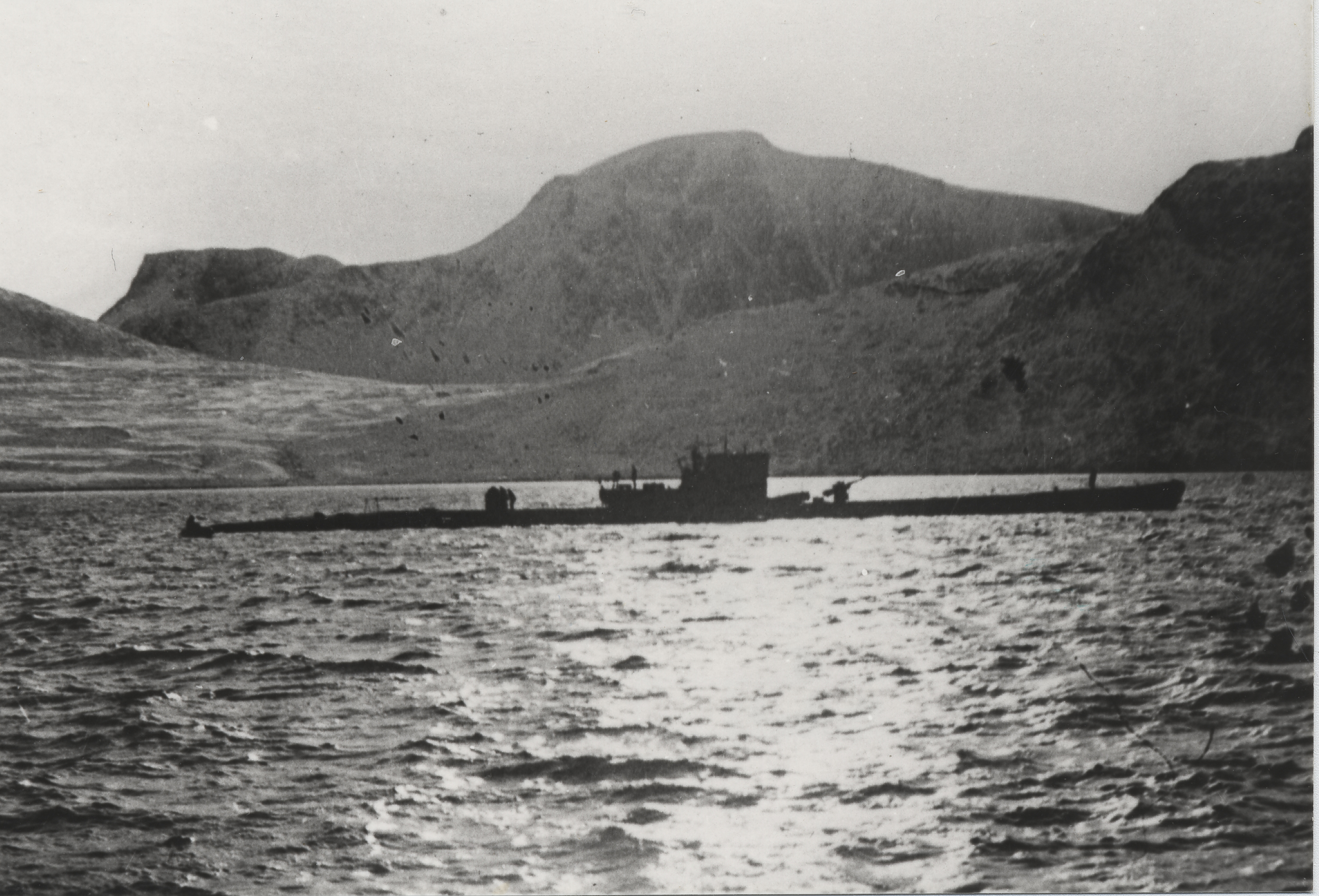
U-537 was a Type IXC/40 submarine of the German Navy, ordered on 10 April 1941. Deutsche Werft at Hamburg laid her down on 10 April 1942, yard number 355, launched her on 7 November 1942, and the Navy commissioned her on 27 January 1943. Kapitänleutnant Peter Schrewe had her from that day until she was lost. He was her only commander. He was born on 3 December 1913 at Grosshof, Tapiau, in East Prussia, and he had been a Kapitänleutnant since 1 January 1943. A boat of this type is listed at about 1,144 tons on the surface and 1,257 submerged, 76.76 meters overall, with six torpedo tubes and a 10.5 cm deck gun. The crew is given as somewhere between 48 and 58.
She trained with the 4th Flotilla at Stettin until 31 July 1943, then served with the 10th at Lorient through 30 September 1944. On 1 October 1944 she joined the 33rd, the Far East flotilla of the Monsun boats. She made three war patrols. The days at sea are printed as 209 and as 210. She sank no ships and damaged none. No man of hers was lost before the last day.
She left Kiel on 18 September 1943, reached Bergen on the 23rd, and sailed again on 30 September. Her task was to land Wetter-Funkgerät Land-26, called Kurt, a Siemens automatic weather station, on the Labrador coast. On 22 October she anchored in Martin Bay, near Cape Chidley. A landing party that included the meteorologist Kurt Sommermeyer set the battery-powered station ashore. Accounts call it the only armed German landing on the North American mainland in the war. The station transmitted for a short time and then failed. It was not found until 1981. She then patrolled off Newfoundland. On 31 October a Canadian Hudson of No. 11 Squadron fired eight rockets and missed. Off Cape Race on 10 November a Canadian Catalina of No. 5 Squadron dropped four depth charges, and she got clear. The next day another Catalina of that squadron dropped four more and did slight damage. She reached Lorient on 8 December.
On 5 March 1944, outbound from France, an Allied aircraft the accounts do not name damaged her badly enough that she turned back. She was in Lorient again on 6 March.
She left Lorient on 25 March 1944 for the Far East with the Monsun boats, which worked from bases such as Penang and Batavia. She carried radar-warning sets and spare parts for other submarines, a spare propeller for U-168, and about 110 tons of lead for Japan. U-488 refueled her at sea. The voyage ran around Africa and across the Indian Ocean. She reached Batavia on 2 August, after 131 days, having sunk nothing.
On 1 October she went from Batavia to Surabaya in a day. She left Surabaya on 9 November on her third patrol, headed east through the Lesser Sundas to raid off the west coast of Australia. German accounts say she was to work vor der Westküste Australiens. She had been at sea about fourteen hours.
At 0026 on 10 November, in the Java Sea east of Surabaya, torpedoes from the American submarine Flounder (SS-251) sank her. James Edward Stevens had Flounder. The patrol account first took the contact for a small sailboat, and then the conning tower showed. Four torpedoes were fired. One hit was seen, and a second was felt. Half an hour later the periscope showed an empty sea. uboat.net prints the place as 7°13' S, 115°17' E. Fifty-eight men died, the whole crew. Schrewe died with them. The commander list dates his death 9 November, the day she left Surabaya. She had sunk nothing.