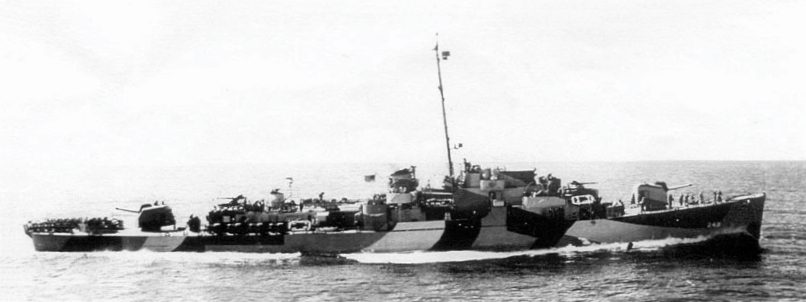
Abercrombie carried the name of Ensign William Warner Abercrombie, called Abbie, a Naval Reserve aviator from Medford, Oregon. He was born on 24 July 1914. He enlisted in 1940, earned his wings in 1941, and joined Torpedo Squadron 8 in Hornet (CV-8). On 4 June 1942, at Midway, he flew one of fifteen TBD Devastators sent against the Japanese carriers. All fifteen were shot down. Ensign George H. Gay was the only man from that attack who lived. After Abercrombie's death the Navy awarded him the Navy Cross and a share of the squadron's Presidential Unit Citation.
She was a John C. Butler-class destroyer escort, hull DE-343. Consolidated Steel Corporation, at Orange, Texas, laid her down on 8 November 1943 and launched her on 14 January 1944. Mrs. C. W. Abercrombie, his mother, sponsored the launch. The Navy commissioned her at the builder's yard on 1 May 1944. Lieutenant Commander Bernard H. Katschinski, USNR, had her from that day until 29 May 1945.
She ran trials in the Gulf of Mexico, shook down in the British West Indies, and took post-shakedown repairs at Boston. She escorted oilers to Aruba, passed through the Panama Canal, and reached San Diego in the middle of August 1944. By the end of August she was at Pearl Harbor, training with escort carriers. In September she escorted the transport General W. F. Hase (AP-146) to Manus, in the Admiralty Islands, and arrived on 30 September.
In the middle of October she joined the screen of an escort-carrier group for the Leyte landings. The force reached Leyte Gulf on 20 October. She kept the screen while the carriers' aircraft worked over the beachhead. On 25 October the crew could see part of the Battle off Samar, where Japanese surface ships attacked the northern end of Task Group 77.4. She was not engaged. Early in November she was back at Manus.
She trained in the Solomons and off New Guinea. On 9 January 1945 she was flagship of Task Group 79.9 for the Lingayen Gulf landing on Luzon. As a control ship she directed landing craft, and she fired on Japanese aircraft during a kamikaze attack on the cruiser Columbia (CL-56). She later escorted convoys between Leyte, Biak, and Mindoro, rested at Ulithi, and trained for the Ryukyus.
On 21 March 1945 she sailed with the Western Islands Attack Group to take Kerama Retto, the anchorage west of Okinawa, a week before the main landings. She covered that seizure, and the assault on Okinawa on 1 April, against aircraft and submarines. From the middle of April to the middle of June she was on radar picket, antisubmarine patrol, and escort around Okinawa. In that stretch the ship's account has her engaging Japanese aircraft on at least sixteen occasions, with two claimed shot down and two shared, and she picked American airmen out of the water. One account has her colliding with the destroyer Dyson (DD-572) at Kerama Retto on 5 June. She came through the campaign without combat damage and without a man lost to the enemy, after about sixty-eight days and nights in the Okinawa area. John R. Hicks, USNR, had relieved Katschinski on 29 May, so the June date in that collision account falls after Katschinski left. Hicks had her until 14 October 1945. NavSource lists him as a lieutenant and as a lieutenant commander.
The July return was still Hicks's tour. After a refit at Saipan she was back at Okinawa in July for antisubmarine and antiaircraft patrol, and she joined Third Fleet ships minesweeping and screening off Japan. After the surrender she escorted occupation troops to Inchon in the middle of September, and to Japanese ports, Wakanoura Wan among them, and she stayed on that duty into early November. Lieutenant Commander Edward Matthews Higgins Jr., USN, relieved Hicks on 14 October 1945, while that duty was still going. She reached San Pedro, California, on 21 November 1945, with Higgins in command. Lieutenant Commander Augustus Knight Jr., USN, had her when she was decommissioned. The day Knight took command is not known, only that it fell in 1946.
The Navy credited her with four battle stars: the Leyte landings, 10 October to 29 November 1944; the Lingayen Gulf landing on 9 January 1945; the assault and occupation of Okinawa Gunto, 26 March to 14 June 1945; and Third Fleet operations against Japan, 26 July to 7 August 1945. Edward P. Stafford, who served in her, wrote Little Ship, Big War: The Saga of DE343. She was decommissioned at San Diego on 15 June 1946 and placed in the Pacific Reserve Fleet, later moved to Bremerton. Her name was struck on 1 May 1967. In November 1967 she was towed back to San Diego. On 7 January 1968 a task group centered on the carrier Bon Homme Richard (CV-31) sank her as a target off California, by gunfire, missiles, and aircraft.