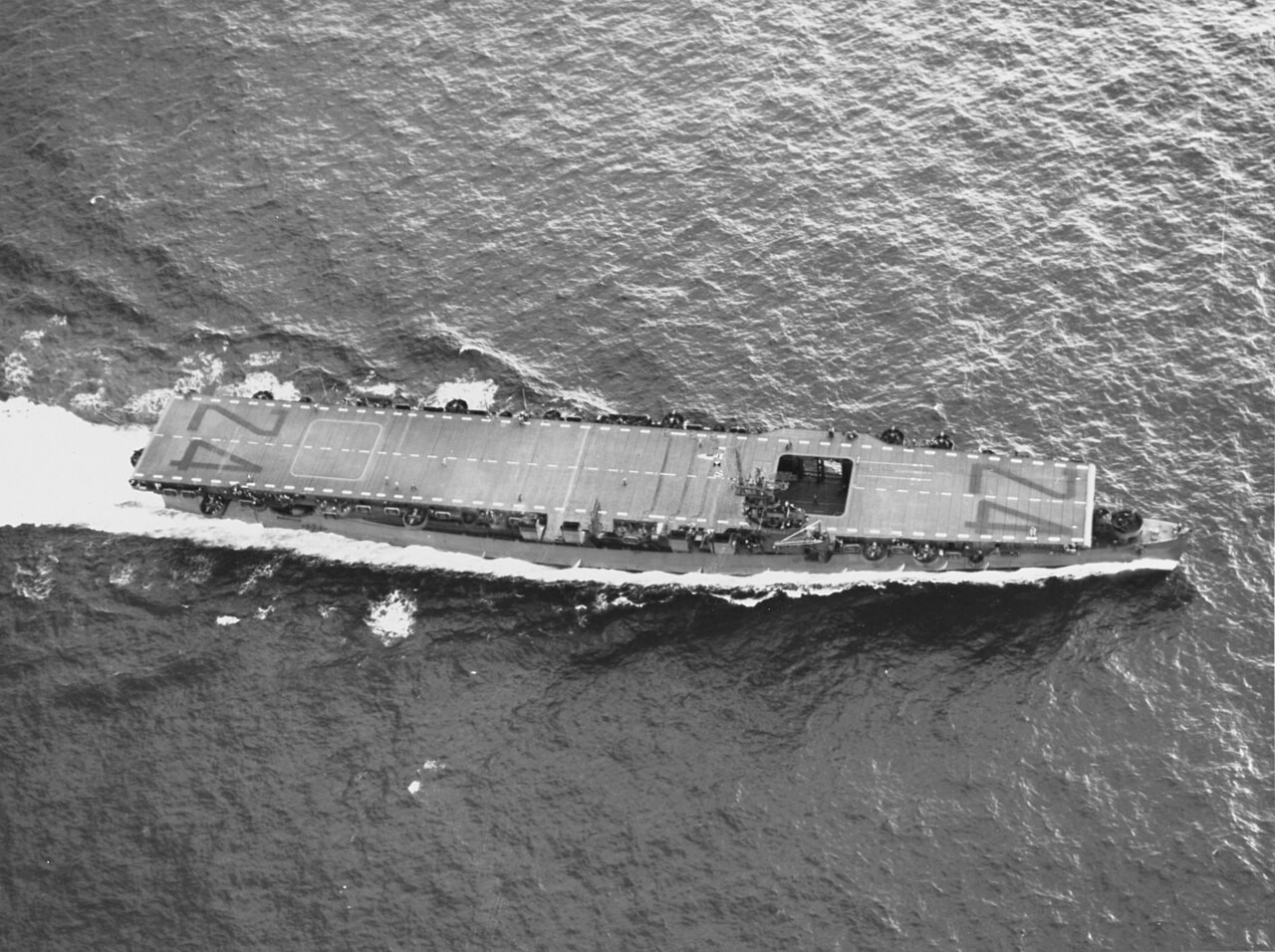
From cruiser to carrier
Her keel was laid on 11 August 1941 at the New York Shipbuilding Corporation in Camden as the Cleveland-class light cruiser New Haven (CL-76). In January 1942 President Roosevelt ordered several of the new cruiser hulls turned into light carriers to fill the gap until the Essex class arrived, and New Haven was chosen on 10 February. On 31 March 1942 she was renamed Belleau Wood (CV-24) after the Marines' great battle of June 1918. She was launched on 6 December 1942 and commissioned on 31 March 1943, the third ship of the Independence class. She was 622 feet long, with four small funnels behind her island and turbines of 100,000 horsepower for 31.6 knots. She carried about thirty planes: twelve fighters, nine dive bombers and nine torpedo bombers. She was redesignated CVL-24 on 15 July 1943.
Baker Island, the Gilberts and Wake
After shakedown off Trinidad she sailed for the Pacific with Princeton and Lexington and reached Pearl Harbor on 9 August 1943. She covered the occupation of Baker Island from 1 September, and her fighters shot down a Kawanishi flying boat that day. She struck the Gilberts on 18–19 September and Wake on 5–6 October. With Enterprise and Monterey she hit Makin on 19 November and supported Tarawa and Makin until 26 November. On the night of 4 December, off Kwajalein, a torpedo from a G4M bomber missed her by about 10 yards. Lexington was hit in the same attack.
Marshalls, Truk and the Marianas
In Task Group 58.1 she helped neutralize Kwajalein, Wotje and Maloelap from 29 January 1944. She joined Operation Hailstone against Truk on 16–17 February and the first raid on the Marianas. On 22 February her guns shot down two bombers diving on her and a fighter attacking Essex. In March she covered the Emirau landing. At the Battle of the Philippine Sea her fighters swept Guam, and on the evening of 20 June four of her Avengers and six Hellcats were in the long-range strike that sank the Japanese carrier Hiyō. The planes then had to land at night. Through the summer she struck Iwo Jima, Guam, the Palaus, Mindanao and the Bonins, and in October Okinawa, Luzon and Formosa.
The kamikaze of 30 October 1944
After the Battle of Leyte Gulf she supported the fighting on Leyte. At about 14:00 on 30 October five kamikazes came in high at about 18,000 feet. One hit Franklin. A Zero bombed Franklin and then, at 14:27, dived into Belleau Wood's flight deck among eleven fueled and armed Hellcats. Explosions and fires followed, and her damage-control teams fought them for three hours. Ninety-two men were killed and 97 wounded. After temporary repairs at Ulithi she was repaired and rearmed at Hunters Point, San Francisco, and was back at Ulithi on 7 February 1945.
Tokyo, Iwo Jima and the end
From 16 February 1945 she flew strikes against airfields around Tokyo, then supported Iwo Jima and the Okinawa campaign and the final raids on Japan. She entered Tokyo Bay on 10 September 1945 and then carried supplies and returning servicemen in Operation Magic Carpet. She was decommissioned on 13 January 1947 and laid up at Alameda.
Bois Belleau
On 5 September 1953, under the Mutual Defense Assistance Act and on President Eisenhower's order, she was lent to France as Bois Belleau for the war in Indochina. She reached Southeast Asian waters on 30 April 1954, a week before Dien Bien Phu fell, and served there until November 1955. In June 1957 she came back to Hampton Roads with a French squadron for the international naval review. France returned her in 1960, and she was broken up for scrap that year.
Sources
Wikipedia, "USS Belleau Wood (CVL-24)" (citing DANFS and Friedman, U.S. Aircraft Carriers).
NHHC/DANFS, "Belleau Wood."