Ships
- USS Saratoga (CV-3) Captain from 12 April 1942 · Temporary command, until 12 May 1942
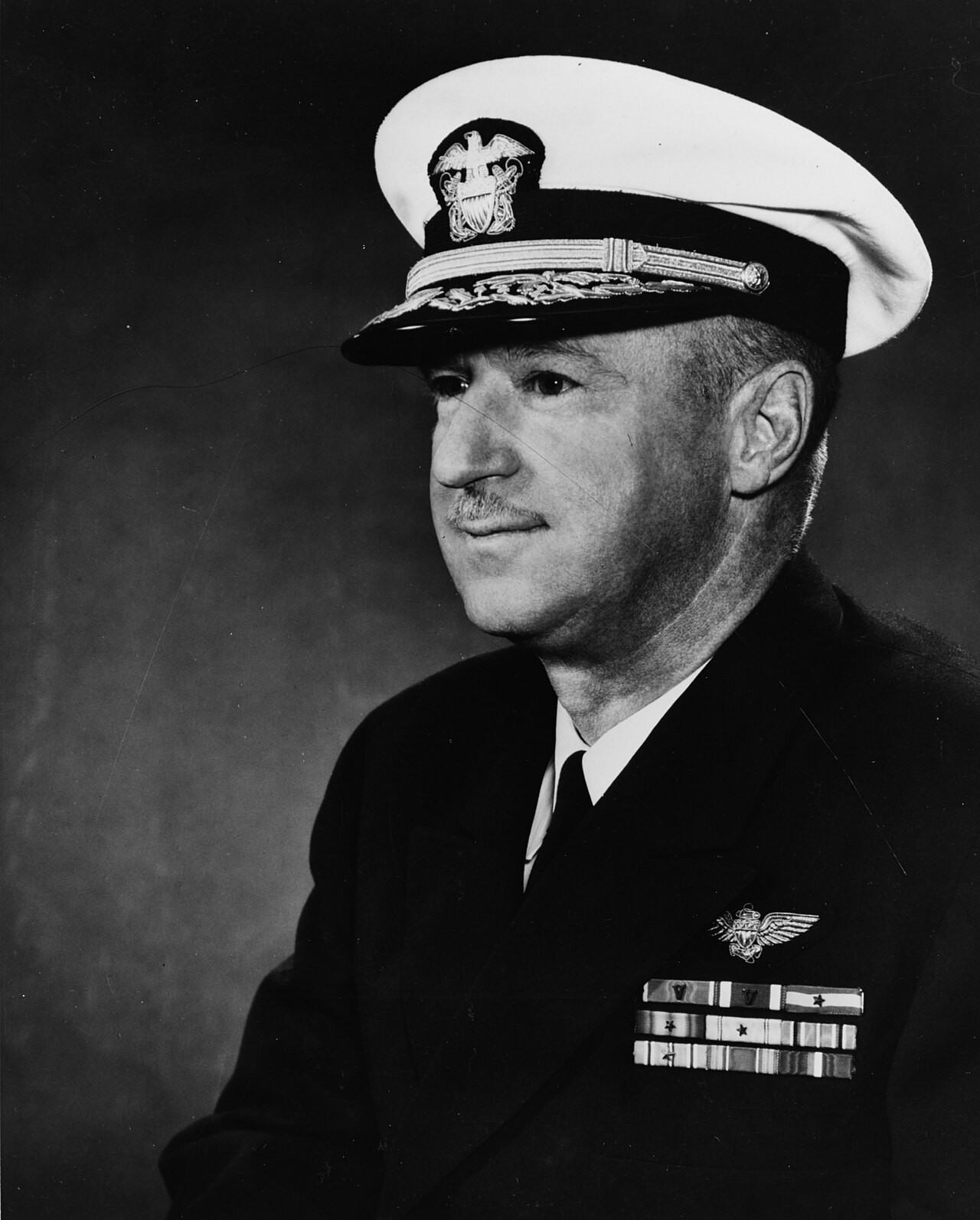
Alfred Melville Pride was born in Somerville, Massachusetts, on 10 September 1897. He spent two years in the engineering school at Tufts College, then left in 1917 and enlisted in the Naval Reserve as a machinist's mate. Flight training followed. The Navy commissioned him an ensign and designated him a naval aviator in 1918, and he finished the First World War on brief duty in England and France. In November 1921 he moved into the regular Navy as a lieutenant. He later reached flag rank on that path, from a reserve enlistment and an unfinished college course, at a time when almost every admiral had come through the Naval Academy.
His work settled on the flight deck as the Navy was learning how to use carriers. He flew with the scout-plane detachment of the battleship Arizona, then joined the crew that put the first American carrier, Langley, into service. On Langley he helped develop the arresting gear that stopped a landing airplane short of the end of the deck, and he took part in the experimental takeoffs and landings that proved the ship. He also helped fit out the next two carriers. In 1927, with the commissioning crew of Lexington, he made the first landing on her deck. The Navy afterward sent him to the Massachusetts Institute of Technology to study aeronautical engineering.
Pride spent much of the 1930s in test flying and in the squadrons that worked out carrier methods. He commanded a fighting squadron on Langley, had charge of an experimental detachment at Norfolk, and from 1934 to 1936 ran the flight-test section at Naval Air Station Anacostia, then the Navy's main center for trying new airplanes. In 1931 he became the first pilot to land an autogiro, an early rotary-wing aircraft, on a carrier deck. A crash injured him badly enough that his flying career nearly stopped. He also served in the fighter section of the Bureau of Aeronautics, as air officer of the seaplane tender Wright, and on the staff of a patrol wing based at San Diego, where he worked with Marc Mitscher.
In May 1941 he went to sea as executive officer of USS Saratoga (CV-3). A Japanese submarine torpedoed the carrier southwest of Hawaii on 11 January 1942, and she spent the next months in overhaul at Bremerton. On 12 April 1942, still a commander, Pride assumed temporary command, succeeding Archibald Hugh Douglas. The temporary command lasted one month. On 12 May 1942 he turned the ship over to Captain DeWitt Clinton Ramsey, who took her to sea again as the yard work ended. That short command stood in a line of Saratoga captains that already included Harry Ervin Yarnell, her first commanding officer, along with Kenneth Whiting, William Frederick Halsey, Jr., John Henry Towers, and Albert Cushing Read. Pride left the ship in June 1942 for a few months in Washington, first in procurement and then back in the Bureau of Aeronautics.
His wartime command of his own ship came with the light carrier Belleau Wood. He fitted her out at the Philadelphia Navy Yard and became her first commanding officer when she was commissioned on 31 March 1943. Over the next year he took her into the Central Pacific. Her aircraft struck Tarawa and Makin in the Gilberts, raided Wake, and later joined the attacks on Kwajalein, the February 1944 raid on Truk, and strikes against Saipan and Tinian. Captain John A. Perry relieved him in the western Pacific on 12 April 1944, before the summer landings in the Marianas.
Pride then went ashore at Pearl Harbor. He commanded the Naval Air Center there and afterward the naval air bases of the Fourteenth Naval District. In the last year of the war he led the air-support control units of the Pacific Fleet amphibious force and served with Kelly Turner. The work covered air cover for the Okinawa landings and planning for an invasion of the Japanese home islands.
After the war he commanded carrier divisions with the Sixth Fleet in the Mediterranean and served a tour as Chief of the Bureau of Aeronautics, the office that developed and bought the Navy's airplanes. In the mid-1950s he commanded the Seventh Fleet in the western Pacific, and Time put him on its cover on 7 February 1955. From 1956 to 1959 he commanded Naval Air Force, Pacific Fleet, at Pearl Harbor. He retired in 1959 after forty-two years of service, with the final rank of admiral. Alfred Melville Pride died on 24 December 1988 in Arnold, Maryland, while visiting his daughter.