Ships
- USS Saratoga (CV-3) Captain from 16 June 1938 · Relieved on 15 March 1940
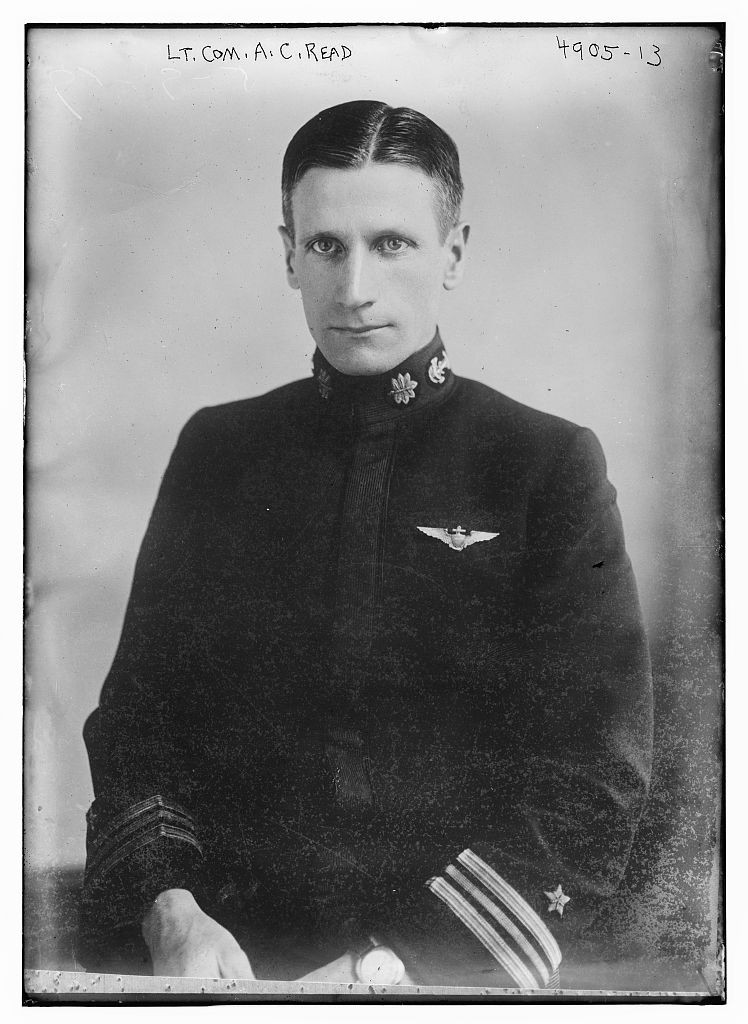
Albert Cushing Read was born in Lyme, New Hampshire, on 29 March 1887, the son of Joseph Brown Read and Mary Elizabeth Barker Read. He died at Mercy Hospital in Miami on 10 October 1967 and is buried at Arlington National Cemetery with his wife. He was called Putty, for a face that gave little away.
He went to high school in Whitman, Massachusetts, entered the Naval Academy from Massachusetts in 1903, and graduated fourth in the class of 1907. After the two years of sea duty then required, he was commissioned ensign on 12 September 1908. As a midshipman he served in the battleship Indiana (BB-1). That is not the later battleship Indiana (BB-58). After graduation he served in the battleship Ohio, the destroyers Decatur, Barry, and Bainbridge, and the battleship Delaware, and then at the Naval Torpedo Station at Newport.
On 8 July 1915 he began flight training at the Naval Aeronautic Station, Pensacola, and was designated Naval Aviator No. 24 on 7 March 1916. He then served in the cruiser North Carolina (ACR-12), one of the first ships fitted to launch aircraft, where he made catapult launches, and in Seattle, the armored cruiser that had been named Washington. Those are not the battleships North Carolina (BB-55) and Washington (BB-56). During the First World War he commanded the naval air stations at Bay Shore, New York, and at Miami.
In 1919, a lieutenant commander, he commanded the flying boat NC-4, with a crew of six, in the Navy's transatlantic attempt. Lieutenant Commander John H. Towers had the division. NC-4 left Rockaway Beach, Long Island, on 8 May 1919, stopped at Trepassey Bay in Newfoundland, the Azores, and Lisbon, and reached Plymouth, England, on 31 May, the first aircraft to complete a crossing of the Atlantic. The other two NC boats were forced down at sea. He received the Navy Distinguished Service Medal for the flight and for the advance of naval aviation. Portugal made him a Commander of the Military Order of the Tower and Sword. Britain awarded him the Royal Air Force Cross. In 1929 the crew received Congressional Gold Medals, and a special NC-4 Medal was struck. After the flight he said air travel would become high, fast, and global. The New York Times answered that the forecast was unrealistic.
He returned to Naval Air Station Pensacola, commanded the seaplane tender Harding, and served on the staff of the aircraft squadrons of the Scouting Fleet. He was a student at the Naval War College and then an instructor there. On 24 June 1924 he took command of Aircraft Squadron 20 and the tender Ajax with the Asiatic Fleet, and kept them into 1925. He commanded torpedo squadrons with the Battle Fleet until October 1926, then Naval Air Station Hampton Roads until May 1929. He was executive officer of Saratoga, and from 25 August 1931 he served in the Bureau of Aeronautics. He commanded the aircraft tender Wright, flagship of the Base Force, from 7 June 1934 into May 1936, and was Assistant Chief of the Bureau from 27 May 1936. He assumed command of Saratoga (CV-3), flagship of Commander Aircraft, Battle Force, and of Carrier Division One, on 26 May 1938. The compiled list of her captains dates that assumption 16 June 1938. He was relieved on 15 March 1940.
In April 1940 he became commandant of Naval Air Station Pensacola. He was promoted to rear admiral on 22 December 1941. In October 1942 he became Chief of Air Technical Training, with headquarters in Chicago. In January 1944 he became Commander Fleet Air, Norfolk, and served until September 1945. The Legion of Merit for that duty cites his part in the anti-submarine work of Atlantic Fleet air units, and in readying carriers and carrier air groups for the Pacific. He then served briefly in the Office of the Deputy Chief of Naval Operations (Air). He retired on 1 September 1946.
In May 1949 he was a passenger on the P2V-2 Truculent Turtle, which left Floyd Bennett Field and retraced much of the NC-4 route. He was inducted into the National Aviation Hall of Fame in 1965. He married Bess Anderson Burdine. They had two children, Albert Cushing Read, Jr., and Elizabeth Burdine Read.