Ships
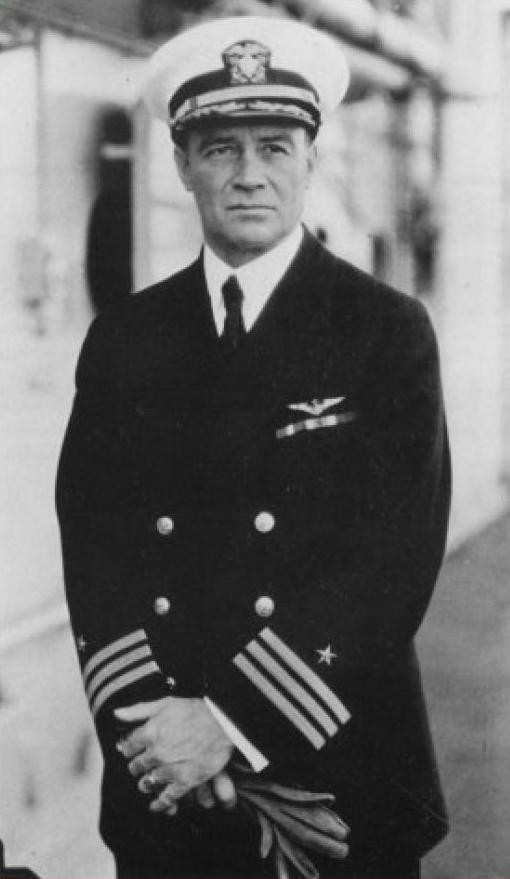
- USS Saratoga (CV-3) Captain from 12 June 1934 · Relieved on 6 July 1935
Kenneth Whiting was born in Stockbridge, Massachusetts, on 22 July 1881. He entered the United States Naval Academy as a naval cadet on 7 September 1900, graduated with the class of 1905, and was commissioned an ensign on 25 February 1908 after the sea duty then required of a new graduate. He volunteered for submarines and commanded Porpoise, Shark, Tarpon, and Seal. On 15 April 1909, with Porpoise on the bottom of Manila Bay in about twenty feet of water, he entered an eighteen-inch torpedo tube, had the outer door opened, and swam to the surface. The trial showed that a trapped man could leave a submarine that way.
He wanted to fly as well. When Glenn Curtiss offered to train a Navy pilot, Whiting applied and persuaded a Naval Academy classmate, Theodore G. Ellyson, to apply too. Ellyson was chosen and became Naval Aviator No. 1. Whiting's own orders came in 1914. At Dayton, Ohio, Orville Wright taught him to fly, the last time Wright personally trained a naval officer, and Whiting was designated Naval Aviator No. 16. He was then placed in charge of the naval aeronautic station at Pensacola, Florida, where the Navy was building a permanent flying school. In 1916 and 1917 he had a seaplane unit attached to the cruiser Seattle.
After the United States entered the First World War, Lieutenant Commander Whiting took Aeronautical Detachment No. 1 to France. It was the first American naval aviation unit sent across the Atlantic and the first United States military unit to arrive in France during that war. He afterward commanded the United States naval air stations at Killingholme, England. The Navy Cross recognized that command of the detachment and of the Killingholme station, work done in a post of heavy responsibility. France awarded him the Legion of Honor.
From 1916 he had argued that the fleet needed a ship that could take airplanes to sea. In 1919 the Navy ordered the collier Jupiter converted, and the ship returned to service as Langley, the first American aircraft carrier. Whiting joined her as executive officer on 20 March 1922. On 18 November 1922, with Langley at anchor in the York River, he flew a PT seaplane off her catapult, the first catapult launch from that ship. On her short experimental deck he helped turn launching, recovery, and the handling of aircraft into routines a larger carrier could use. In July 1924 he returned to the Bureau of Aeronautics, serving first as assistant chief and later as head of the aircraft carriers division.
In September 1926 he was sent to the builder in Camden, New Jersey, to follow the construction of Saratoga. She entered service in 1927 as a carrier big enough to steam with the battle fleet, and on 16 November 1927 Whiting became her first executive officer. He stayed in that billet until May 1929 and was promoted to captain on 1 July 1929. That September he joined the staff of Commander, Aircraft Squadrons, Battle Fleet, as aide and chief of staff. He later commanded the naval air station at Hampton Roads and attended the Naval War College. On 15 June 1933 he took command of Langley. In December he left her to help fit out Ranger at Newport News, and early in 1934 he was detached from that work to assist with the plans for Yorktown and Enterprise.
Whiting returned to Saratoga as her commanding officer on 12 June 1934. He already knew the ship from her building and from his years as executive officer, and he brought with him the deck methods worked out on Langley and the design work he had done on the carriers that followed. He was relieved on 6 July 1935. For those thirteen months he had command of one of the fleet's large carriers while naval aviators were still settling how a full air group would scout, strike, and keep the sea with the battle line.
In July 1935 he became commander of Aircraft Squadrons, Battle Fleet, and at the same time commander of the Fleet Air Base at Pearl Harbor, in the Territory of Hawaii. In September 1937 he took command of Patrol Wing 2 and held that wing until 3 June 1938. On 14 July 1939 he was made general inspector of naval aircraft for the Eastern Division. He retired as a captain on 30 June 1940 and was kept on active duty in the same inspection work while the Navy expanded for the Second World War. On 19 February 1943 he was given command of the Naval Air Station at New York, at Floyd Bennett Field, with added duty as aviation officer of the Third Naval District. He was being treated for pneumonia at the Navy medical center in Bethesda, Maryland, when he died of a heart attack on 24 April 1943, at the age of sixty-one. The seaplane tender Kenneth Whiting (AV-14) was named for him, and so was Whiting Field, the naval air station at Milton, Florida.