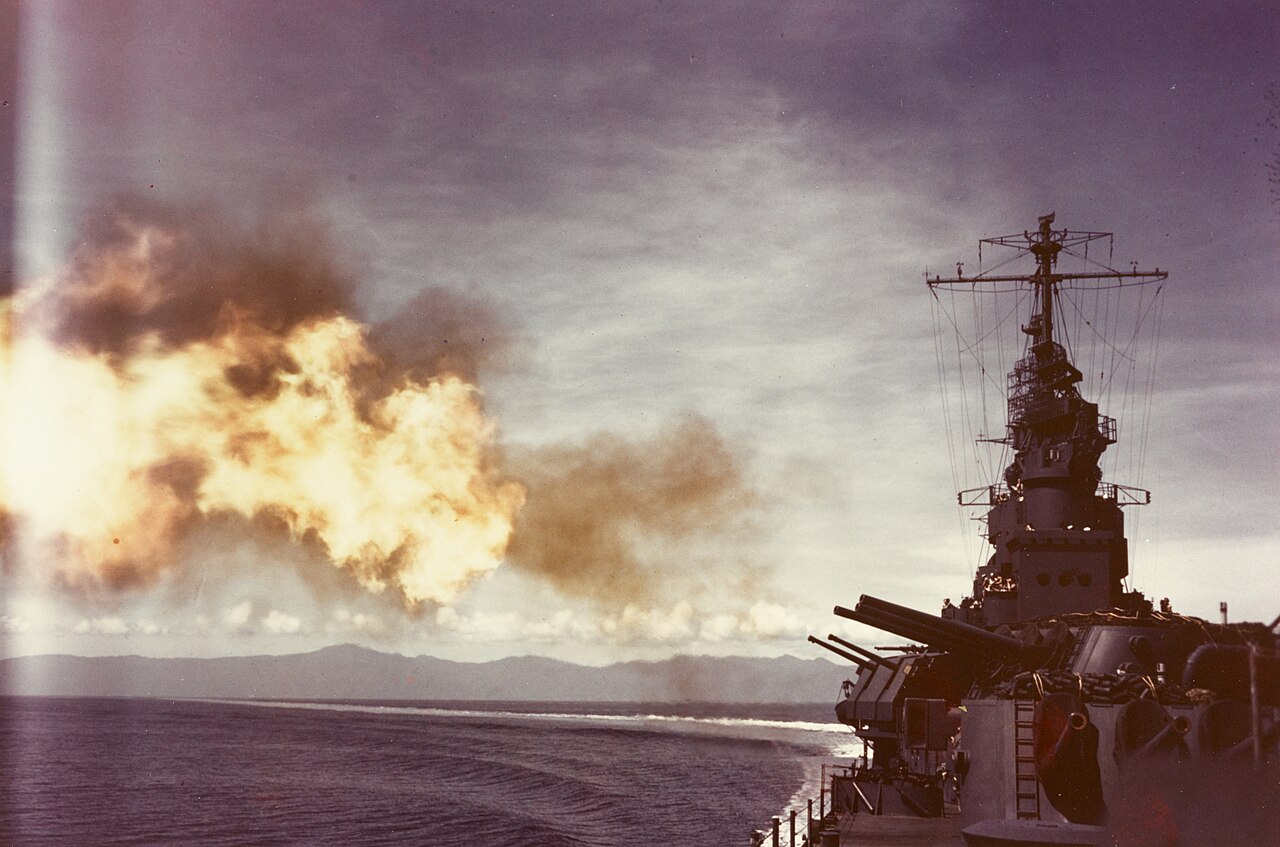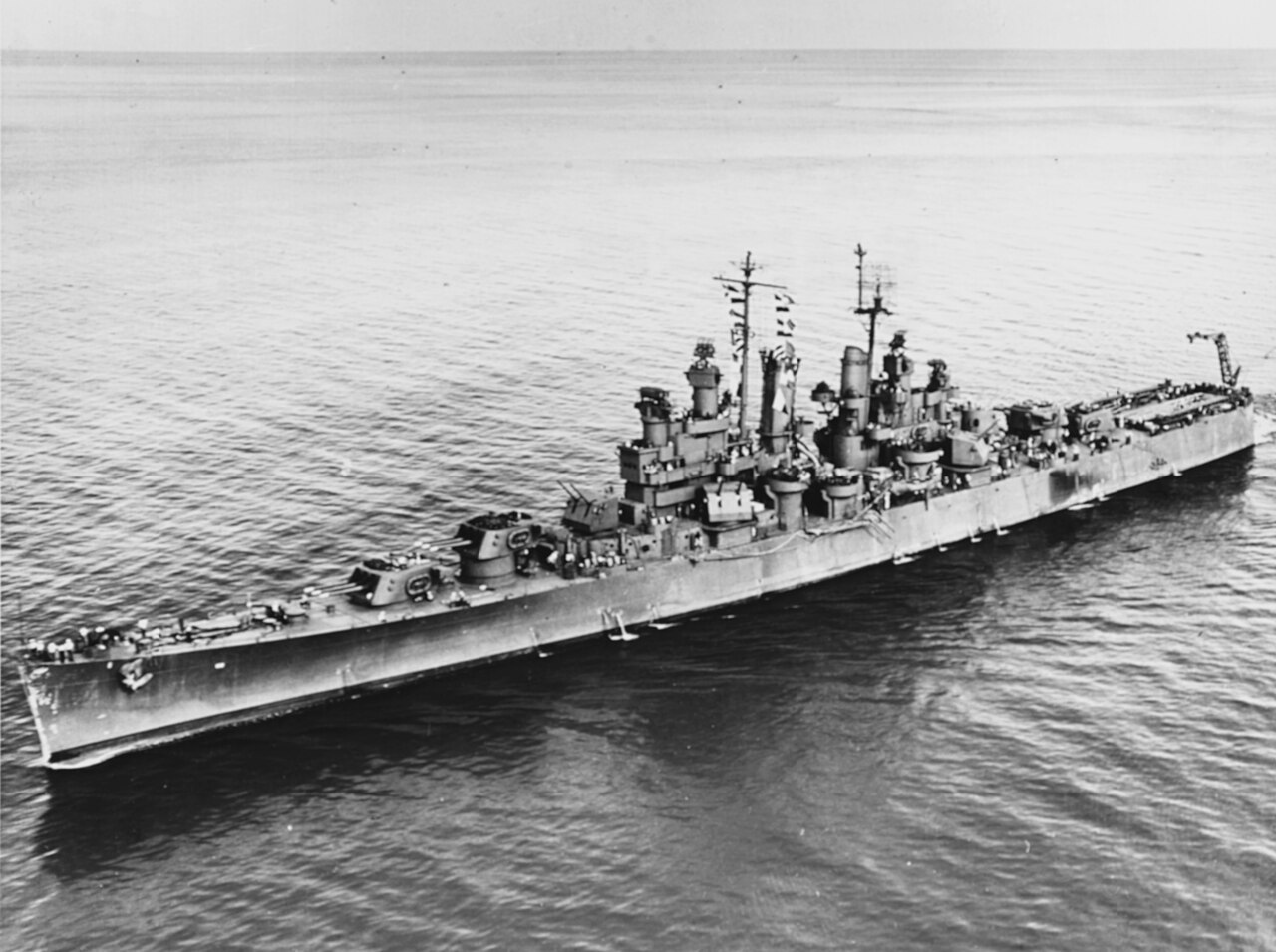
Biloxi was a Cleveland-class light cruiser, the first Navy ship named for the Mississippi city on the Gulf. Newport News Shipbuilding and Dry Dock Company laid her down at Newport News on 9 July 1941. She went down the ways on 23 February 1943, sponsored by Mrs. Katharine G. Braun, wife of the mayor of Biloxi, and she was commissioned at the Norfolk Navy Yard on 31 August 1943 with Captain Daniel Michael McGurl in command. The DANFS line for the hull gives 10,000 tons, a length of 610 feet 1 inch, a beam of 66 feet 4 inches, a draft of 26 feet 6 inches, 33 knots, a complement of 992, and twelve 6-inch and twelve 5-inch guns.
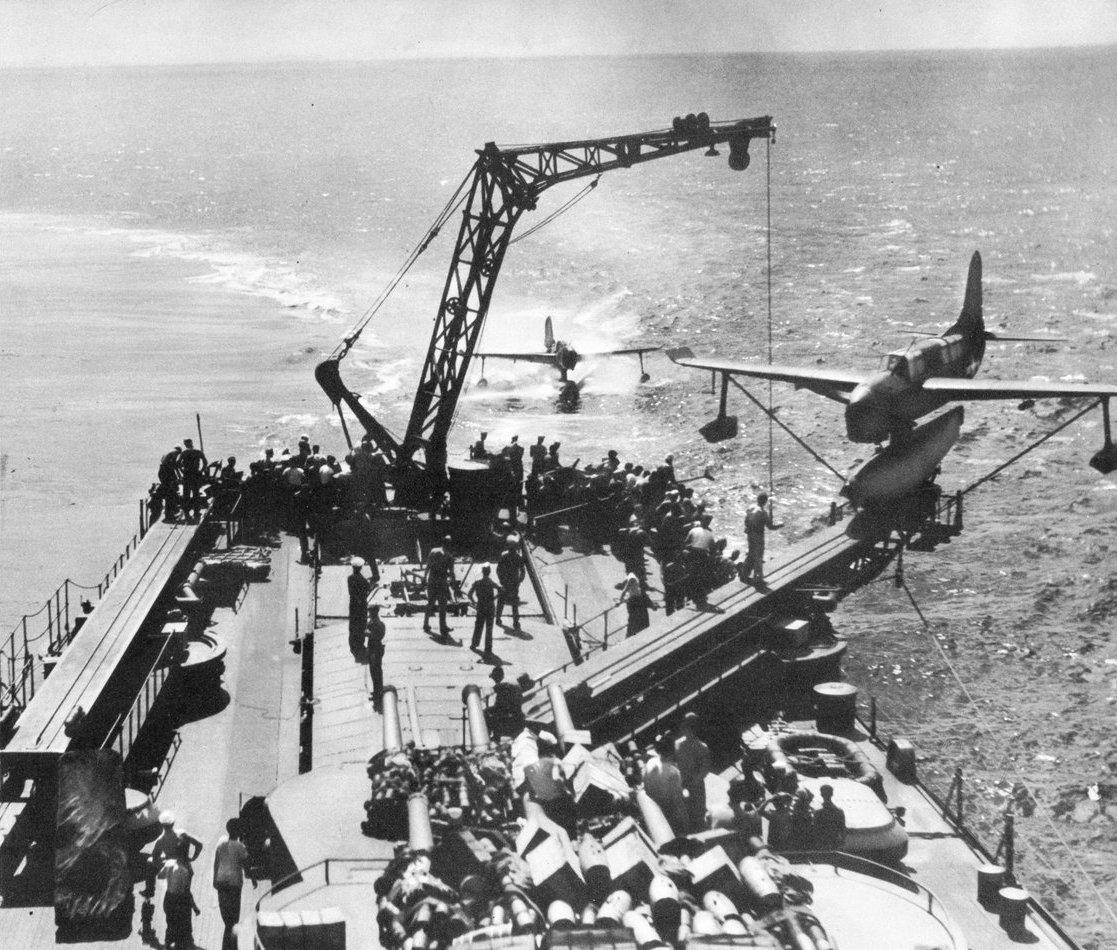
She fitted out at Norfolk until 17 September and then shook down in Chesapeake Bay: plane launch and recovery, structural test firing, day spotting, and antiaircraft drills. A training gun mount knocked Seaman Second Class Scott overboard, and the crew got him back. On 29 September she sailed for Trinidad with the destroyer Sproston. One of her four Curtiss SO3C Seagulls crashed on a landing attempt off the port beam. Ensign H. Jolly and Aviation Chief Machinist's Mate J. Phagan were picked up, and the wreck was sunk by gunfire as a hazard. Two weeks of battle drills at Trinidad followed. She was back in the Norfolk Navy Yard on 26 October for the post-shakedown overhaul, ran up to Rockland, Maine, for gyro and compass trials, and sailed for the Canal Zone on 20 November. She passed the canal on 24 November and reached San Francisco on 4 December. The war diary has the crew exchanging four SO3C Seagulls and spare parts for two Vought OS2U Kingfishers and no spare parts. She was at Oahu on 11 December and fired her first shore-bombardment practice at Kahoolawe with Wichita between 15 and 19 December, then went back to the coast for blower repairs at San Pedro and reported to the Fifth Fleet.
On 1 January 1944 she exercised at San Clemente with Maryland, Louisville, Mobile, and two destroyers, and on 13 January she put to sea for Operation Flintlock. With Task Group 53.5 she went on to the Marshalls in company with Louisville, Mobile, Santa Fe, and six destroyers. Early on 30 January she launched Kingfishers and bombarded the airfield on Wotje from dawn until noon. Shore batteries answered. One straddled her. A ricochet later hit the superstructure above the signal bridge and did not explode. Over the next two days she bombarded Roi for the Northern Attack Force landings, then screened three escort carriers and entered Majuro lagoon on 7 February.
She joined the fast carriers for the raid on Truk. Operation Hailstone opened on 16 February with strikes on the airfields. After a second strike on the morning of the 17th the group retired to fuel, Enterprise left, and the rest, shifted into Task Group 58.2, went northwest for Saipan. A snooper was shot down on 19 February, and a salvo of antiaircraft shells landed 500 yards off Biloxi's starboard bow. From 2300 on the 21st until 1000 the next morning three waves of Mitsubishi G4M Bettys came in, nineteen at night and five in the morning. None got through the screen. Eleven were shot down by antiaircraft fire. The group was back at Majuro on 26 February.
On 7 March she sailed south with Enterprise, Belleau Wood, two other light cruisers, and eight destroyers. The ships crossed the equator, and the shellback ceremony made loyal shellbacks of 1,139 polywogs. She reached Espiritu Santo on the 11th, then covered the Marine landings at Emirau on 20 March and again on the 25th. Cowpens and more ships joined, and on 30 March she covered the carriers at Palau. A Betty was shot down trying to close that morning. That night the gunners fired 5-inch at a single Aichi D3A Val and did not hit it. The next day she watched two destroyers destroy three Japanese patrol craft off Woleai, and she was back at Majuro on 6 April.
She sortied on 13 April with Task Group 58.1 for Hollandia. On 21 April the carriers struck Sawar, Wakde, and Sarmi. At 1456 she launched two Kingfishers after a ditched Grumman TBF Avenger. Neither found the crew. One floatplane ran out of gas. Lieutenant (junior grade) H. Jolly landed it, and Frazier took the crew off. That night Biloxi, two other light cruisers, and five destroyers closed the coast and fired from 0115 to 0225 on 22 April at aircraft on Wakde and at the airfield and dumps on Sawar. She screened the carriers until Manus on 28 April, covered strikes on Truk on 29 April and Ponape the next day, watched battleships bombard Ponape on 1 May, and entered Kwajalein on 4 May to load for the Marianas.
For Operation Forager she was in Task Group 58.2 with Bunker Hill, Wasp, Monterey, and Cabot. She covered the strikes on Saipan and Tinian on 12 June and the landings on Saipan from the 15th. On the 16th the group heard that a large Japanese force was coming from the Philippines. The carrier groups met about noon on 18 June and took station about 150 miles west of Saipan. From the southern flank of that disposition Biloxi was in the Battle of the Philippine Sea. Around noon on 19 June six Yokosuka D4Y Judys got through the fighters to the task group. Biloxi and other escorts fired on the two that went for Bunker Hill, and both were splashed. At least four more Judys came in that afternoon and were shot down by antiaircraft fire without hitting the ships. On the 20th a sighting at 1613 sent off a 206-plane strike that caught the retiring Japanese at dusk, sank the light carrier Hiyo, and damaged another. Many of the American planes ditched on the way back in the dark, and Biloxi picked crews out of the water with the other ships. A stern chase on the 21st came to nothing. She reached Eniwetok on 27 June.
On 30 June she sailed for the Bonins and screened Yorktown, Hornet, and Bataan while they struck Iwo Jima on 3 July. The next day she went in with four light cruisers and seven destroyers. Firing was to begin at 1445 when three Japanese fighters took off and went for the Kingfishers. Biloxi's plane got back under the ship's antiaircraft fire. Santa Fe's spotter was badly hit and made an emergency landing, and Burns rescued the crew. The bombardment went on, and the planes reported the target areas covered and many fires burning. For the next two weeks she screened carriers over Guam and Rota. The group then struck Palau, Yap, and Ulithi. On the morning of 27 July she catapulted two Kingfishers for a pilot in the water off the southwest tip of Yap. Lieutenant (junior grade) R. Dana found him at 0905, landed outside the reef, and taxied in while four fighters silenced a Japanese antiaircraft gun that had opened on the floatplane. Dana pulled the exhausted pilot aboard with a line, took off at 0940, and brought him back. Further strikes were washed out by rain, and after a stop at Saipan on 2 August the group went for the Bonins and Volcano Islands again.
On 4 August a fighter sweep reported a small enemy force. Late that afternoon Biloxi, three other cruisers, and seven destroyers closed for an anti-shipping sweep. Brown and Izard sank a sampan, and the cruisers picked up a convoy on radar north of Muko Jima. They stayed at long range, out of torpedo water, and their fire damaged and then sank the escort destroyer Matsu and the collier Ryuko Maru. At 0400 the next morning, as the ships prepared to bombard Ani Jima and Chichi Jima, a Betty came over from astern and a heavy underwater explosion, probably a torpedo, went off in Biloxi's wake. It shook her and did no damage. The bombardment was fired that morning. She was at Eniwetok on 9 August, fueled from Tappahannock, and the crew had three weeks of rest.
On 28 August she sailed in Task Group 38.4 with Franklin, San Jacinto, Enterprise, New Orleans, and twelve destroyers. After a fighter sweep on the 31st the cruisers bombarded Chichi Jima and drove off a Betty. The next day they fired at Iwo Jima. Friendly planes strafed a patrol craft and Helm sank it. At 1500 a damaged Army B-24D came over and eleven men bailed out. Ten were picked up. The eleventh was not found. She moored at Saipan on 4 September, went south to Yap, and on the morning of 7 September put a bombardment into a vehicle depot and an oil storage building. She screened the carriers off Palau from 10 to 15 September, launching Kingfishers for close antisubmarine patrol, and after the landings on the 15th headed for the Admiralties. She crossed the equator on 20 September. The war diarist recorded that the executive officer, Commander E. F. McDaniel, was initiated after twenty-one years of dodging King Neptune. She reached Manus the next day.
From Kossol Passage she joined Task Group 38.1 and, with the rest of Task Force 38, went to Okinawa. On 10 October she screened the carriers against airfields in the Ryukyus. Two Kingfishers went after a Franklin pilot. One landed and recovered him, then capsized in the takeoff in rough seas. Rather than risk her last working airplane, Biloxi left the two pilots to the submarine Sterlet. The carriers shifted to Formosa on 12 October. Just before sunset on the 13th seven Bettys came out of a rain squall. Biloxi's forward 6-inch turrets and her 5-inch and 40-millimeter batteries took five of them under fire down the port side. One broke into flames. She checked fire so as not to hit two destroyers, and all five were splashed by other ships. From 14 to 19 October she covered strikes on Luzon airfields ahead of the Leyte landings. On the 19th her remaining Kingfisher, with a plane from New Orleans, picked up the crew of a crashed dive bomber and returned them to Franklin.
She covered Leyte strikes from 20 to 22 October and then shifted to Task Group 38.2, built around Intrepid, Bunker Hill, Cabot, and Independence. Captain Paul Ralph Heineman had taken her on 20 October. Word that three groups of Japanese warships were closing the Philippines put the force east of Samar. On 24 October, the second day of the Battle of Leyte Gulf, planes from Intrepid and Cabot took part in the attacks that sank the battleship Musashi south of Luzon and damaged two other battleships. That night the task group steamed north off Cape Engano after the fleeing carriers. Air strikes the next day disposed of five of them. The American ships then turned south after a second retiring group. Just after midnight on the 26th Biloxi and four other cruisers and destroyers picked up a surface contact near San Bernardino Strait. Three cruisers opened fire and destroyed the Japanese warship Nowaki in a blinding explosion.
Task Group 38.2 struck Luzon airfields and Manila Bay shipping again on 28 October. Bad weather on the 29th put aircraft in the water, and the evening went to picking up ditched airmen. Two more rounds of Luzon strikes in the first weeks of November sank half a dozen light warships and more than a dozen cargo ships and auxiliaries. She left the Philippines on 15 November and reached Ulithi on the 17th. Lieutenant (junior grade) Dana came back aboard from Sterlet and told of a cruise in which the submarine sank at least two cargo ships. On 20 November the crew was in the anchorage when Japanese kaiten attacked. All five of the midget submarines were lost. Their torpedoes damaged and sank the tanker Mississinewa.
On 22 November she joined Task Group 38.3 for another set of Luzon strikes. On the 25th, while the aircraft worked over coastal shipping, kamikazes got through the fighters. Five American carriers were damaged, and the group retired. The carriers were back in the Philippines on 13 December for the Mindoro landings and for night raids on airfields meant to keep the coordinated kamikaze attacks, which the war diary called green hornets, from forming up. On 18 December the task force met a typhoon northeast of Samar. Three destroyers were lost, many other ships were damaged, and an OS2U was washed off Biloxi. She spent the next days searching for survivors and reached Ulithi on the 24th.
She sailed with Task Group 38.3 on 30 December, with Essex, Ticonderoga, and Langley. The first strike on Formosa went off on 3 January 1945, and then the weather canceled much of the plan. When it cleared on the 6th the carriers covered the bombardment and the landings in Lingayen Gulf, found the enemy planes carefully hidden, and shifted to Formosa, the Ryukyus, and the Pescadores. On the evening of 9 January the group ran south through Bashi Channel. Two days later the aviators worked the coast from Cam Ranh Bay to Cape Varella and nearly wiped out a convoy north of Qui Nhon. Nine Japanese ships were sunk in that attack and thirteen were damaged. A typhoon made the next fueling hard. The carriers then struck Hainan and Hong Kong. The following day a wave swept Seaman First Class Daniel A. Little overboard, and he drowned. It was the first loss of life in the crew. After strikes on Formosa on 21 January, kamikazes crashed Ticonderoga twice and damaged Maddox. That evening Biloxi was detached to take the two damaged ships to Ulithi, where she arrived on the 26th.
On 10 February she joined Task Group 58.4 for Iwo Jima. The carriers swept airfields in the Tokyo area first, then closed the island for the landings. On the morning of 19 February she fired in support of the troops ashore and shifted to harassing fire that evening. The same pattern held until the 21st, when 5-inch mount number 6 fired into the barrels of mount number 5, slightly injuring several sailors and destroying the second mount. She went back to Task Group 58.4 and to the Tokyo area on the 25th. Heavy weather canceled the strikes, the force hit Okinawa, and she reached Ulithi on 1 March to repair the mount and fill the magazines.
On 21 March she sailed with a fire-support group for the Ryukyus, in Task Group 54.1. She covered minesweeping, underwater demolition, and the landings on Kerama Retto on the 26th, then moved to Okinawa that morning, launched spotting planes, and fired west of Zanpa Misaki. Just after dawn a kamikaze wave broke through the fighter cover. Two Vals were splashed, a third crashed Nevada, and a fourth, already burning under fire, crashed Biloxi amidships. The 500-kilogram bomb did not explode. The damage was a storeroom. For three weeks she bombarded the island, at one point closing to 3,000 yards and using 40-millimeter guns for the demolition teams. From 1 April she fired north of the main landings for the troops moving inland. Kamikazes kept coming. One just missed her on 3 April. She also fired on concentrations of suicide boats. She left Okinawa on 20 April, reached Ulithi on the 24th, took battle repairs alongside Vulcan, and arrived at San Francisco, by way of Pearl Harbor, on 11 May.
Bethlehem Shipbuilding had her for three weeks. The work finished on 6 July. Heineman was relieved in June 1945. Captain Allan Douglas Blackledge took her in June 1945. Two weeks of post-overhaul work off San Diego and San Clemente were broken on 14 July when a feedwater line ruptured in the after fireroom, flashed to steam, and burned eight men, none of them seriously. She went west on 19 July, practiced bombardment in Hawaii, and left Pearl Harbor on 2 August. On 8 August, on the way to Ulithi, she fired a long-range bombardment of Wake to train the gunners. She fueled at Ulithi on 12 August and anchored in San Pedro Bay, Leyte, on the 14th. At 0815 the next morning the crew heard the announcement that Japan had surrendered.
She left for Okinawa on 20 August and waited there three weeks. On 16 September she sailed for Nagasaki to take off prisoners of war. She arrived on the 18th. The crew saw what the atomic bomb had done to the city. She embarked 11 American, 17 British, one Australian, one Canadian, and 187 Dutch recovered Allied military personnel and landed them at Okinawa on 21 September. She went back to Japan and called at Nagasaki, Wakayama, and Hiro Wan while the occupation settled in. In October some of the ship's officers took part in inspections of the surviving Japanese shipping at Kure. She sailed on 9 November, picked up passengers at Okinawa on the 11th, and reached San Francisco on 27 November. On 15 January 1946 she moved to Port Angeles and reported to Commander, Nineteenth Fleet, for inactivation. On 18 May she was placed in commission in reserve at the Puget Sound Naval Shipyard. Commander Robert Hartley Kerr relieved Blackledge on 19 May 1946 and had her until 20 August. On 29 October 1946 she went out of commission in reserve. Her name was struck on 1 December 1961, and on 29 March 1962 she was sold for scrap to the Puget Sound Towing and Barge Company. She received nine battle stars for World War II. She was not sunk.
A note on sources. The narrative follows the Naval History and Heritage Command's Dictionary of American Naval Fighting Ships entry for Biloxi (CL-80), the long text on history.navy.mil drawn from the war diary, for dates, places, and the figures it gives. A shorter digitized copy of an older DANFS entry on the HyperWar site is not followed where the two disagree. HyperWar prints the commanding officer as Captain D. M. McCurl and the sponsor as Mrs. Louis Braun. The NHHC text prints Captain Daniel M. McGurl, and NavSource gives his name as Daniel Michael McGurl. The NHHC text prints the sponsor as Mrs. Katharine G. Braun, wife of the mayor. HyperWar dates a suicide-plane hit to 27 March 1945. The NHHC text places the crash just after dawn, after she had moved to Okinawa on the morning of 26 March, and does not give the crash its own date. HyperWar has her leaving the fighting area on 27 April 1945. The NHHC text has her leaving Okinawa on 20 April, Ulithi on the 24th, and San Francisco on 11 May. HyperWar dates the Wake bombardment to 18 July 1945. The NHHC text dates it to 8 August. HyperWar, in a bracketed later note, has her struck on 1 September 1961 and sold on 5 March 1962. The NHHC text has the name struck on 1 December 1961 and the sale to Puget Sound Towing and Barge Company on 29 March 1962. Both give nine battle stars, commissioning on 31 August 1943, in commission in reserve on 18 May 1946, and out of commission in reserve on 29 October 1946. HyperWar also says she reported to Cruiser Division 13, which the NHHC text does not. The NHHC text prints Witchita for Wichita, Monterrey for Monterey, Tappahanock for Tappahannock, Mississenawa for Mississinewa, Lingayan for Lingayen, Cam Rahn for Cam Ranh, and San Bernadino for San Bernardino. Those ordinary spellings are used here. It also prints the departure for the Truk raid as 12 January, after she had already entered Majuro on 7 February and before it dates Operation Hailstone to 16 February. The 12 January date is not used. The collier is left as Ryuko Maru, the form the NHHC text prints. Commanding officers and their dates are NavSource's list for CL-80. DANFS names only McGurl. NavSource ends his command in 1944 and gives no day. Uboat.net dates Heineman from 20 October 1944 to 28 June 1945 and Blackledge from 28 June 1945 to 18 May 1946. NavSource has Heineman through June 1945 with no day, Blackledge from June 1945 to 19 May 1946, and Kerr, a commander, from 19 May 1946 to 20 August 1946. No commanding officer is listed for the weeks between 20 August and the decommissioning. McGurl is the same man who left Alcyone on 3 August 1943.