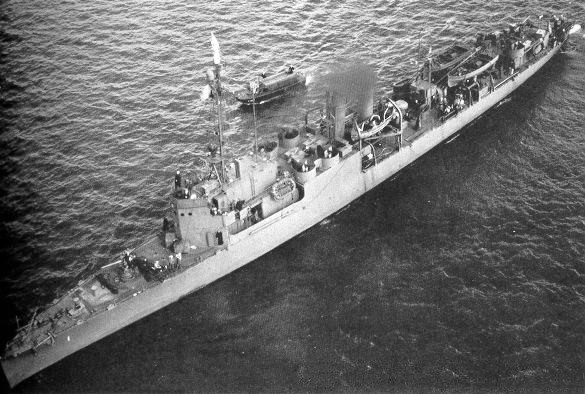
| Class | Clemson class |
|---|
| Type | Seaplane tender, destroyer (AVD) |
|---|
| Hull | AVD-1 |
|---|
| Builder | New York Shipbuilding Corp., Camden, New Jersey |
|---|
| Launched | 1920-09-15 |
|---|
| Commissioned | 1920-10-22 |
|---|
| Fate | Afloat. Clemson-class destroyer, later a seaplane tender. Laid down 19 March 1919, launched 15 September 1920, and commissioned 22 October 1920 as Destroyer No. 241. The ship history names the commissioning commanding officer Louis H. Mayfield. A second account names Irving Hall Mayfield. As DD-241 the ship history gives 1,215 tons, length 314 feet 4 inches, beam 31 feet 8 inches, draft 9 feet 10 inches, 35 knots, a complement of 137, four 4-inch guns, one 3-inch gun, and twelve 21-inch torpedo tubes. A second account gives a length of 314 feet 5 inches and a crew of 114. Reclassified AVP-14 on 1 July 1938. The ship history dates AVD-1 on 1 October 1940. A second account dates it 2 August 1940. In December 1941 she was AVD-1. In the Cavite yard for repair when the war opened, she maneuvered during the raid and was not hit. Decommissioned 10 December 1945, struck 3 January 1946, and sold for scrap 23 May 1946. Named for Earle W. F. Childs, lost on 2 March 1918. |
|---|
| Armament (class) | Flush-deck four-piper, the same pattern as the Wickes class. |
|---|
| Command | - Mayfield, Irving Hall Commander, 22 October 1920 – 20 October 1922
- Byrnes, Charles Carroll Jr. Lieutenant commander, 20 October 1922 – 27 December 1922
- Rowcliffe, Gilbert Jonathan Lieutenant commander, 27 December 1922 – 29 August 1923
- Goss, Nelson Henry Commander, 29 August 1923 – 1 January 1926
- Dessez, John Harrison Semmes Lieutenant commander, 1 January 1926 – 6 September 1927
- Hall, John Lesslie Jr. Lieutenant commander, 6 September 1927 – 31 May 1930
- Welden, Frederick Lieutenant commander, 31 May 1930 – 24 March 1932
- Fultz, Harold Farnham Lieutenant commander, 24 March 1932 – 4 June 1932
- Carter, Grayson Birch Lieutenant commander, 4 June 1932 – 29 January 1933
- Hungerford, Ralph Waldo Lieutenant commander, 29 January 1933 – 3 June 1933
- Sterling, Paul Raymond Lieutenant, 3 June 1933 – 18 June 1934
- Walker, Harold John Lieutenant commander, from 18 June 1934
- Culver, Burtnett Kent Lieutenant commander, 8 June 1936 – 30 September 1937
- Fick, Harold Foster Lieutenant commander, 30 September 1937 – 16 May 1940
- Pratt, John Lockwood Commander, 16 May 1940 – 10 April 1942
- O'Beirne, Frank Commander, 10 April 1942 – 9 November 1942
- Christopher, Thomas Aloysius Lieutenant commander, 9 November 1942 – 10 September 1943
- Ingebrand, Charles Daniel Lieutenant, 10 September 1943 – 17 April 1945
- Evans, Richard William Lieutenant, 17 April 1945 – 21 September 1945
- Welch, Ted J. Lieutenant, 21 September 1945 – 1 December 1945
- Patton, Robert E. Lieutenant, 1 December 1945 – 10 December 1945
|
|---|
Laid down, displacement, length, beam, draft, speed, and complement are not stored for each hull, so this table leaves them out.
The armament line is the class drawing, not a measurement of this hull.
Childs was a Clemson-class destroyer, named for Earle W. F. Childs. He was a lieutenant of the Naval Academy class of 1915, lost on 2 March 1918 when the British merchant ship Rutherglen rammed the British submarine H-5 off the Welsh coast. Childs was aboard H-5 as an observer. The destroyer was laid down on 19 March 1919 at New York Shipbuilding in Camden, New Jersey. She was launched on 15 September 1920. Mrs. Gertrude Childs, his widow, sponsored her. She was commissioned on 22 October 1920.
As a destroyer she was given as 1,215 tons, 314 feet 4 inches long, with a beam of 31 feet 8 inches and a draft of 9 feet 10 inches. Her speed was 35 knots. Her complement was 137. She carried four 4-inch guns, one 3-inch gun, and twelve 21-inch torpedo tubes. On 17 July 1920, before she was launched, she was designated DD-241.
On 14 May 1938 she cleared for Philadelphia to be converted to a seaplane tender. She became AVP-14, and then, in 1940, the destroyer seaplane tender AVD-1. She was ordered to the Asiatic Fleet and reached Cavite on 1 November 1940.
When the war opened she was in the Cavite Navy Yard for repair. On 10 December 1941, while Japanese aircraft were wrecking the yard, she maneuvered in the narrow harbor and was not hit. She tended PBY-4 Catalinas of Patrol Wing 10 from Manila for four more days. She then withdrew from base to base and reached Exmouth Gulf, Australia, on 28 February 1942. She kept that tender work from Fremantle and other ports on the west coast of Australia until 12 August 1944. She reached the west coast of the United States on 19 September 1944.
She was decommissioned on 10 December 1945, struck on 3 January 1946, and sold for scrap on 23 May 1946. She earned one battle star. She was not sunk.
A note on sources. The career, the 1,215-ton figures, the sponsor, the Cavite escape, and the sale on 23 May 1946 are the Navy's ship history. That history names Commander Louis H. Mayfield at the commissioning. A second account names Commander Irving Hall Mayfield. The ship history dates the change to AVD-1 on 1 October 1940 and does not date AVP-14. The second account dates AVP-14 on 1 July 1938 and AVD-1 on 2 August 1940. It gives an overall length of 314 feet 5 inches, a crew of 114, and a 3-inch 23-caliber gun. In December 1941 she was AVD-1, not still AVP-14. The combat narrative names Commander John L. Pratt as her captain. His tour in the second account runs from 16 May 1940 to 10 April 1942. The namesake is Earle W. F. Childs in the ship history.