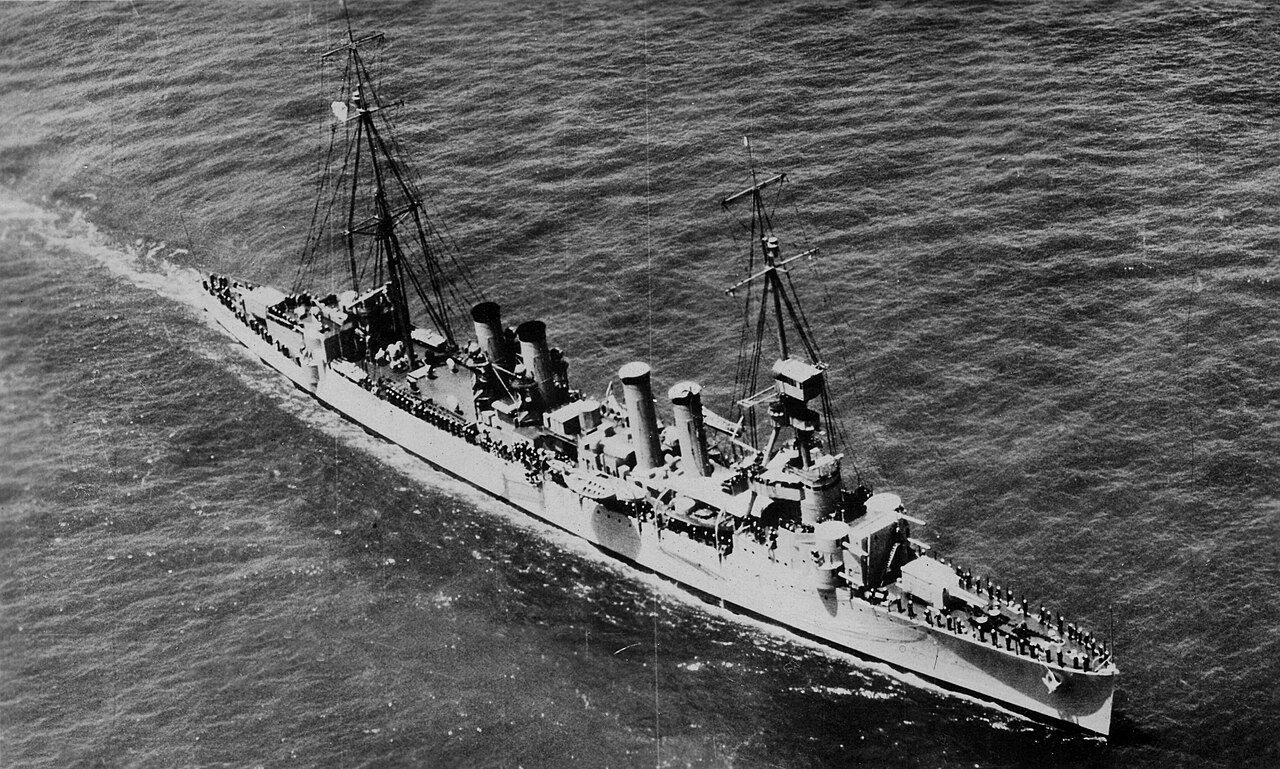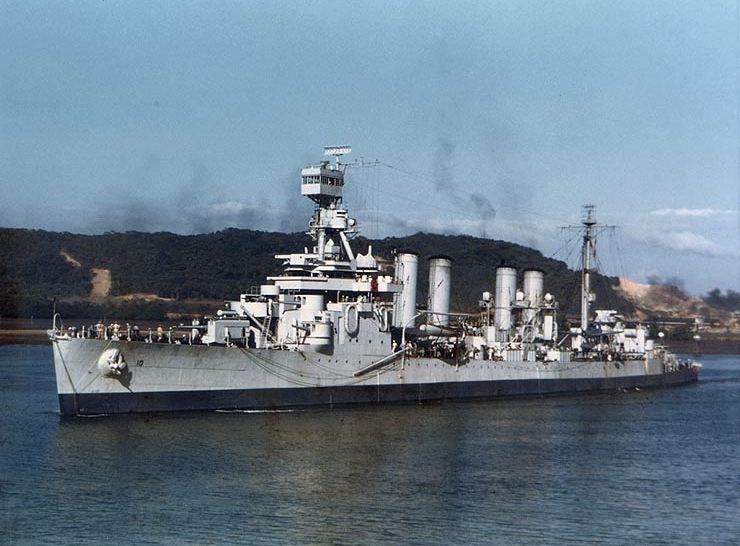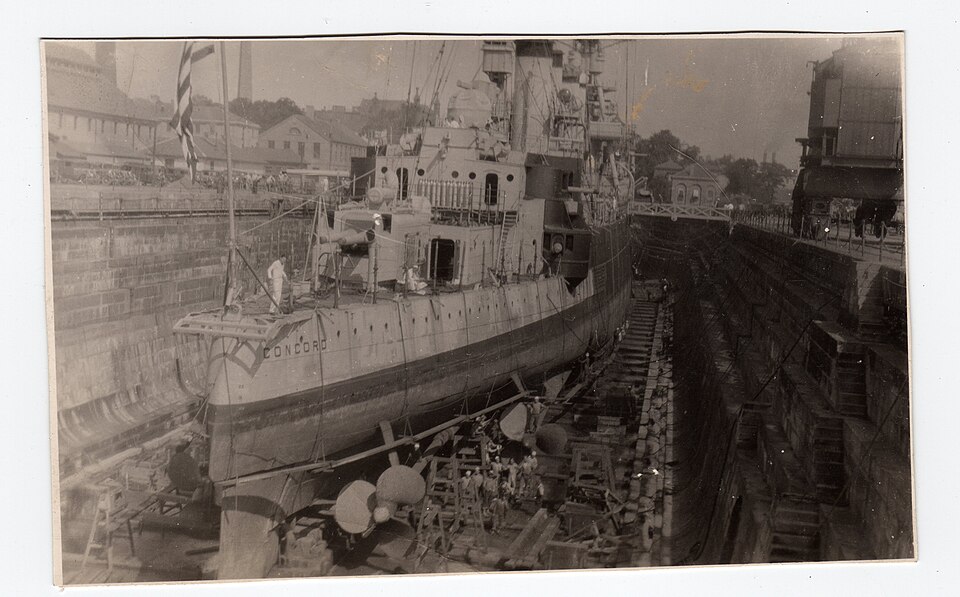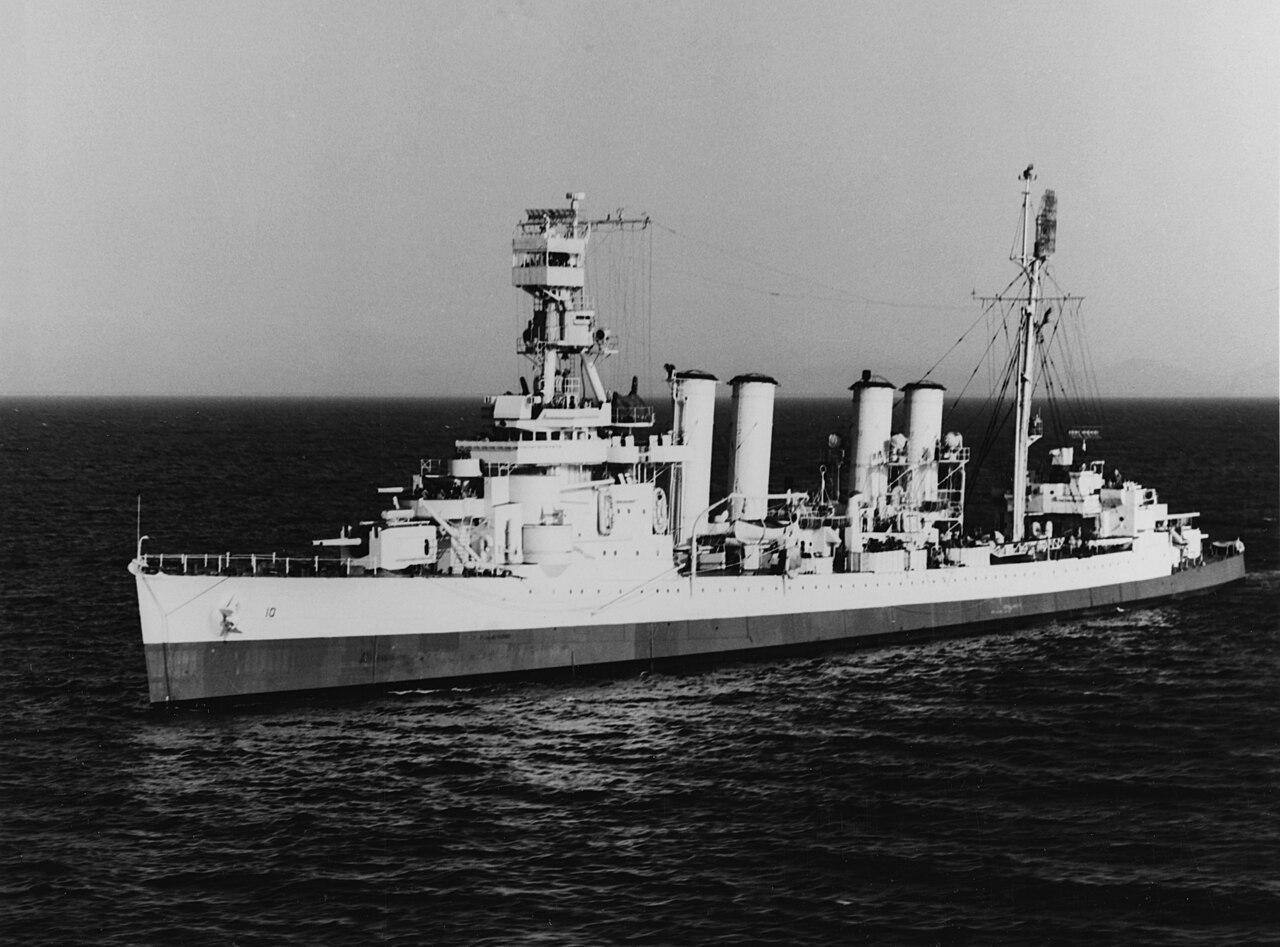
Concord, CL-10, was an Omaha-class light cruiser, the fourth Navy ship of the name, for the Massachusetts town where the first fighting of the American Revolution began on 19 April 1775. William Cramp and Sons of Philadelphia laid her keel on 29 March 1920. She went down the ways on 15 December 1921, sponsored by Miss H. Butterick, and the Navy commissioned her on 3 November 1923 with Captain O. G. Murfin in command. The DANFS line for the hull gives 7,050 tons, a length of 555 feet 6 inches, a beam of 55 feet 4 inches, twelve 6-inch guns, four 3-inch guns, ten 21-inch torpedo tubes, and a designed complement of 458.
Her maiden cruise, from 23 November 1923 to 9 April 1924, took her to Mediterranean ports, through the Suez Canal, around the Cape of Good Hope, and into the Caribbean before she came back to Philadelphia. As flagship of Commander, Destroyer Squadrons, Scouting Fleet, she worked the Caribbean and went through the Panama Canal to exercise in the Hawaiian Islands in 1924 and 1925. She was still an Atlantic ship when she joined the Presidential Fleet Review taken by Calvin Coolidge on 4 June 1927.
From early 1932 she was in the Pacific, based at San Diego, as flagship of Commander, Cruiser Division 3, Battle Force. She exercised in the Canal Zone and the Caribbean in 1934, stood in the Presidential Fleet Reviews Franklin D. Roosevelt took on 30 September 1935 and 12 July 1938, and joined fleet exercises off Hawaii, in the Canal Zone, and off Alaska. After a winter on the east coast in 1938–39 she returned to the Pacific, and from 1 April 1940 her base was Pearl Harbor. The training schedule tightened as the war came closer. Captain Ingram C. Sowell had her from 20 January 1940.
She was not at Pearl Harbor on 7 December 1941. DANFS places her at San Diego, preparing for a shipyard overhaul that she finished early in February 1942. The Navy then gave her to the Southeast Pacific Force. She escorted convoys to Bora Bora in the Society Islands, exercised in the Canal Zone, and cruised the coast of South America and the islands of the southeast Pacific, and from time to time she wore the flag of the force. Sowell was relieved on 13 July 1942 by Captain Irving R. Chambers.
Between 5 September and 24 November 1943 she carried Rear Admiral Richard E. Byrd on a survey of southeast Pacific islands, looking at what they might be worth for national defense and for commercial aviation. During that cruise a gasoline explosion killed 22 men, her executive officer among them, and did considerable damage. The ship was repaired at Balboa. Chambers left her on 16 December 1943. Captain Oberlin C. Laird took her the same day.
The repairs were finished in March 1944. She sailed north and joined the Northern Pacific Force at Adak on 2 April. At the start of that duty she was flagship of Task Force 94. She joined the bombardments of the Kurils that went on, at intervals, until the end of the war, the point of them being to keep the Japanese from making real use of those bases. The force harassed the northern shipping lanes and sank several small craft. On 25 August 1944 the destroyers of the force attacked a Japanese convoy. Laird was relieved on 10 October 1944 by Commander Cyril A. Rumble.
On 31 August 1945 Concord left Adak. She covered the occupation landings at Ominato, Japan, from 8 to 14 September, and then went on to Pearl Harbor, the Canal Zone, Boston, and Philadelphia. Captain Carl H. Bushnell had relieved Rumble on 23 September. She was decommissioned at Philadelphia on 12 December 1945 and sold on 21 January 1947. She received one battle star for World War II service.
A note on sources. The narrative follows the Naval History and Heritage Command's Dictionary of American Naval Fighting Ships entry for Concord IV (CL-10), the page published from the 2015 text on history.navy.mil, for dates, places, the explosion, and the sale. The keel date, the striking on 8 January 1946, and the sale to Patapsco Scrap Company of Bethlehem, Pennsylvania, for $67,228 are from NavSource and are not in that DANFS entry. NavSource also gives the sponsor as Miss Helen Bagley Buttrick; DANFS gives only Miss H. Butterick. A digitized copy of DANFS on the HyperWar site disagrees with the NHHC page on several points, and the NHHC page is followed here: HyperWar has the launch on 16 December 1921 rather than 15 December, the 1927 review taken by Herbert Hoover rather than Calvin Coolidge, Hawaiian exercises in 1926 rather than 1925, a Roosevelt review on 30 September 1936 rather than 1935, Byrd embarked on 6 September rather than 5 September, and the destroyer attack on a convoy on 26 August 1944 rather than 25 August. HyperWar also prints a different displacement, beam, and complement. NavSource's armament line shows two 3-inch guns and a speed of 35 knots; the DANFS line shows four 3-inch guns and 34 knots. The commanding officers and their dates are NavSource's list. DANFS names only Murfin, at the commissioning. Uboat.net gives Sowell's birth as 3 August 1889; the account used for him gives 2 January 1892. A letter from Byrd, reproduced on the Wikipedia page for Washington Irving Chambers, speaks of 24 men lost in the explosion; DANFS says 22, including the executive officer. NavSource lists Rumble as a commander and carries his command through 23 September 1945; uboat.net lists him as a captain from 18 June 1942. NavSource carries Bushnell through 21 December 1945, nine days after the decommissioning DANFS dates to 12 December.