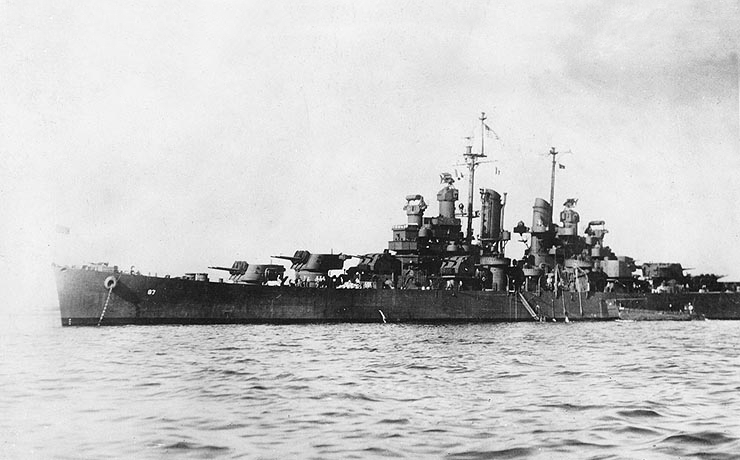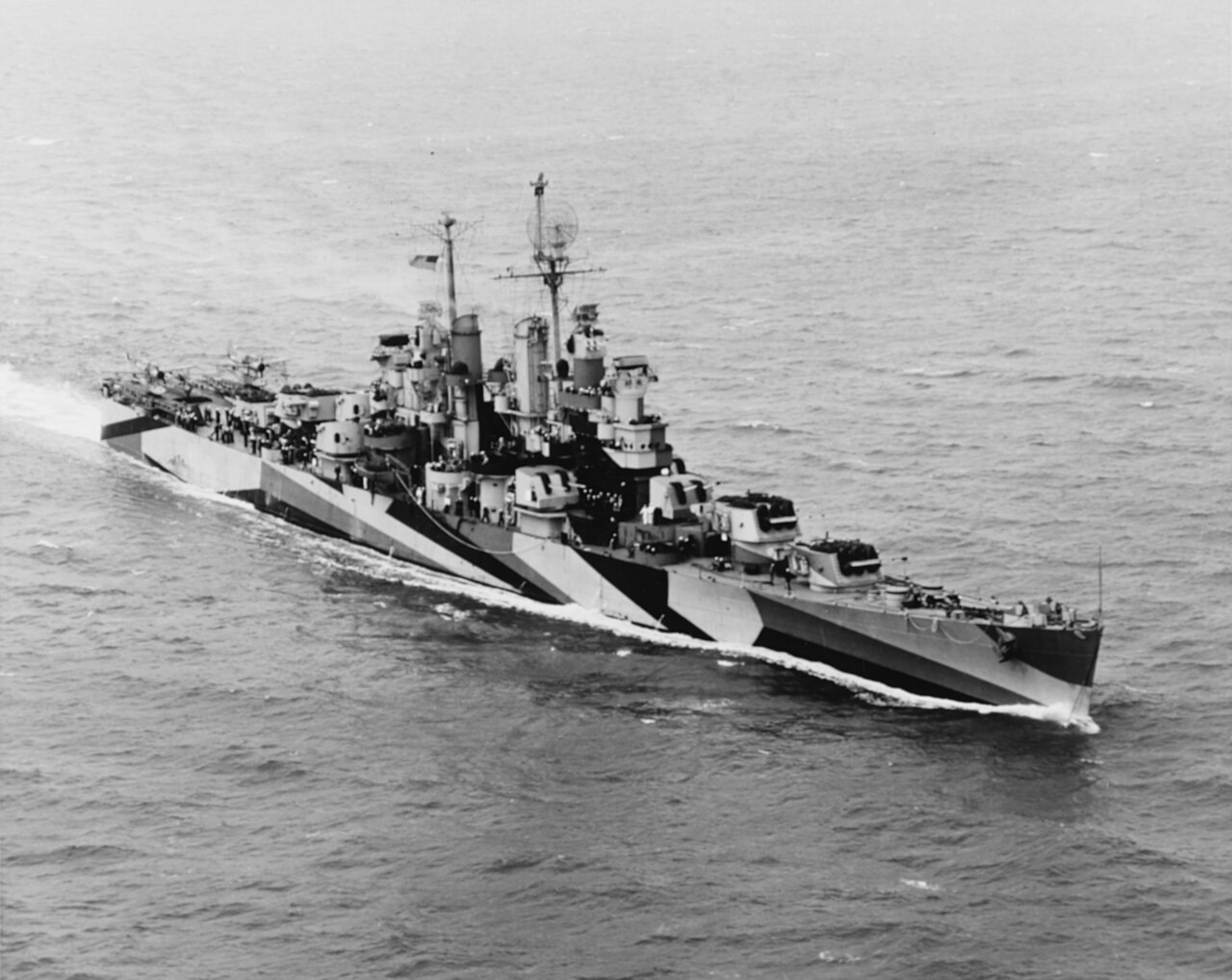
Duluth (CL-87) was a Cleveland-class light cruiser, named for the city in Minnesota. Newport News Shipbuilding and Dry Dock Company launched her at Portsmouth, Virginia, on 13 January 1944. Mrs. E. H. Hatch, wife of the mayor of Duluth, sponsored her. She commissioned on 18 September 1944, Captain Donald Roderick Osborn, Jr., in command. The DANFS line for the hull gives 10,000 tons, a length of 610 feet 1 inch, a beam of 66 feet 4 inches, a draft of 20 feet, 33 knots, a complement of 992, and twelve 6-inch and twelve 5-inch guns.
From 14 December 1944 to 2 March 1945 she served as a training cruiser at Newport, Rhode Island. After a brief overhaul at Norfolk she sailed for the Pacific on 7 April and reached Pearl Harbor on 29 April. On 8 May she got underway to join the Fifth Fleet and met the fast carriers on 27 May. A typhoon on 5 June did severe structural damage to her bow, and she returned to Guam for repairs. She rejoined Task Force 38 on 21 July and screened the carriers during the final air strikes on the Japanese home islands. Those strikes continued until the end of the war.
From 24 August 1945 until she entered Tokyo Bay on 16 September she stayed with Task Force 38. The force was on radar picket and combat air patrol for transport aircraft flying occupation troops into Japan. On 1 October she sailed for the United States and reached Seattle on 19 October for Navy Day.
Based at San Pedro, she served a tour in the Far East from 3 January to 27 September 1946. Captain Samuel Walter DuBois had relieved Osborn on 21 September 1945. On 24 February 1947 she sailed for an extended visit at Pearl Harbor. Between May and July she called at Melbourne and Sydney, at Truk, at Guam, and at Manila. She went out again to patrol the China coast from 22 September 1947 to 19 May 1948, and came back to a new home port at Long Beach. Commander John Joseph Hyland, Jr., relieved DuBois on 21 February 1948. In the summer of 1948 she took NROTC midshipmen on a training cruise to British Columbia. In February 1949 she joined cold-weather operations off Kodiak, Alaska. She was placed out of commission in reserve on 25 June 1949, with Hyland still in command that day. She was sold on 14 November 1960. She received two battle stars for World War II service. She was not sunk.
A note on sources. The narrative follows the short Naval History and Heritage Command Dictionary of American Naval Fighting Ships entry for Duluth (CL-87). The HyperWar copy of that entry was not available. The fetch of the usual HyperWar address returned no page. Digitized copies are what were used. DANFS places the builder at Portsmouth, Virginia. NavSource places the same company at Newport News, Virginia. The DANFS place is the one used above. NavSource, not DANFS, gives the keel, laid on 9 November 1942, and a striking date of 1 January 1960. DANFS gives the sale on 14 November 1960 and names no buyer and no price. The keel and the striking date are not stated above as DANFS facts. NavSource gives a draft of 25 feet, 32.5 knots, a crew of 1,255, and 40-millimeter and 20-millimeter guns. The short DANFS line gives a draft of 20 feet, 33 knots, a complement of 992, and the 6-inch and 5-inch batteries only. Those are the figures used above. DANFS names Captain D. R. Osborn, Jr., at the commissioning and does not name the later commanding officers. Their dates are NavSource's list. She received two battle stars. The entry does not name the actions those stars stand for.