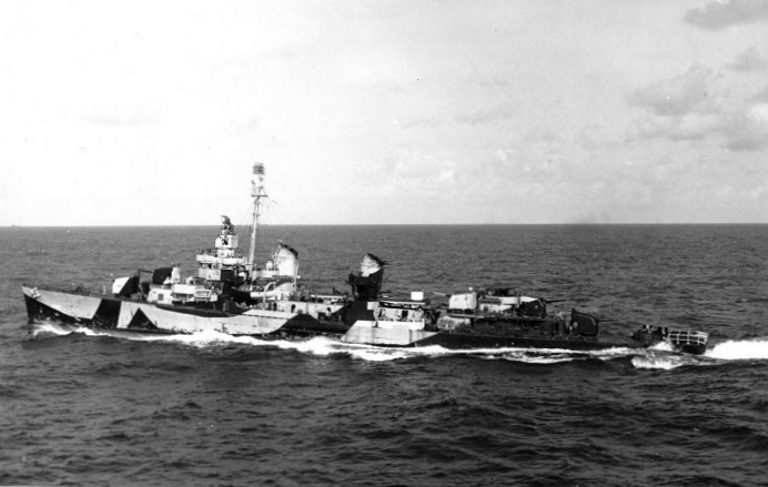
She was named for Rear Admiral Robley D. Evans, “Fighting Bob,” and built at Chickasaw, Alabama. Commissioned on 11 December 1943, she was a Fletcher: five 5-inch guns, a thicket of 40 mm and 20 mm, and a crew of a little over 300. Her war was mostly the unglamorous half of the Pacific drive. She screened replacement and fueling groups through the Marianas and the Palaus in the summer and fall of 1944, hunted submarines, and in January 1945 bombarded Yap. In February she screened the transports into Iwo Jima, put harassing fire on Japanese positions ashore, and stayed with the escort carriers until 8 March.
Okinawa began the same way. She cleared Ulithi on 21 March with the escort carriers, covered the pre-invasion strikes, and stayed with them through the 1 April landing until 2 May, when she put into Kerama Retto. On 10 May she sailed with Hugh W. Hadley for Radar Picket Station 15, about forty miles northwest of the transport area. Four smaller support craft went with them. The picket line existed so the fleet would not be surprised. The price was that the pickets met the raid first, and alone.
The raid that arrived before dawn on 11 May was the sixth mass kamikaze attack of the campaign. Estimates of the formation run from about 100 in the Presidential Unit Citation to 150–156 in the action accounts. Combat air patrol, Marine Corsairs and Navy Hellcats, broke up much of it. What got through came from every quadrant.
Evans fought for about an hour and a half under Commander Robert J. Archer. His Navy Cross citation credits the ship with fifteen planes shot down and four more shared. The unit citation is tighter: fourteen destroyed, three assisted, then one more shot clear of the ship in the final rush. Destroyer History’s later tally is nineteen plus four shared with Hadley. The numbers do not reconcile cleanly. What they agree on is that she was still shooting, and still undamaged, when the coordinated attack came.
Five planes came in together. She killed one clear. The other four hit. One bomb went down through the galley into the forward fireroom and wrecked both forward boilers. Another strike opened her below the waterline and flooded the after engine room. Oscars hit in quick succession and set gasoline fires. Every engineering space flooded. She lost power and steerage and lay dead in the water while Hadley fought on alone.
The guns were done. The rest of the crew was not. Portable extinguishers and bucket brigades worked the fire amidships with no pressure on the mains. The support craft closed in as the raid died away. Thirty-two men were dead and twenty-seven wounded. On 14 May she was towed into Kerama Retto. Emergency patches held her for the long tow to San Francisco. The war ended before anyone repaired her. She was decommissioned on 7 November 1945 and sold for scrap on 11 February 1947.
She earned the Presidential Unit Citation and five battle stars. The citation’s sentence is the one that still fits: she avoided damage until five planes came at once, shot one down clear, took the other four, and the crew saved a ship with no engines.
Between them, on one morning, the two ships’ guns were credited with something on the order of thirty-eight to forty-two aircraft, depending on which tally is used and how the shared kills are counted. The air patrol did the rest. Neither ship was repaired. Both were saved by men who had already lost the engines.