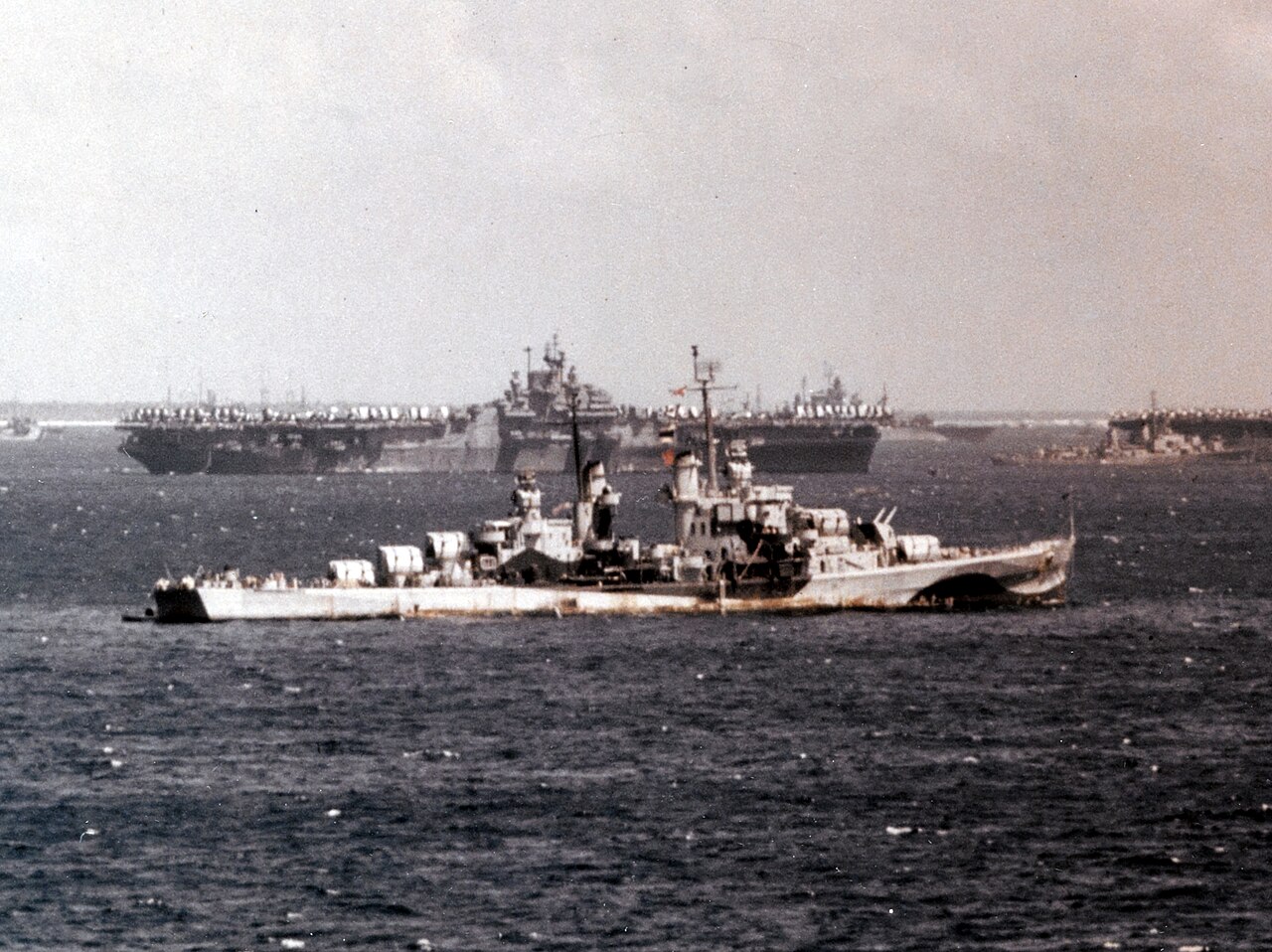
An earlier Flint (CL-64) was renamed Vincennes (CL-64) on 16 October 1942. The light cruiser that kept the name was Flint (CL-97), an Oakland-class ship, launched on 25 January 1944 by Bethlehem Steel Co. at San Francisco and sponsored by Mrs. R. A. Pitcher. She was commissioned on 31 August 1944 with Captain Charles Raymond Will in command, and the Navy reclassified her CLAA-97 on 18 March 1949. DANFS gives her 6,000 tons, a length of 541 feet 6 inches, a beam of 53 feet 2 inches, a draft of 16 feet 4 inches, a speed of 33 knots, a complement of 623, twelve 5-inch guns, and six 21-inch torpedo tubes.
She reported to the Third Fleet at Ulithi on 27 December 1944. Six days later she sailed with Task Force 38 for a month in support of the invasion of Luzon, screening the carriers while they struck Luzon, Taiwan, and the China coast, and firing antiaircraft cover during a Japanese kamikaze attack on 21 January 1945. She replenished at Ulithi from 26 January to 10 February, then sailed with the newly designated Task Force 58 for air strikes on Tokyo ahead of the attack on Iwo Jima. The force arrived off Iwo Jima on 21 February to fly air support for the Marines, who had landed two days before. Flint was back at Ulithi on 12 March for two days.
She went to sea again with Task Force 58 for strikes on Kyushu before the invasion of Okinawa, and from 18 to 22 March 1945 she helped bring down several airplanes in heavy attacks on the task force. The force then closed Okinawa, and Flint with other cruisers bombarded beach installations for the landings on 1 April. Aside from 14 to 24 May, when she was at Ulithi for upkeep, she stayed off Okinawa until 13 June, and then anchored in Leyte Gulf. On 1 July she sortied to screen the last air attacks on the Japanese home islands and to join the bombardment of the east coast of Honshu until the fighting stopped. On 24 August she took station off Nii Shima as rescue ship and homing station for transport planes carrying occupation troops. She lay in Tokyo Bay from 10 to 15 September, then sailed with a carrier task force on air and sea surveillance of central Honshu until 21 September.
Captain Will left her on 5 October 1945. Captain Elwood Dixon Poole had her from that day until 23 March 1946. In that stretch she made a voyage from Japan to Eniwetok, loaded servicemen at Yokosuka on 13 October, and brought them into San Francisco Bay on 28 November. She then went to Kwajalein for more men eligible for discharge, and reported at the Puget Sound Naval Shipyard, Bremerton, on 11 January 1946. Commander Willis Ormond Johnson relieved Poole on 23 March 1946 and had her until 26 October 1946. Commander Walter Philip Reuland, a Naval Reserve officer, relieved Johnson and was in command when she was placed out of commission in reserve at Bremerton on 6 May 1947. She received four battle stars for World War II service.
A note on sources. The wartime narrative is the Naval History and Heritage Command DANFS entry for Flint III (CL-97). The commanding officers and their dates are NavSource's list for CL-97, which matches the commissioning date and names Captain C. R. Will as DANFS does. HyperWar's page for CL-97 was not found. DANFS gives no keel date. NavSource dates the keel 23 October 1942 at Bethlehem Steel, San Francisco, and a Wikipedia infobox dates it 1 August 1941. Those two dates are left out of the narrative. NavSource also lists an inactivation on 1 June 1946, a striking on 1 September 1965, and a sale for scrap on 6 October 1966 to Zidell Explorations of Portland, Oregon. The Wikipedia infobox gives the striking as 1 June 1965 and the sale as 6 October 1966, without a buyer. DANFS stops at the decommissioning, the 1949 reclassification, and the four battle stars, so the later dates stay here. The Commons description of the March 1945 photograph, Navy number 80-G-K-3813, says she was probably at Ulithi and that the picture was taken from West Virginia (BB-48). The place is hedged, so no caption is attached. DANFS puts her off Iwo Jima on 21 February flying air support, and off Okinawa from the bombardment for the 1 April landings until 13 June. It does not name the Sibuyan Sea, Surigao Strait, Samar, Cape Engaño, or the 7 April sortie of Yamato. The January cruise in support of Luzon and the July and August strikes and bombardment of Japan are in the history and have no separate battle entry in the list used here. The four battle stars are the DANFS total. Digitized copies of the pages named above are the texts used.