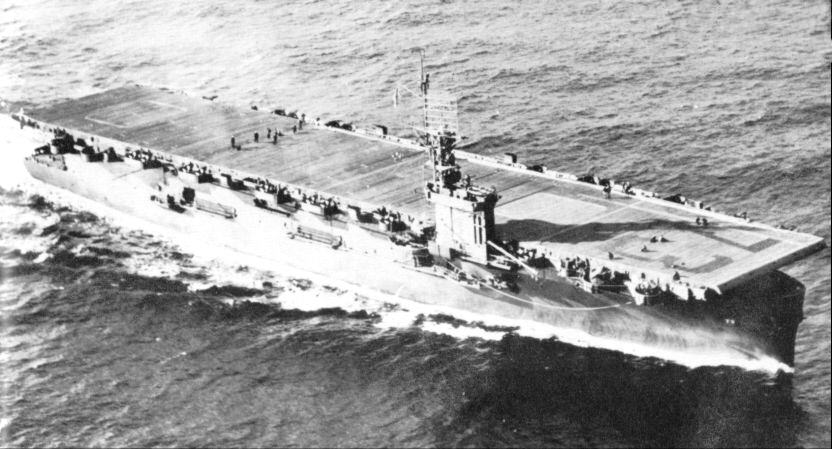
The "Bonus Ship"
Gambier Bay was named for a bay on Admiralty Island in the Alaska Panhandle. She was ordered as AVG-73, became ACV-73 on 20 August 1942 and CVE-73 on 15 July 1943. Kaiser launched her at Vancouver, Washington, on 22 November 1943, sponsored by Mrs. H. C. Zitzewitz, wife of Lieutenant Commander Herbert C. Zitzewitz, the Bureau of Ships liaison officer at the yard. She was commissioned at Astoria, Oregon, on 28 December 1943, Captain Hugh H. Goodwin in command. Kaiser had first planned to deliver 16 carriers in 1943. When the Navy asked for at least two more, the yard rallied its workers with the slogan "18 or More by '44." Gambier Bay was the 19th and last of the year, and the workers called her the "Bonus Ship."
Ferry runs and the Marianas
After shakedown she sailed from San Diego on 7 February 1944 with 400 troops for Pearl Harbor. Off the Marshalls, guarded by Norman Scott, she flew 84 replacement planes to Enterprise. On 1 May she joined Rear Admiral Harold B. Sallada's Carrier Support Group 2 for the Marianas. Her Composite Squadron 10 (VC-10) gave close support to the first Marine landings on Saipan on 15 June, hitting gun positions, troops, tanks and trucks, and eight of its pilots took off to help repel an air attack. She supported Tinian from 19 to 31 July and Guam until 11 August.
Samar
On 24 October 1944 Halsey's planes battered Kurita's Center Force in the Sibuyan Sea, and Halsey then went north after Ozawa. Early on the 25th Kurita came out of San Bernardino Strait upon Taffy 3. Gambier Bay's aircraft attacked with torpedoes, bombs and guns until their ammunition was gone, then flew "dry runs" with nothing in their guns to break up the Japanese formation. The destroyers laid smoke and charged in through the rain.
Gambier Bay sailed on the exposed rear of the formation. From about 22,000 yards Yamato hit her on the first salvo. An 18.1-inch shell smashed through her flight deck near the stern, and the fire was out in three minutes. The cruiser Chikuma closed to 10,200 yards before shifting fire to Samuel B. Roberts. Around 08:20 a hit flooded her forward engine room. Her speed fell to 10 knots, and within 15 minutes she was dead in the water. American accounts long credited cruiser fire. Japanese records say that hit too came from one of Yamato's 18.1-inch shells at about 20,000 yards. The Japanese cruisers never shifted to high-explosive shells, so their armor-piercing rounds would have passed through the thin-skinned carrier without exploding. Evidence suggests the cruiser column was firing at Kalinin Bay, next to her. She took at least 15 hits between 08:10 and 08:50, mostly from Yamato. Burning, she capsized at 09:07 and sank at 09:11, near 11°31′N 126°12′E.
She was the only American aircraft carrier sunk by enemy surface gunfire in World War II. Some 147 of her crew were killed. Nearly 800 survivors spent about two days in the water until landing and patrol craft from Leyte Gulf rescued them. Taffy 3 and the planes of Taffy 2, VC-10 among them, had stopped the Center Force. She received the Presidential Unit Citation. No ship of her class survives.
Sources
Wikipedia, "USS Gambier Bay" (citing DANFS; Hornfischer; Lundgren, The World Wonder'd, on Japanese records).
NHHC/DANFS, "Gambier Bay."