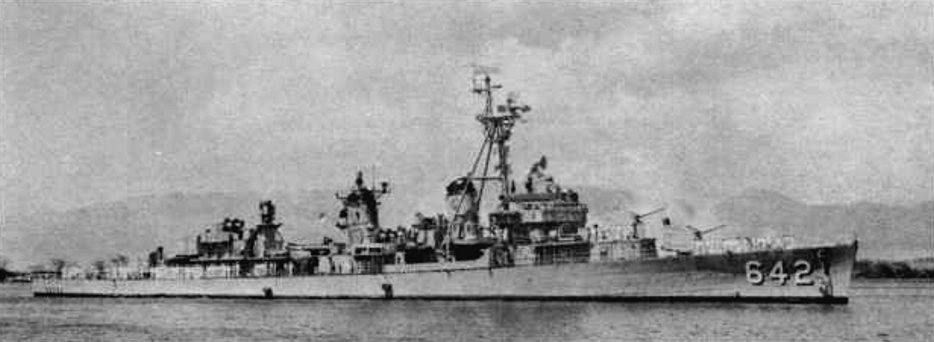
USS Hale (DD-642) was a Fletcher-class destroyer. Bath Iron Works launched her at Bath, Maine, on 4 April 1943, with Mrs. G. H. Chase, granddaughter of Senator Hale, as sponsor. The Navy commissioned her at Boston on 15 June 1943, and Karl F. Poehlmann took command that day.
Her opening weeks went to shakedown in the Caribbean and to drills along the East Coast. She cleared Halifax on 21 September, passed through the Panama Canal, and reached Pearl Harbor on 9 October 1943. On 8 November she sailed for the Gilbert Islands landings. From 18 to 20 November she screened carriers striking Tarawa, on the 19th she shelled Betio, and on the 20th she stood by the Marines as they went ashore. In the air attacks that followed, her guns brought several planes down. She then spent two days covering the damaged light carrier Independence as that ship drew away, and afterward rejoined the carriers for strikes on the Marshall Islands.
She was back at Pearl Harbor on 8 December to train the next assault troops and on 21 December sailed for the Ellice Islands. On 21 January 1944 she left for the Marshalls invasion. From 29 January to 22 February she shelled Maloelap and Wotje, both ahead of the landings and after them. Lieutenant Commander D. W. Wilson, her executive officer, took command on 2 March. She left Kwajalein on 11 March for Guadalcanal, patrolled against submarines while ships loaded, and on 27 March escorted reinforcements to Cape Torokina on Bougainville. During the Hollandia landings in New Guinea she screened escort carriers and watched for submarines, then lay in Seeadler Harbor from 4 to 7 May. Practice in the Solomons readied her for the Marianas. She joined strikes on Guam before the assault, called at Eniwetok on 14 July, and on 21 July supported the troops landing on Guam. On 4 August she was at Eniwetok again and, six days later, headed for Hawaiian waters to rehearse the Leyte assault.
On 15 September she sailed with troop transports for Manus, and on 14 October she left with the Southern Attack Force for the Philippines. On 18 October Nashville joined, General Douglas MacArthur aboard. Early on 20 October Hale entered Leyte Gulf and laid gunfire while troops took Dulag airfield. On 25 October, after the escort carriers' fight off Samar, she joined Rear Admiral Clifton A. F. Sprague. She next screened reinforcements from Morotai and put them ashore at Tacloban on 14 November. A further run from Hollandia to Leyte that November added to the Philippine buildup. On 24 November she started home by way of New Guinea, the Marshalls, and Pearl Harbor, and she reached San Francisco on 22 December 1944.
She returned to the Pacific early in 1945 and arrived at Pearl Harbor on 25 February. From Ulithi, on 14 March, she sailed with Rear Admiral Forrest Sherman's task force, built around the carrier Essex, to strike airfields ahead of the Okinawa landings. Between 19 and 21 March air attack hurt ships of the group, Franklin and Wasp among them, while Hale's gunners knocked down several of the raiders. The carriers and their destroyer screen then left the waters off Japan and turned to Okinawa, where aircraft covered the beaches and ships shelled shore targets before, during, and after the assault on 1 April. Through that stay she picked up two fighter pilots, turned away many kamikaze attacks, and came through a bombing run that fell close aboard. On 11 April she left the Okinawa area, stopped at Ulithi and Guam, and on 1 June entered Leyte Gulf while screening the battleship South Dakota.
She took the battleship Washington on to Guam and there met the tug Munsee, towing the bow of the cruiser Pittsburgh, torn away in a typhoon off Okinawa. Hale helped bring that tow into Apra Harbor. On 21 June she joined the Third Fleet at Leyte Gulf. On 1 July she sailed with Admiral Marc Mitscher's Task Force 38 for heavy strikes on Japan, and on 29 July she bombarded factories at Hamamatsu. When the fighting ended on 15 August she patrolled offshore to recover airmen while occupation troops landed. She entered Tokyo Bay on 16 September, left for the United States on 1 October with 100 veterans aboard, and reached Seattle on 19 October 1945. At San Diego she stayed in reserve commission until decommissioning on 15 January 1947.
The Korean War, and wider tension abroad, brought her out of reserve. She recommissioned at Long Beach on 24 March 1951. After another shakedown she crossed the Panama Canal and on 11 July 1951 arrived at Newport, Rhode Island, her new home port. Refresher work followed. On 22 April 1952 she left for the Sixth Fleet in the Mediterranean, called at sixteen ports, and was back in Newport on 23 October 1952. Over the next year and a half she trained against submarines off the Atlantic coast, guarded carriers during flight operations in the Gulf of Mexico, and took Naval Academy midshipmen to sea. A modernization overhaul at the Philadelphia Navy Yard ran from September 1953 into January 1954. On 1 June 1954 she began a cruise around the world, passed Panama into the Pacific, and served in the Far East. She went through the Suez Canal on 17 November 1954, visited Sixth Fleet ports, and returned to Newport on 18 December 1954.
She kept up that round of readiness work, and at Newport served as gunnery school ship for the Destroyer Force, until 6 November 1956. She then sailed for the Mediterranean again, met Sixth Fleet ships, and waited in the eastern Mediterranean through the Suez Crisis, on hand for American interests while the trouble was held from spreading. Newport received her on 20 February 1957. She had come through the Second World War. On 23 January 1961 the United States transferred her to Colombia.