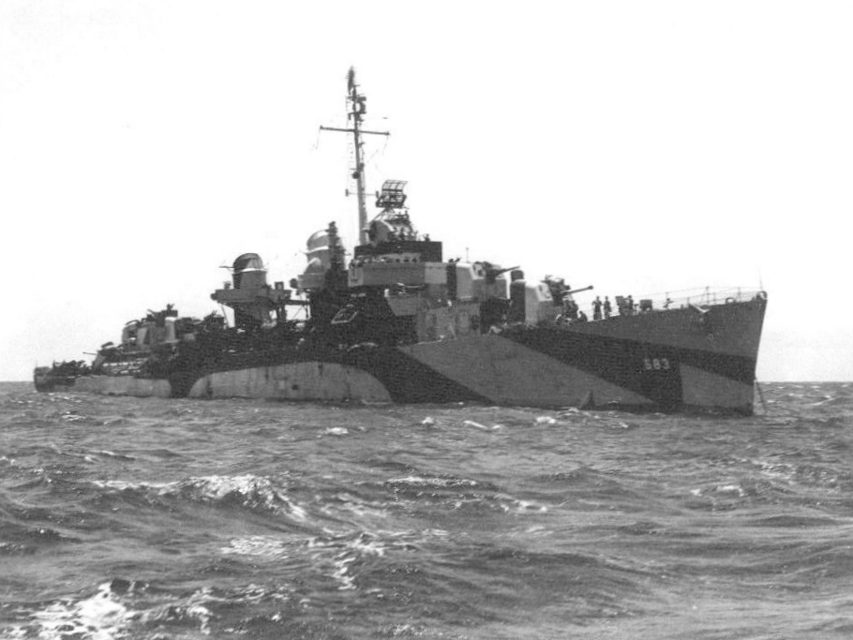
USS Hall (DD-583) was a Fletcher-class destroyer. She was named for Elijah Hall, born in Raynham, Massachusetts, on 8 December 1742. On 14 June 1777 he received a lieutenant's appointment in the Continental Navy and joined John Paul Jones in the frigate Ranger. The ship left for France on 1 November 1777 and captured two prizes before making port. On 10 April 1778 she put out from Brest for a cruise in the Irish Sea. Hall shared in the seizure of several vessels, went ashore on St. Mary's Isle on 23 April, and the next day was present when HMS Drake was taken. He had charge of the sailors who brought that prize into Brest. He continued as a lieutenant in Ranger until captured at Charleston, South Carolina, on 12 May 1780. Set free when the war ended, he took up residence in 1818 at Portsmouth, New Hampshire, served in various local posts, and died there on 22 June 1830.
Boston Navy Yard began construction on 16 April 1942. Launch came on 18 July 1942, sponsored by Mrs. Elizabeth Williams Greenleaf, a great-granddaughter of Lieutenant Hall. Commissioned on 6 July 1943, the destroyer had John Francis Delaney as her first commanding officer. She left Boston on 11 August 1943 for East Coast shakedown and on 28 September reported at Norfolk for duty. Serving as escort, she took the French transport Richelieu toward Boston on 2 October and was back three days later. Escort work in the Norfolk and Boston area went on until 5 November, when she sailed with the destroyers Halligan and Macomb on special duty. At sea the three ships met Iowa. The battleship had President Franklin D. Roosevelt aboard, with other officials, on the way to the conference at Teheran. The Atlantic crossing was completed safely. Near Gibraltar on 17 November the destroyers handed off the escort. They carried out convoy and antisubmarine searches off the west coast of Africa until 6 December, then met Iowa again and accompanied the presidential party on the return.
The Pacific was her next station. She departed Charleston, South Carolina, on 21 December and reached Pearl Harbor on 11 January 1944. On 22 January the ship cleared Hawaii with Rear Admiral Richmond K. Turner's expeditionary force for the seizure and occupation of the Marshall Islands. Detached with three cruisers and three other destroyers, she helped wreck Tarao's airfields. In the bombardment of 30 January her shells blew up a gasoline dump, the blast enormous, and struck several emplacements. She then screened the heavier ships until the firing ended. With Tarao out of the fight, the force moved on to Kwajalein for the principal assault. Across the weeks of that invasion her tasks kept changing. On 4 February she supported soldiers landing on Burnet Island. On 18 February, off Eniwetok, she covered the Engebi landing and fired in support. On 22 and 23 February her star shells illuminated Parry Island as troops landed. From 29 February to 26 March she escorted transports to Pearl Harbor and back, then shifted to patrol and lifeguard work in the Kwajalein area.
On 4 April, while looking near Wotje for a Marine flyer down at sea, Hall had two 6-inch shells fall close aboard from an enemy battery ashore. One sailor died. She shot back, continued the search, and finally picked up the airman. She kept at the Marshalls operation until leaving Majuro on 12 May, and she entered Pearl Harbor on 18 May. Laurence Charles Baldauf relieved John Francis Delaney the following day, 19 May 1944. Under Baldauf she screened twelve fleet oilers that refueled 5th Fleet ships during the Marianas campaign, making two such voyages from Majuro. On 26 August her base moved to Seeadler Harbor, Admiralty Islands, where she guarded fueling and replacement groups for the Carolines landings through 24 November.
On 29 November Hall left Manus Island for Humboldt Bay, New Guinea, and joined the 7th Fleet for the Philippines operation then building. She convoyed amphibious ships loaded with troops and entered Leyte Gulf on 7 December 1944. Four days afterward she left San Pedro Bay for Mindoro with that island's attack group. Air attack was frequent and severe as the column passed Surigao Strait and entered the Sulu Sea, but by 13 December the escorts had destroyed four planes. On 15 December Hall, with the other escorts, covered the landing in Mangarin Bay. Japanese planes struck the first assault wave with bombs and strafing runs. From her offshore station she patrolled and fired. Ships' gunfire and the covering aircraft accounted for 15 dive bombers during those opening landings.
Two further escort runs to Leyte Gulf followed. Hall then became part of the covering force commanded by Admiral Jesse B. Oldendorf for the assault at Lingayen Gulf. Sailing 30 December, the ships crossed the Sulu Sea bound for Luzon. On 3 January 1945 they met determined enemy air strikes. Close fighter protection and the group's guns drove the attackers off. The raids grew worse, and battle stations lasted almost without a break for more than four days. A kamikaze on 4 January left the escort carrier Ommaney Bay fatally hit and burning. After she was abandoned, torpedoes fired by American ships sank her. Over the next two days the Japanese attacks were heavier still. Suicide planes crashed into more than 16 vessels, California and New Mexico among the battleships struck, although Hall and the ships with her kept up a thick fire. That defense beat back the kamikazes and saved the transports and the landing force from destruction.
Baldauf's tour ended on 31 May 1945, and John Daly Pye Hodapp became commanding officer. Hall survived the war. She went into reserve and, on 9 February 1960, was transferred to the Hellenic Navy. Renamed Lonchi, she served the Greek navy until 1990 and was scrapped in 1997.