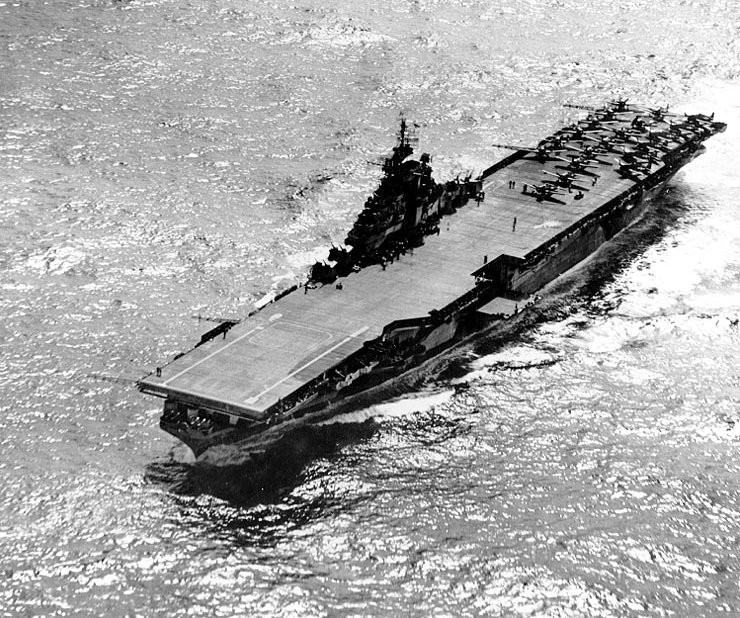
Building and namesake
Hancock was the fourth Navy ship named for John Hancock, president of the Second Continental Congress and first governor of Massachusetts. Bethlehem Steel laid her down at Quincy, Massachusetts, on 26 January 1943 as Ticonderoga. On 1 May 1943 she swapped names with CV-14, then building at Newport News, so that the Massachusetts yard could build the ship named for the Massachusetts patriot. She was launched on 24 January 1944, sponsored by Juanita Gabriel-Ramsey, wife of Rear Admiral DeWitt Clinton Ramsey, Chief of the Bureau of Aeronautics. She was commissioned on 15 April 1944, Captain Fred C. Dickey in command. After shakedown off Trinidad and Venezuela she returned to Boston for alterations on 9 July 1944.
The Philippines, 1944
On 10 October 1944, off the Ryukyus, her planes destroyed seven aircraft on the ground and helped sink a submarine tender, 12 torpedo boats, two midget submarines and four cargo ships. During the Formosa strikes a bomber dropped a bomb off her port bow seconds before her guns shot it into the sea. On 18 October she struck Laoag, Aparri and Camiguin in northern Luzon, and then Cebu, Panay, Negros and Masbate. She struck Manila with Rear Admiral Bogan's group on 29 October. On 17 November Vice Admiral John S. McCain came aboard, and she became flagship of Task Force 38. On 25 November a kamikaze dove on her out of the sun. Flak exploded it 300 feet up, but part of its fuselage fell amidships and a burning piece of wing landed on the flight deck. She covered the Mindoro landings with strikes on Clark and Angeles fields from 14 December. In Typhoon Cobra on 17 December, waves broke over her flight deck 55 feet above the waterline.
The South China Sea and Japan
She struck Luzon on 7–8 January 1945 and Formosa on 9 January, then swept into the South China Sea. She hit a convoy north of Cam Ranh Bay, sinking two ships and damaging 11, and struck the airfields at Saigon. On 21 January, the day after she struck Formosa again, one of her returning planes made a normal landing, taxied abreast the island, and blew apart. The explosion killed 50 men and injured 75. She was back in formation the next morning to strike Okinawa. She struck Tokyo on 16 February and Chichi Jima and Haha Jima on 19 February to isolate Iwo Jima. On 20 March, while she was fueling the destroyer Halsey Powell, a kamikaze dove on both ships. It was destroyed 700 feet overhead, its fragments hit Hancock's deck, and its engine and bomb crashed into the destroyer's fantail. Her gunners shot down another attacker.
She struck the Nansei Shotō from 23 March and gave close support to the Tenth Army's landing on Okinawa on 1 April. On 7 April a kamikaze crashed among the aircraft on her flight deck and its bomb hit the port catapult. Sixty-two men were killed and 71 wounded. The fires were out in half an hour, and she was back in action within the hour. After repairs she sailed from San Pedro Bay on 1 July and struck Tokyo's airfields on 10 July and onward to the end. Her planes flew over Missouri at the surrender on 2 September. She entered Tokyo Bay on 10 September and carried 1,500 passengers from Okinawa to San Pedro, arriving on 21 October 1945. She earned four battle stars.
Second career and fate
She was decommissioned, rebuilt, and recommissioned on 15 February 1954 as an attack carrier (CVA-19), the first carrier in the fleet with steam catapults. On 17 June 1954 off California she launched the first aircraft ever catapulted by steam from an American carrier. She tested Sparrow and Regulus missiles and Cutlass jets, deployed to the Seventh Fleet from 1955, and stood off Quemoy and Matsu during the Taiwan Strait crises. She served off Vietnam from 1964 through 1972, when she returned to Yankee Station on 30 March during the North Vietnamese invasion, and earned a Navy Unit Commendation. In 1975 she took part in Operation Eagle Pull, the evacuation of Phnom Penh on 12 April, and Operation Frequent Wind, the evacuation of Saigon on 29–30 April. She was decommissioned on 30 January 1976, struck the next day, sold for scrap on 1 September 1976, and broken up at Los Angeles in 1977.
Sources
Wikipedia, "USS Hancock (CV-19)" (citing DANFS).
NHHC/DANFS, "Hancock IV."