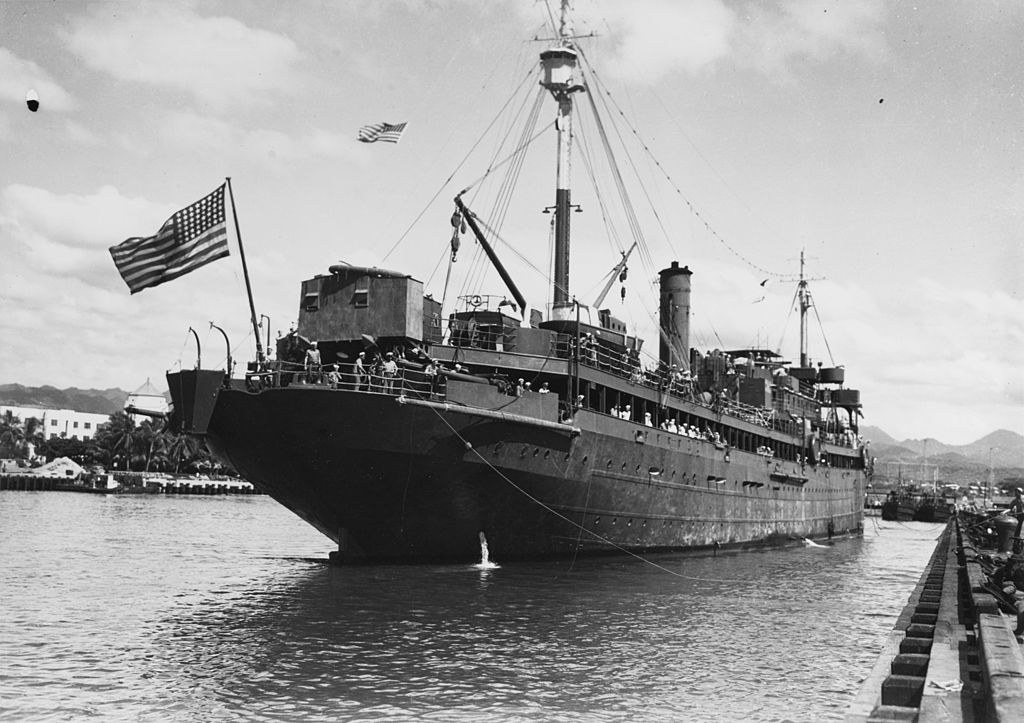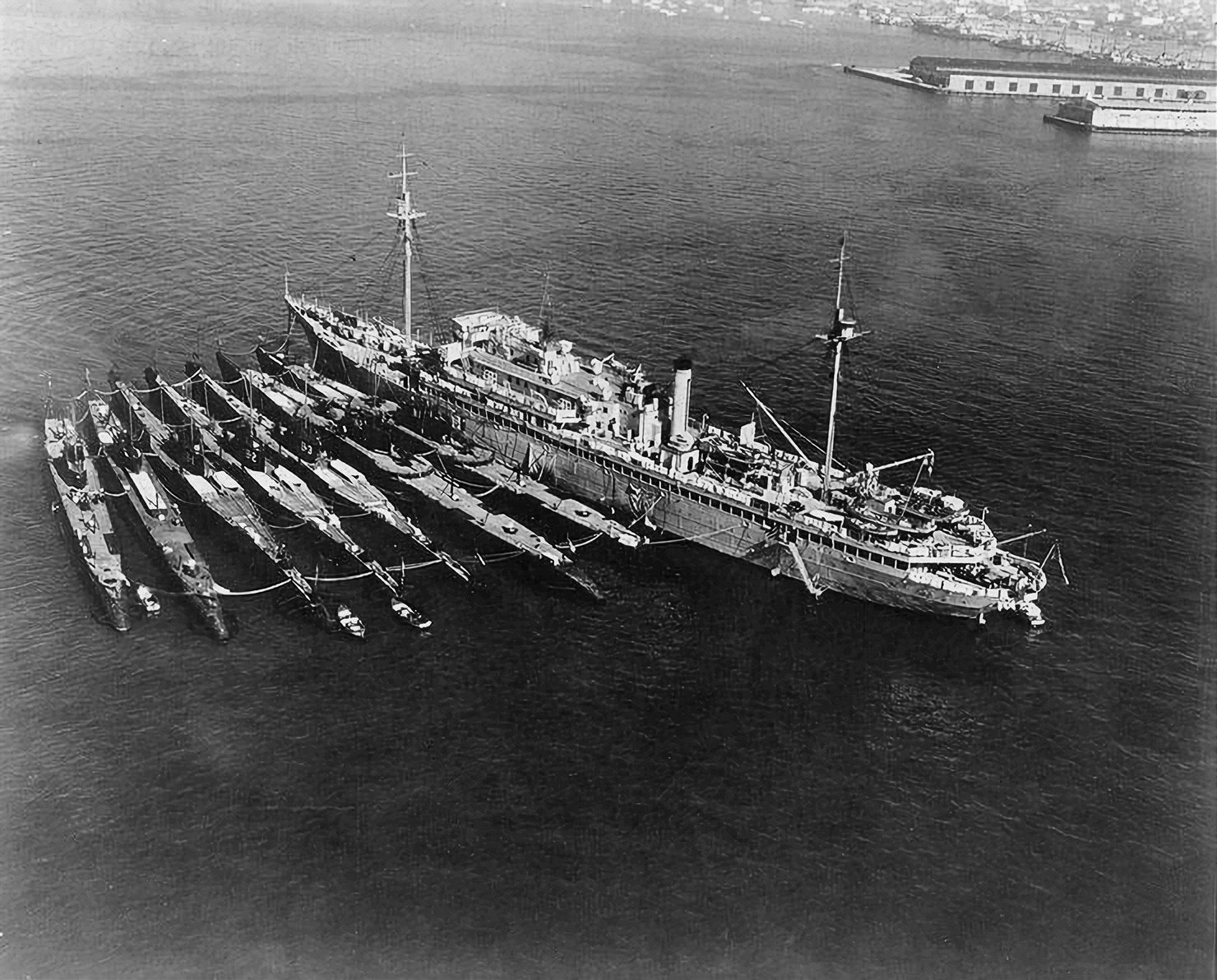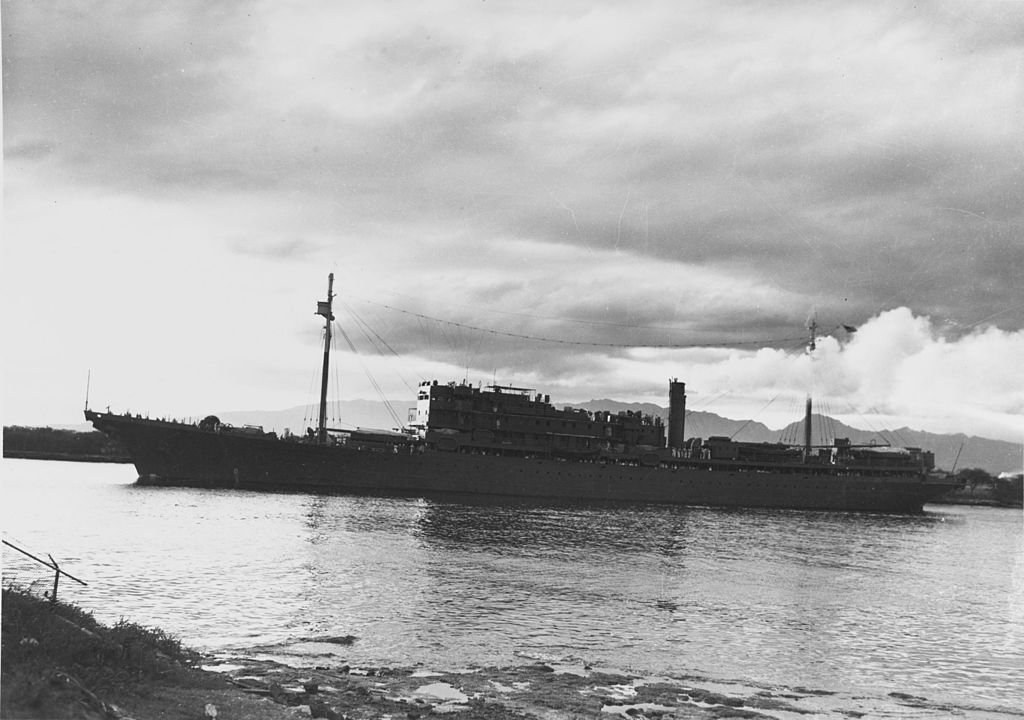
John Philip Holland was born at Liscannor, County Clare, Ireland, on 29 February 1840. As a young man he thought about the submarine as a weapon for Irish independence. He came to the United States in 1873. In 1875 he offered submarine designs to the Navy, and the Navy turned them down as unworkable. He kept at the problem. A privately built Holland, launched in 1898, was the first submarine with the power to run submerged for any considerable distance. The Navy bought her after hard trials and ordered six more of the type. Holland died at Newark, New Jersey, on 12 August 1914. The tender commissioned in 1926 was the second ship of the name. A later submarine tender, AS-32, was a different ship, and so was the 1898 boat.
The Puget Sound Navy Yard at Bremerton laid the tender down on 11 April 1921 and launched her on 12 April 1926. Mrs. Elizabeth Saunders Chase, daughter of Admiral J. V. Chase, sponsored her. She was commissioned on 1 June 1926, with Commander John Bayliss Earle in command. The Dictionary of American Naval Fighting Ships gives her as 8,100 tons, 483 feet 10 inches long, with a beam of 61 feet 1 inch and a draft of 16 feet 9 inches, a complement of 388, and a battery of eight 5-inch guns and four 3-inch guns. She came down from the yard to San Francisco and became flagship for Captain J. T. Thompkins, Commander Submarine Divisions, Battle Fleet. On 24 September she was permanently assigned to base at San Diego. From there she tended submarine divisions, and she made periodic trips to Panama to service the boats based at the Canal Zone.
Commander Milo Frederick Draemel had her in 1927 and left on 23 July 1928, when Captain David Allen Weaver relieved him. On 5 November 1930 she became flagship for Captain Chester W. Nimitz, Commander Submarine Divisions, Battle Fleet, with additional duty as commander of Submarine Division 20. That first command was abolished on 1 April 1931. Nimitz kept his flag in her as commander of the division, now Submarine Division 12, and left her on 17 June 1931. Captain W. L. Friedell then had the submarine command, with his flag in the tender. Captain Draemel returned as commanding officer on 1 June 1931 and had her into 1933. From March to July 1933 she was also temporary flagship of the Submarine Force. Captain Lemuel Mussetter Stevens had her in 1933 and left on 15 August 1934. Captain John Wilkes Rankin took command that day. In June 1935 she became joint flagship of Submarine Squadron 6 and Submarine Division 12. Captain Howard Hartwell James Benson had her from 8 June 1936. Captain William Middleton Quigley had her from 1 June 1938 into June 1940. The squadron-and-division flag duty lasted until June 1941, when she became flagship of Submarine Squadron 2.
Commander Oberlin Carter Laird had her from 3 July 1940 to 1 October 1940. Captain Walter Edward Doyle relieved him and stayed until 9 July 1941. Commander Joseph Wesley Gregory then had her. On 22 November 1941 she arrived at the Cavite naval base to service the submarines of the Asiatic Fleet. Air raids in the first days of December drove her out of Manila Bay at night, carrying repair parts and spares for those boats. She was not hit in two air raids while she was at Balikpapan, Borneo. At Soerabaja, Java, she repaired a submarine that had been damaged in action. Two destroyers joined her there and escorted her to Darwin, where she arrived on 2 January 1942. The work at Darwin ran around the clock: docks and floats, and the repair and fitting out of ships and submarines. On 3 February she got under way for Tjilatjap, Java, to take Rear Admiral Charles A. Lockwood, Jr., and the staff of the Asiatic Fleet submarine force on to Australia. Sailfish ended a patrol at Tjilatjap on 14 February 1942 and was refitted there by the tender. The Navy Unit Commendation covers her service in those first months of the war.
Gregory left her on 5 April 1942. Commander Perley Earl Pendleton took command that day. He was promoted to captain on 20 June 1942 and remained until 1 October 1943. While she was based in Australia she serviced and overhauled submarines. She returned to the Mare Island Navy Yard for overhaul in late February 1943, and she reached Pearl Harbor from the West Coast in June. In the next eleven months she finished 22 submarine refits and 13 repair jobs. Captain George Thomas Boldizsar had her from 1 October 1943 to 31 December 1943. Captain Joseph Philip Thew had her from 31 December 1943. On 1 June 1944 she shifted to Midway Atoll, and the next month she sailed to support submarines in the Marianas. Her second battle star is for the capture and occupation of Saipan, 29 July to 10 August 1944. Commander Carroll Quinn Wright, Jr., had her from 21 May 1944 to 15 December 1944. Her executive officer, Commander James Alexander Flenniken, was acting commanding officer from 15 December 1944 to 15 March 1945. She was back at Pearl Harbor late in November 1944 to be fitted as headquarters ship for Vice Admiral Lockwood, Commander Submarine Force, Pacific Fleet.
In January 1945 she left Pearl Harbor for Guam and embarked Lockwood. By the end of hostilities she had given submarines 55 refits, repaired and served 20 surface craft, and done jobs on shore installations. Wright returned on 15 March 1945. On 30 August 1945 Lockwood moved the submarine-force flag ashore to Coconut Island in Apra Harbor. The same day the tender was reclassified the repair ship ARG-18. Newer submarine tenders had taken over the work she had done for the boats. With some alterations she headed for Buckner Bay, Okinawa, embarked Rear Admiral Allen E. Smith, Commander Service Squadron 10, and his staff, and anchored in Tokyo Bay on 29 September 1945. Wright left her on 13 October 1945. Commander James Walker Hager had her, as ARG-18, until 2 November 1946. Lieutenant Commander Laurence Ernest Tagtmeyer then had her. On 6 June 1946 she sailed by way of Pearl Harbor and reached San Diego on 28 June. She went to San Pedro for inactivation at the Terminal Island Navy Yard, was towed back to San Diego, and was decommissioned there on 21 March 1947, with Tagtmeyer still in command. She lay in the San Diego group of the Reserve Fleet until her name was struck on 18 June 1952. The hull was sold for scrap to the Bethlehem Steel Company on 3 October 1953. She earned two battle stars. The first is the Philippine Islands operation, 8 December 1941 to 2 January 1942. The second is Saipan. The Navy Unit Commendation is the other wartime award on her record.
A note on sources. The career is the Dictionary of American Naval Fighting Ships entry for Holland II (AS-3), read from the HyperWar transcription, and NavSource's page for AS-3. Commanding officers and their dates are that NavSource table, with the spellings used by the Navy's own sketches where the two differ: Bayliss, not the Bayless of one photograph title; Boldizsar, not Boldizar; Perley Earl Pendleton, not Pearley Earl Pendelton; Joseph Philip Thew, where one submarine-command compilation prints Phillip. NavSource gives Earle's relief and Draemel's first start only as 1927, Weaver's end as a question mark, Draemel's second tour as ending in 1933, Stevens's start as 1933, and Rankin's tour as beginning on 15 August 1934 with no end printed. Benson's line ends in a mistyped June 1938. His biographical sketch says he assumed command of Reina Mercedes in July 1938, and Quigley's line starts on 1 June 1938. A NavSource line places Commander William Bryan Coleman in Holland in 1939, with no months, across Quigley's tour. Coleman's official sketch has him as maintenance officer at the Naval Training Station, San Diego, until 1939, then in command of Bushnell, and in 1940 as executive officer of Portland. He is not counted here among her commanding officers. NavSource prints Gregory's name inverted and gives him the class of 1927. His class is 1917, and a temporary captaincy dated 1 January 1942 falls inside the Holland tour. Thew's NavSource end is 21 May 1944, the day Wright's line starts. A submarine-command compilation ends Thew's Holland tour in April 1944 and starts him in Sperry on 4 April 1944. Flenniken is marked on NavSource as a Naval Reserve officer and as executive officer acting as commanding officer. His Academy class and his Silver Star citation treat him as a regular officer. The Dictionary prints the San Francisco arrival as 24 April and does not give the year. It spells the Java port Tjilaljap. It spells Thompkins as printed. It gives speed as 10 knots. NavSource gives 16 knots, an overall length of 513 feet 1 inch, a wartime complement of 74 officers and 724 enlisted, and a wartime battery of four single 5-inch/38 guns and four twin 40 mm mounts. The Dictionary's dimensions are the ones in the story. Nimitz, Friedell, Thompkins, Lockwood, and Allen E. Smith flew flags in her. They were not her commanding officers. Sailfish's 14 February 1942 refit at Tjilatjap is from the boat's patrol dates as compiled on uboat.net. The two battle-star periods are NavSource's. The Dictionary states the Navy Unit Commendation and the two stars and does not name the star periods. She was at Darwin from 2 January 1942 and sailed on 3 February. The Darwin raid was 19 February. She had been at Pearl Harbor in October 1941 and was at Cavite on 22 November. She was not in the harbor on 7 December.