Ships
- USS Washington (BB-56) Captain from 15 May 1941 · Relieved in July 1942
The initials are the index form. The Register of Commissioned and Warrant Officers prints the name in full, Howard Hartwell James Benson, and indexes him as Benson, Howard H. J. The Lucky Bag of 1909 heads his class page the same way, in the black-letter the class used for its seniors. He is not his father, William Shepherd Benson, and he is not Francis W. Benson, James F. Benson, Roy S. Benson, or Ralph H. Benson, Jr.
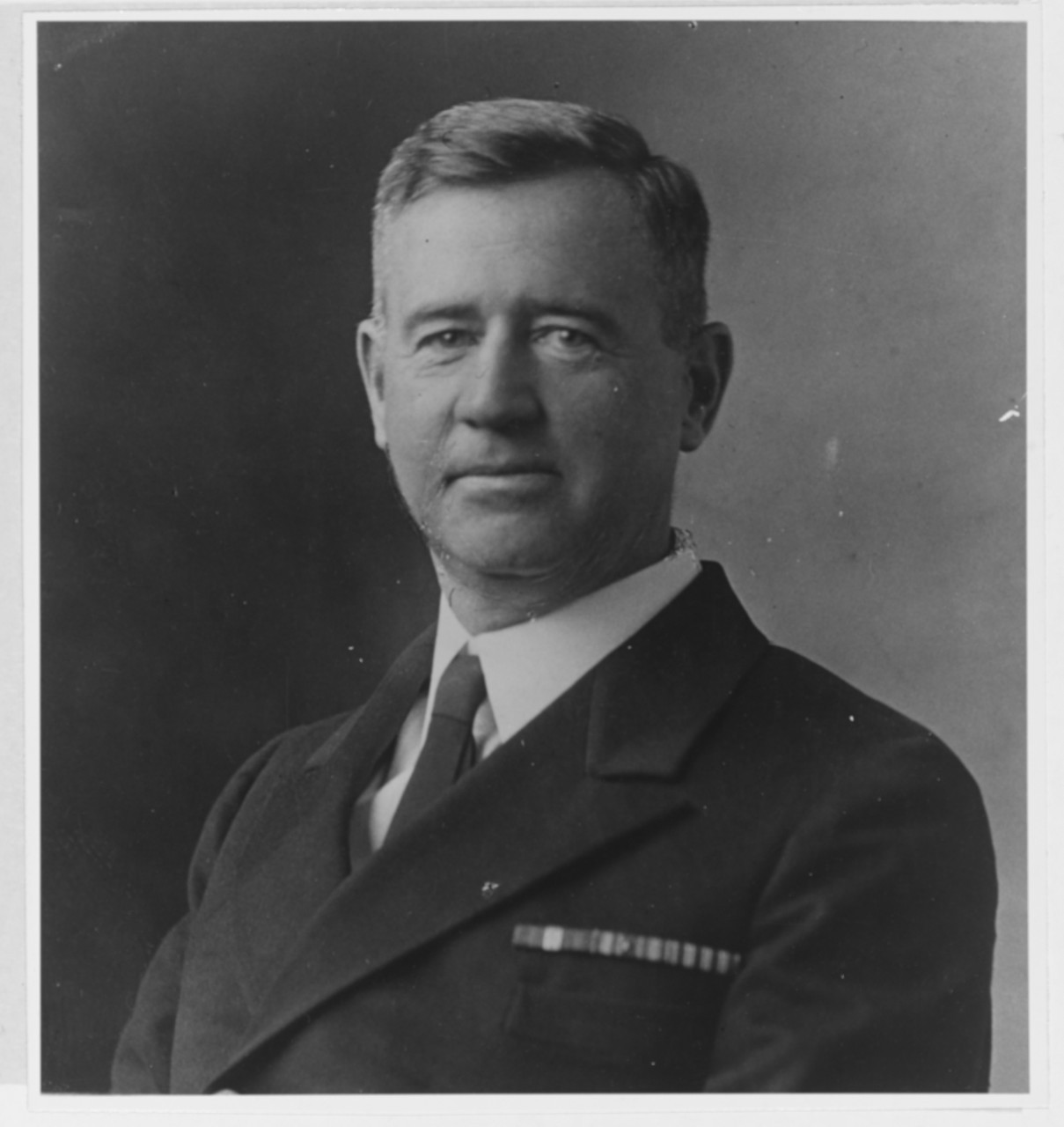
Washington was commissioned at the Philadelphia Navy Yard on 15 May 1941 with Captain Howard H. J. Benson in command, and the Dictionary of American Naval Fighting Ships says so in those words. The command had already started, on paper, six weeks earlier, and it ended in July 1942, before the ship he had commissioned ever sailed for the Pacific. The Navy Directory of 1 April 1941, the day the Navy's own later sketch says he reported for fitting-out duty, already lists "Benson, Howard H J, capt, comdg u s s Washington." He brought her out, worked her up, took her to Scapa Flow, and was detached in July 1942 while she was coming home to the New York Navy Yard. The night action off Guadalcanal in November 1942, and everything Washington did after 23 August 1942, belongs to other captains.
Origins
He was born in Baltimore on 8 October 1888, son of William Shepherd Benson and Mary A. Wyse Benson. The Navy's biographical sketch, prepared in the Office of Information and dated 6 October 1970, states the day, the city, and both parents, and calls the father Admiral William Shepherd Benson, both parents by then dead. The registers that can be read cleanly put the same birthday on his line. The 1 July 1943 book prints 8 Oct. 88 beside Howard Hartwell James Benson, and the 1 July 1945 book prints 8 Oct. 88 and a date of entry of 29 June 05. The stone transcribed at Arlington gives the same birth date. The registers do not print Baltimore. The city is the Navy sketch, not the register.
The appointment that took him to Annapolis was not a Maryland appointment. The sketch says he entered the Naval Academy in 1905 from the Sixth Georgia District, was graduated in 1909, and then did the two years at sea the law then required before a commission. The class book explains the geography the register does not. His classmates called him a son of the sunny South. They did not, on the page, name a town in Georgia, and this essay does not invent one. Baltimore is the birthplace in the Navy sketch. The South is the identity the class gave him. Both can be true of a naval family that moved with orders. The sketch does not say why the warrant came from Georgia.
He was graduated with the Class of 1909. In the Lucky Bag he is "Benny," "Beany," and "Howard," with three stripes, which is to say cadet lieutenant, and the company list in the same book makes him cadet lieutenant of the Ninth Company. The class gave him crew manager, class football, and the interclass sailing championship, and then a paragraph that is classmate prose, not an official fitness report. He was, they wrote, slow, easy-going, steady, upright, with a conscience as long as a navigation practical work. He had a beard early. He "rhinos" all the time, they said, not because he was sore but for lack of anything better to do. The word is theirs; this essay will not translate it into a modern mood. What they were sure of was the sailing. Prize sailor of the class, never more at home than with a tiller in his hand and the lee rail awash, winning the annual sailing race each year as a matter of course, skipper of the sloop Robert Center on two summer cruises down the bay. A separate cruise sketch in the same book names Howard Benson as skipper of the Center in the summer of 1907, second-class year, with five classmates, bound for the Jamestown exposition. The biography page adds that he had an easy time with the professors until first-class year, that he stayed by a launch in some disaster the page does not explain, and that in first-class year he caught what they called the love microbe and went about with a faraway look. They do not name the woman. They close the professional forecast in one line: a born sailor who bid fair to be as excellent an officer as his father.
That last clause is the only hint the class book gives of the household he came from. The father is not named there. By the 1 January 1912 register the father is on the active list as Captain William S. Benson, and the son, on another page, is Ensign Howard H. J. Benson. The 1970 sketch is the document that puts Admiral in front of the father's name. It does not recite the father's commands. The son grew up inside a Navy that already had a Benson of flag rank in prospect, and his classmates knew it well enough to measure him by it.
Formation
The two years before the commission were in Vermont. The sketch says that and nothing more about the cruise. He was commissioned ensign on 5 June 1911. The 1 January 1912 register still has him an ensign, signal number 1546, indexed as Benson, Howard H. J. The station column in that year's text does not stay with his name, so the register as read here does not prove which ship he was on that New Year's Day. In April 1912 he was detached from Vermont with orders to Castine and the American Submarine Flotilla, for instruction. He qualified in submarines in July 1913. The sketch then says he fitted out and commanded H-2. It does not give the day he took her or the day he left her, and no deck log was read for this essay. Between January and March 1916 he had a short tour at the Washington Navy Yard, and from then until July 1917 he was in the Bureau of Steam Engineering. The later web transcription of the same sketch says Bureau of Engineering. The 1970 typescript, which is the earlier text, says Steam Engineering, which is what the bureau was still called in 1916.
In the summer of 1917 the Navy sent him to the Boston Navy Yard to help fit out steam fishing vessels for distant patrol, and then to the patrol squadrons based on France. The sketch gives the French duty as a succession, not as one command: aide to the commander of Patrol Forces Three and Four; command of Guinevere, Corona, Noma, and Roe; and duty, not described as command, in Sigourney. The Navy Cross citation, as the sketch prints it, names only two of those ships. It cites him for distinguished service as commanding officer of Corona and later of Roe, "engaged in the important, exacting and hazardous duty of patrolling the waters infested with enemy submarines and mines, in escorting troops and supplies through these waters, and in offensive and defensive action, vigorously and unremittingly prosecuted, against all forms of enemy activity." A published rendering of the same decoration, on the Hall of Valor, uses different verbs in three places: "and" rather than "later," "protecting vitally important convoys" rather than "escorting," and "enemy naval activity" rather than "enemy activity." The original general order was not in hand. The Navy's own sketch is what is quoted here. Either way the citation is the broad World War I patrol citation, not a named action. It does not say he sank a submarine, and this essay will not say it for him.
The 1 January 1918 register lists him as a lieutenant, still indexed Howard H. J. Benson. The duty column in that book is scrambled in the text that survives, so it does not confirm which of the patrol ships he had on New Year's Day 1918. By the 1 January 1922 register the index has moved him to lieutenant commander. The date he put on each half-stripe between ensign and lieutenant commander is not in any line read cleanly for this essay. The sketch says only that he advanced progressively, and then gives the two dates it cares about for the top of his career: captain, which the registers fix at 1 November 1937, and commodore, to date from 27 November 1944.
After the war he came home to new destroyers. In January 1919 he had fitting-out duty in Buchanan at Bath Iron Works and took command when she went into commission that month. The sketch does not give the day of the month. In February 1920 he went to Yarnell, and in March 1920 to Howard. Two commands in two months is what the sketch says. It does not say why the first was so short. From September 1920 to June 1922 he taught electrical engineering and physics at the Academy. Then the Pacific: Destroyer Squadrons, Pacific Fleet, in command of S. P. Lee, and from October 1922 the battleship Tennessee, first as first lieutenant and then as navigator, until March 1925.
The next two years were at the Hydrographic Office in the Bureau of Navigation. The 1 January 1927 register still has him a lieutenant commander and places him at the Bureau of Navigation, with 9 May 1925 and April 1925 in the duty-date columns beside his name. It says Bureau, not Hydrographic Office. The sketch supplies the office. In May 1927 he took Sloat. The sketch does not say when he left her, only that he was detached in time to attend the senior course at the Naval War College from June 1929 to May 1930. The Navy sketch credits him with the Second Nicaraguan Campaign Medal and does not say on which ship, or on which beach, he earned it. Sloat and the months in Tennessee as executive officer fall inside the years for which that medal was given. That is a coincidence of dates, not a finding. The medal is not pinned to a cruise here.
From the War College he went back to Annapolis, to the Department of Navigation. He headed it from 6 February 1932 to 25 July 1932. While he was in that chair the Academic Board, of which he was a member, studied the curriculum. The change the sketch records is the merger of Navigation and Seamanship into one department, carried out the next year, after he had gone back to sea. The officers of the department finished a revision of Dutton's Navigation and Piloting. The sketch does not say the revision was his alone, and it does not say he was still head of department when the merger took effect.
In July 1932 he took Sapelo. A month later he was ordered as executive officer of Tennessee, the battleship he already knew from the mid-1920s. On 4 May 1934, with the United States Fleet anchored in Colon harbor, Tennessee's commanding officer was taken ill and sent to a hospital ship. Benson assumed command. The sketch says that under his command the ship got underway with the fleet for an anchorage near Culebra, that maneuvers were held on the way, that further drills were held near Culebra and on the way north, and that at New York the fleet was reviewed by President Franklin D. Roosevelt. It does not name the captain he relieved. It does not say whether anyone offered him the ship for good or only for the passage. The next assignment in the sketch is the Army War College in Washington, June 1934 to June 1935. As the Navy tells it, the battleship command lasted from the first days of May into June.
A year at the Army War College was followed by the Shore Establishments Division in the Navy Department. In June 1936 he went back to sea in command of Holland. The 1 July 1936 register, in which he is still a commander, prints "Commanding Holland" on his line, in the same column where the men above and below him are printed with their own stations. In July 1938 he took Reina Mercedes, the station ship at the Naval Academy, and kept her until March 1941. On 1 November 1937, while that shore-and-station-ship stretch was underway, he was promoted to captain. The 1 July 1940 and 1 July 1941 registers both give 1 November 1937 as his date of rank.
The war, as he lived it
On 1 April 1941 he reported at the Philadelphia Navy Yard to fit out Washington. The same day's Navy Directory already calls him her commanding officer. She was commissioned on 15 May 1941, Captain Howard H. J. Benson in command. The 1 July 1941 register prints 15 May 41 in the duty-date columns on his line, and June 38 beside it, which sits where the end of the previous tour would sit if the columns have been read right. Reina Mercedes in the sketch runs to March 1941, not June 1938. June 1938 is close to the July 1938 the sketch gives for the start of that command, and it may be a reporting date rather than a relief date. The text layer of the register does not label the column on the same line as his name. The 15 May 1941 date is the one that matches every other record of the commissioning.
What he had was a new 35,000-ton battleship, nine 16-inch guns, not yet worked up, and not yet at war. Through the rest of 1941 her shakedown and training ran along the eastern seaboard and into the Gulf of Mexico, sometimes with North Carolina and the new carrier Hornet. She became flagship for Rear Admiral John W. Wilcox, Commander, Battleship Division Six, and Commander, Battleships, Atlantic Fleet. Benson was the captain under that flag. The sketch and the ship's history agree that the ship stayed in the Atlantic. They do not agree in detail about every week, because the sketch is a career summary and the ship's history is a narrative, and only the ship's history has the day-by-day.
On 26 March 1942, at Portland, Maine, Washington sailed as flagship of Task Force 39, still flying Wilcox's flag, to reinforce the British Home Fleet. With her went Wasp, Wichita, and Tuscaloosa. The next day, 27 March, in moderately heavy weather, the man-overboard alarm sounded on Washington. A muster showed that Admiral Wilcox was missing. Tuscaloosa, a thousand yards astern, dropped life buoys. Two destroyers searched the wake. Planes from Wasp flew in spite of the weather. Lookouts on Wilson saw the body, face down, and could not recover it. At 1228 the search was abandoned. The ship's history says the circumstances have never been fully explained, and that one line of thought is a heart attack. It does not say the captain was blamed, and it does not quote him. Command of the task force passed to Rear Admiral Robert C. Giffen, whose flag was in Wichita. Benson was still captain of the ship that had lost its admiral on the first full day out of the United States.
The force reached Scapa Flow on 4 April and joined the Home Fleet under Admiral Sir John Tovey, in King George V. Washington exercised with British ships into late April. Task Force 39 was then redesignated Task Force 99, with Washington as flagship. On 28 April she sailed on reconnaissance for the convoys carrying lend-lease supplies to Murmansk. The Navy sketch describes those sorties as guard duty against probable attack by the German force in the northern Norwegian ports, Tirpitz, Lützow, Hipper, and Scheer, in the Greenland and Norwegian Seas and the Arctic Ocean, with the ice barrier on the north side of the route. On one sortie, the sketch says, Washington reached 76 degrees 20 minutes north, 10 degrees 20 minutes east. The sketch does not say the German ships came out, and the ship's history does not describe a surface action under Benson. The threat was the work. The battle with those ships was not.
The loss on that cruise was British, and it nearly became his. On 1 May 1942 King George V collided with the destroyer Punjabi and cut her in two. Punjabi sank across Washington's bow. The battleship had to pass between the halves. Punjabi's depth charges exploded under the hull. The ship's history says Washington took no major hull damage and opened no serious leak from the concussion, but that some of her fire-control gear and radars were damaged and a diesel-oil tank leaked. She stayed at sea until 5 May, then went into Hvalfjörður in Iceland to provision from Mizar. On 12 May the American and Danish ministers to Iceland called on Admiral Giffen and inspected the flagship. Task Force 99 sailed again on 15 May, met units of the Home Fleet, and was back at Scapa Flow on 3 June. On 4 June Admiral Harold R. Stark, Commander, Naval Forces, Europe, came aboard and broke his flag, using the ship for a temporary headquarters. On 7 June King George VI came aboard at Scapa Flow to inspect her. The ship's history tells that as the ship's occasion. It does not describe what the captain said to the King. Benson was still in command. The sketch's detachment is July.
After Stark left, the ship went back to the lanes toward the Russian ports. On 14 July 1942, at Hvalfjörður, Giffen hauled down his flag and shifted to Wichita. The same day Washington, with four destroyers, sailed for home. She reached Gravesend Bay, New York, on 21 July, and on 23 July she went into the New York Navy Yard for overhaul. The sketch says Benson was detached from command in July 1942 and reported the next month as chief of staff to the commandant of the Seventh Naval District. It does not give the day he left the quarterdeck, and it does not say whether he asked to go or was ordered. A date of 25 July 1942, and the name of the officer who relieved him, appear on compiled commanding-officer lists. They are not in the ship's history read here, and they are not in the Navy sketch. They are not used.
What is certain is the sequel in the ship's history, and it is the point of the compiled list's silence. Washington finished the yard and sailed for the Pacific on 23 August 1942. On 14 September, at Tongatabu, Rear Admiral Willis A. Lee broke his flag in her. In the night action of 14–15 November she fought Kirishima off Savo Island. Benson was by then in Miami. The thirteen battle stars the ship eventually earned, and the Arctic-to-Pacific sentence the ship's history closes on, are the ship's, not the man's. He had her for the working-up, for the Atlantic flagship duty, for the loss of Wilcox, for the Punjabi charges, for the King, and for the run home. He did not have her for the battle that made her name.
The Miami job is the rest of his war, and the decoration he received for the war was for that, not for Washington. He reported in August 1942 as chief of staff to the commandant of the Seventh Naval District, headquarters in Miami. In September 1944 the title became chief of staff to the commandant of the Seventh Naval District and to the commander of the Gulf Sea Frontier. The Legion of Merit citation, as the sketch quotes it, runs from 14 August 1942 to 12 September 1944 in the first title, and from 12 September 1944 until the cessation of hostilities in the second. Twice he was acting commandant of the district and acting commander of the frontier: 3 February 1943 to 1 April 1943, and 25 March 1944 to 17 July 1944. The citation says that in the first of those spells aggressive operations were pursued against enemy submarines in the waters of the Gulf Sea Frontier. It does not name a boat or a sinking. It says he was personally responsible for finding people, standing up activities and advance bases, organizing the staff, and keeping liaison with the Army and the Coast Guard, at a headquarters that was new. It says he applied himself to difficult problems of housing and discipline in Miami, and that the work called for loyalty, judgment, firmness, and ability. That is the Navy's adjective list, from the citation, not a diary.
On 27 November 1944, still in that assignment as far as the sketch tells it, he was made commodore, to date from that day. The 1 July 1945 register prints 27 Nov. 44 on his line, then "Capt." and 1 Nov. 37, then the birth and entry dates. Read against the sketch, that is temporary commodore rank over a permanent captaincy dating from 1937. The Legion citation addresses him as commodore. The sketch does not say on which day the medal was signed.
The cost, and what remained
The war he was decorated for in 1918 was other men's convoys, in small ships, in mined water. The war he was decorated for in 1942–45 was a staff in a city that had a housing shortage and a discipline problem, and a gulf in which submarines were hunted while he was acting commander for two months in 1943 and again in the spring and early summer of 1944. The command that put him on the compiled list sat between those two decorations and produced no third one. The Navy Cross and the Legion of Merit are the two awards the sketch narrates. It does not record a decoration for Washington.
What the sketch adds, without a story attached, is the rest of the ribbon bar: the World War I Victory Medal with Patrol Clasp; the Second Nicaraguan Campaign Medal; the American Defense Service Medal with Fleet Clasp; the American Campaign Medal; the European-African-Middle Eastern Campaign Medal; the World War II Victory Medal. The European-African-Middle Eastern medal is the one that covers Scapa Flow and the Arctic convoy routes. There is no Asiatic-Pacific medal in the list the sketch gives, which fits a man who left Washington before she went west. Brazil gave him the Order of the Southern Cross and a diploma. The sketch gives no date and no reason. Britain, on 7 October 1946, gave him a certificate of mention in a despatch, with the oak-leaf emblem. The sketch says "for distinguished service" and stops. A London Gazette entry for that mention was not found in this pass. The date is twenty-five days before he retired.
He was transferred to the retired list on 1 November 1946. The sketch does not name a duty between the end of hostilities and that day. It does not say he stayed in Miami until the retirement, and it does not say he went anywhere else. The Legion citation stops at the cessation of hostilities. The fifteen months after that, if he was still on active duty, are not described.
The 1970 sketch ends with the medals. It was written while he was alive. The Navy's later web page of the same sketch adds one sentence: he died on 28 January 1975. It does not say where. A memorial at Arlington transcribes a stone: Howard Hartwell James Benson, Commodore, U.S. Navy, 8 October 1888 to 28 January 1975, and his wife Elizabeth Rea Thompson, who died 11 March 1961. The same memorial's contributor links give her a birth date, a marriage year of 1917, a plot in Section 3, and three children, one of them an infant who died in 1919. Those links are not the stone, and they were not confirmed in a register, a census, or an obituary read for this essay. They are not used as fact. The Lucky Bag joke about a girl in 1909 is not evidence about Elizabeth Rea Thompson. The Navy sketch of 1970, which names his parents, does not name a wife or a child. What he is known to have left, on a stone the Navy did not write, is a wife's name and the rank commodore.
The place of death is the gap that secondary pages fill with Greenbelt, Maryland. No obituary, no death certificate, and no Navy casualty notice was found to support the town. The date is in two places that do not depend on each other: the Navy's updated biographical page, and the Arlington transcription. The town is not.
He was a captain's son who became a commodore and not an admiral, a submarine officer who spent the middle of his life teaching navigation and then took a battleship because the captain was ill, and the first captain of a ship whose famous night was fought by someone else. The records that say so are consistent on the large things. They are thin on the private ones, and they are silent on why, in July 1942, the Navy took him off Washington.