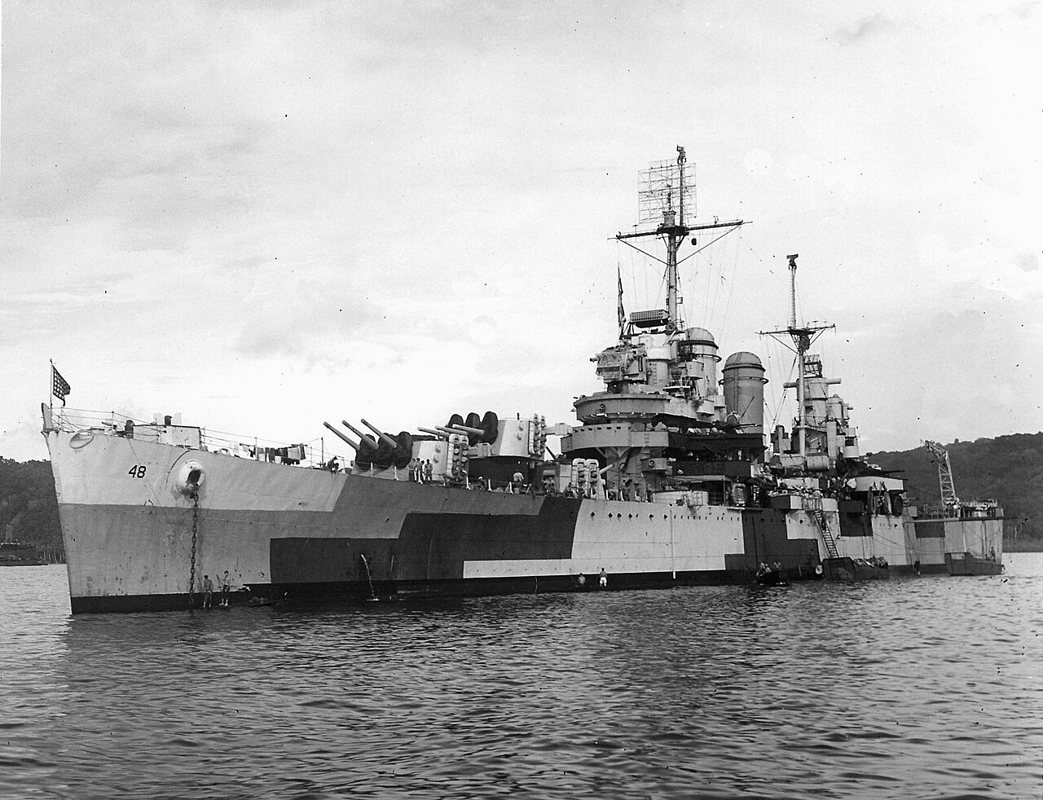
Building and pre-war service
Honolulu was the second Navy ship named for the city of Honolulu and a Brooklyn-class light cruiser with fifteen 6-inch guns. She was launched at the New York Navy Yard on 26 August 1937, sponsored by Helen Poindexter, daughter of Governor Joseph B. Poindexter of the Territory of Hawaii, and commissioned on 15 June 1938. She sailed from New York on 24 May 1939 and joined the Pacific Fleet at San Pedro on 14 June. After an overhaul at Puget Sound she left Long Beach on 5 November 1940 for duty at Pearl Harbor.
Pearl Harbor
On 7 December 1941 she was moored in the Navy Yard. She came through the first wave untouched. In the second wave a dive bomber's 500-pound bomb exploded underwater close aboard and caved in part of her hull, minor damage that still made her one of three cruisers notably hurt that day. After repairs she escorted a convoy to San Francisco from 12 to 21 January 1942. After yard work at Mare Island she sailed on 3 November 1942 with a convoy for Nouméa.
Tassafaronga
At Tassafaronga on the night of 30 November 1942, she sailed with Minneapolis and New Orleans when they opened fire on the destroyer Takanami at 23:21. Takanami was hit more than 50 times and blew up with 197 men, but not before her torpedoes and those of her squadron tore the bows off Minneapolis and New Orleans, crippled Pensacola, and sank Northampton. Rear Admiral Mahlon Tisdale ordered a hard turn to starboard that took Honolulu clear of a torpedo, and she was the only American cruiser to leave the battle undamaged.
Kula Gulf and Kolombangara
She bombarded Japanese positions on Kula Gulf on 13 May 1943. In the Battle of Kula Gulf on the night of 5–6 July 1943, under Rear Admiral Walden Ainsworth, she, St. Louis and Helena turned their radar-directed fire on the destroyer Niizuki, which sank with no survivors. Long-range torpedoes from the Japanese destroyers then sank Helena. One of Honolulu's 6-inch shells hit Nagatsuki below the waterline and wrecked her engine room, and the destroyer ran aground and was abandoned. Hits by Honolulu and St. Louis on Hatsuyuki turned out to be duds.
At Kolombangara a week later, on the night of 12–13 July, the light cruiser Jintsū turned on her searchlights to illuminate the Allied line. She drew the concentrated fire of the cruisers, mostly Honolulu and St. Louis, and by about 01:20 she was a burning wreck. A torpedo, probably from Yukikaze, crippled HMNZS Leander. When the Japanese destroyers came back with reloaded tubes, one torpedo hit Honolulu's stern without exploding and another blew off her bow. St. Louis's bow was twisted, and Gwin was sunk. With a temporary bow she reached the repair ship Vestal on 16 July and was then fully repaired.
Bougainville to Leyte
She bombarded Bougainville on 27 December 1943, screened the Green Island landings on 13 February 1944, and shelled Saipan in June. She sortied from Guam toward the Japanese fleet during the Philippine Sea battle, returned to Eniwetok on 28 June, and gave three weeks of fire support for the Guam invasion. From 6 September she supported the Peleliu and Angaur landings. She sailed from Manus on 12 October for Leyte, bombarded on 19 October, and screened the landings the next day. At 16:00 on 20 October 1944 a torpedo plane slipped in. Captain Harry R. Thurber maneuvered hard, but the torpedo hit her port side, killing 64 men and injuring 35.
Fate
She was patched at Manus and reached Norfolk on 20 December 1944. She stayed there through the end of the war for repairs and alterations, which included four twin 5-inch/38 mounts. After shakedown in October 1945 she served as a training ship at Newport. She was decommissioned at Philadelphia on 3 February 1947 and scrapped in 1959.
Sources
Wikipedia, "USS Honolulu (CL-48)" (citing DANFS; Morison; Hone on Tassafaronga).
NHHC/DANFS, "Honolulu II."