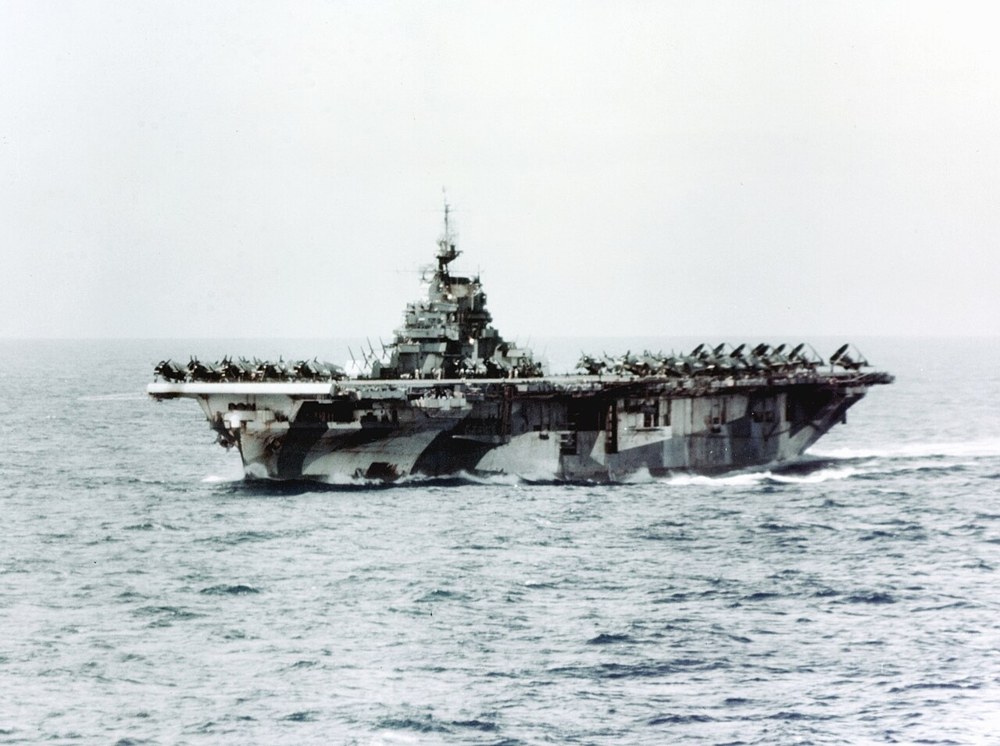
USS Hornet (CV-12) is an Essex-class carrier built by Newport News Shipbuilding. She was laid down on 3 August 1942 as Kearsarge and renamed Hornet after the carrier of that name (CV-8) was sunk at Santa Cruz that October. She was launched on 30 August 1943 and commissioned on 29 November 1943 with Captain Miles R. Browning in command. She is CV-12, not the Hornet (CV-8) that launched the Doolittle Raid.
She joined the fast carrier force at Majuro on 20 March 1944 and supported the landings in New Guinea, then raided the Carolines. On 11 June 1944 her aircraft struck Tinian and Saipan, and on 15 and 16 June they struck Iwo Jima and Chichi Jima. In the Battle of the Philippine Sea on 19 June her fighters met the Japanese raids. On 20 June she took part in the long-range strike on Ozawa's carriers. The Navy credits the strike with sinking the carrier Hiyo and two oilers; it is not credited to one plane or one ship. She supported the Leyte landings from 20 October and on 25 October launched two long-range strikes at Kurita's ships off Samar. She joined a raid that destroyed a convoy in Ormoc Bay and then raided Formosa, Indochina and the China coast in January 1945.
In February 1945 she struck Tokyo and supported the Marines on Iwo Jima on 19 and 20 February. On 1 April she supported the Okinawa landings, and on 6 April her aircraft joined the attacks that sank Yamato and her escort. A typhoon on 4 and 5 June collapsed about 25 feet of her forward flight deck and she went back for repairs. She came home in 1945 and carried troops home in Operation Magic Carpet. She earned seven battle stars and the Presidential Unit Citation in the war. She was decommissioned in 1947, later rebuilt as an attack carrier and then an antisubmarine carrier, served in the Vietnam War era, recovered the Apollo 11 and Apollo 12 crews and was opened as the USS Hornet Museum at Alameda in 1998.
Her wartime commanding officers, from NavSource: Captain Miles Rutherford Browning, 29 November 1943 to 29 May 1944; Captain William Dodge Sample, 29 May 1944 to 9 August 1944; Captain Austin Kelvin Doyle, 9 August 1944 to 1 August 1945; Captain Charles Randall Brown, 1 August 1945 to 14 February 1946.
Sources: Dictionary of American Naval Fighting Ships (DANFS), Wikipedia, NavSource Online (commanding officers) and Wikimedia Commons (photograph records).