Ships
- USS Kalinin Bay (CVE-68) Captain from 16 October 1943
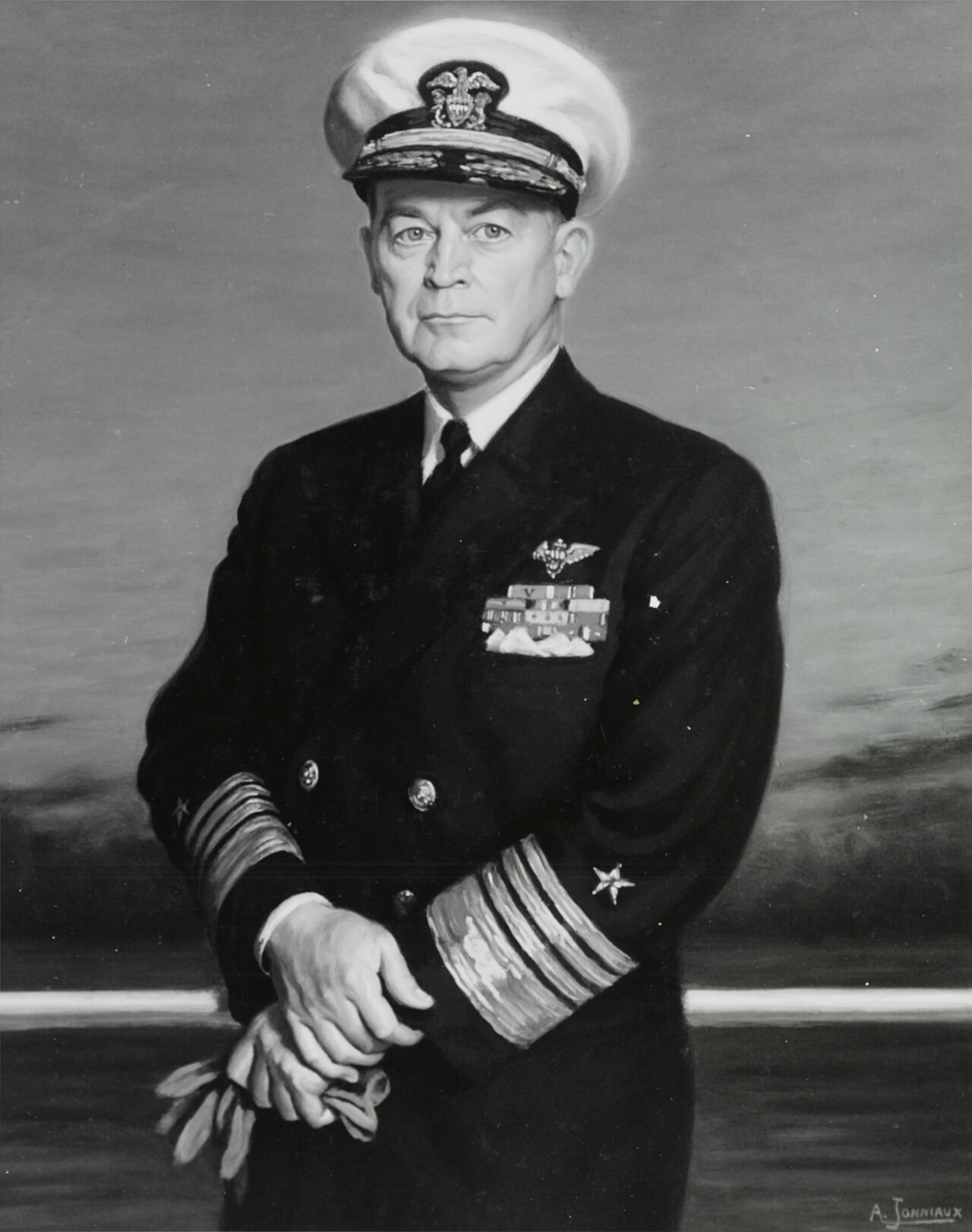
The Navy that put him on the bridge of the escort carrier Kalinin Bay already knew the nickname. So did the classmates who wrote him up in the 1921 Lucky Bag. What the list does not show, and what a later magazine profile blurred, is that he gave that ship up at Manus on 3 October 1944, three weeks before the battle that made her name. Off Samar she belonged to another captain. Brown was by then chief of staff to the commander of a fast-carrier division, in the same war and not on her deck.
He was born in Tuscaloosa on 13 December 1899, to Robison and Stella Brown. Time, writing him up in middle age, called the father a respected lawyer and a Democratic figure in town, and called Charles the grandson of a Civil War veteran. The town, the magazine said, then held about nine thousand people. Nothing in the Academy file or the yearbook fills in the house, the sisters and brothers of childhood, or the grandfather’s name. A classmate from the same town, Thomas Lee McCann, later wrote that he had “brought Cat along” from Alabama. That is as close as the record comes to a boyhood.
Senator Oscar Underwood of Alabama appointed him to the Naval Academy, and he was admitted on 21 June 1917, in the first summer of the American war. He was seventeen. The next summer the Academy sent him to the old battleship Ohio for the Atlantic Fleet’s training cruise. That was his World War I: a midshipman’s summer, not a watch in a fight. He graduated on 3 June 1921. The National Archives’ authority record says he was commissioned ensign the same year. His papers at the Academy, and every later official sketch that bothers with a full name, give him as Charles Randall Brown. The Lucky Bag prints it that way under a photograph the ship list never had, and under it the single word Cat.
The yearbook is not kind, and it is not the polished admiral of 1958 looking backward. It says no one in the class had a history to match his, that a study of his “tactics and strategy” would train any aspiring duty officer, and that under the hard surface he could still meet the academics when he chose. It calls him stubborn as a mule. It has him scrapping at the drop of a hat, sometimes to soothe his own conscience and more often to get the offending object out of his sight. It says the girls had taken over the hours he once spent, in the yearbook’s joke, throwing rocks and burning sagebrush. The entry’s offices are a clean sleeve, no cadet rank, and a bare “Buzzard,” a tag the page does not define. McCann’s sketch, printed next, claims the credit for whatever good conduct Cat showed, and adds the barb that both the Admiral and the Secretary of the Navy had taken special pains, at the start of first-class year, to mention that young man’s past conduct. The yearbook never uses the word expelled. Time did, twice, decades later. In one profile he had logged so many demerits for drinking, practical jokes, and general roistering that he was put out, and got back only on his father’s plea and on probation, the shock of it driving him to work hard enough to graduate “far, far down the list.” A shorter Time item of 28 July 1958, when he was fifty-eight and commanding the Sixth Fleet, put a number on it: three hundred demerits, near the bottom of the class of 1921. No order-of-merit list readable here confirms the number or the expulsion. The two accounts agree on the shape of the thing. He got through Annapolis as a problem the authorities had already noticed, without stripes on his sleeve, and with a nickname that stuck for sixty years.
On 26 November 1921 he married Eleanor T. Green of Annapolis. He told Time, in the jazz-age phrasing the magazine preserved, that they “exchanged sarcasms and fell in love, a well-known fad.” In his own files, decades later, she is Snooks. The marriage is the one long private fact that runs from the month he left the Academy to the last years of his flag career. The papers do not give a wedding guest list, and they do not give the day the marriage ended. They do show her still opening the mail, and still being written to, while he was commander in chief in Naples.
The Navy that took him did not yet know what to do with an aviator, because he was not one. In July 1921 he went to the battleship Arkansas. In December he shifted to the transport Columbia, left her in March 1922 for the receiving ship at Philadelphia, and in April sat in the Office of Naval Communications under the Chief of Naval Operations. In December 1922 he joined Langley, the collier the Navy had made into its first carrier. Time later collapsed that sequence and had him turning to aviation after a 1924 tour in Langley. The Academy chronology is tighter. He reported to Pensacola for flight training in February 1924 and was designated a naval aviator on 15 August 1924. In November he joined the aircraft squadrons of the Scouting Fleet. In May 1926 he went on that commander’s staff. In December he was in the flight division of the Bureau of Aeronautics.
The magazine, not a gunnery log, is the only source here for the story that followed: that fighter pilot Brown once put sixty hits into a towed sleeve in sixty shots, in five passes, and that the Navy treated it as a record. The same profile has him remembering the old Liberty-engined torpedo plane as a machine that could make seventy miles an hour “going downhill.” Both sentences are his legend as Time printed it. They are not copied from a bureau score sheet in this research, and they should not be told as if they were.
In September 1929 he went back to sea in Bombing Squadron 2 on Saratoga. In April 1931 the squadron was redesignated Fighting Squadron 6. In October he was in the Bureau of Aeronautics again, and in December in the administration section of the Bureau of Navigation. The pattern is already the one Time would later mock and he would later resent: a tour in a cockpit or on a flight deck, then a desk, then another ship. In March 1934 the desk ended in a command, and not a glamorous one. He took the minesweeper Gannet, then serving as tender for the Aleutian survey. He kept her until August 1935. That is the first time the record shows him responsible for a ship and a crew in bad water, far from the carrier Navy he was building his name in. There is no diary of that cruise in anything read for this essay. What it was like to run a survey tender in the Aleutians is a gap, not a story waiting to be colored in.
From Gannet he went to Utility Squadron 2 in the tender Wright, then in June 1936 to the heavy cruiser San Francisco for duty with Scouting Squadron 11, and afterward with Scouting Squadrons 14 and 12. In June 1937 he reported to the Naval War College for the junior course. In June 1938 he was at Pensacola again. In June 1939 he was back on Saratoga. In May 1940 he was her carrier air group commander. In April 1941 he was her air officer. The second Time portrait places here the landing that, if it happened as told, is the clearest picture of how he behaved when a flight went wrong. On his last scheduled carrier landing in the old Saratoga in 1941, the hook skipped the wires and he went into the barrier at high speed. Shaken, he got into another airplane, took off, and came back aboard for a landing the magazine calls perfect. The chronology fits the job he held. It does not, by itself, prove the crash. No action report or log entry was found to confirm it. It is what he, or the Navy’s public story of him, gave a reporter in the late 1950s.
He was still Saratoga’s air officer when the war began. The finding aid does not put him at Pearl Harbor on 7 December. It puts him in command, from 21 December 1941, of the shore-based carrier aircraft units of the Fleet Air Detachment at Naval Air Station Pearl Harbor. Two weeks after the attack he was on the beach, responsible for carrier airplanes that no longer had an ordinary fleet to come home to. Saratoga’s later torpedoing, in January 1942, fell after he had left her. In May 1942 he was ordered to the headquarters of the Commander in Chief, United States Fleet. That commander was Ernest J. King. He stayed in that orbit until November 1943. Time remembered the interval as the peacetime-style staff duty his temper could not stand, even in the middle of a war. The 1958 item has the boil-over in his own words, spoken to Raymond Spruance: “I’ve got a carrier, and I’d like a job of work.” Spruance, in the magazine’s telling, snapped, “You’ve got one.” The sentence is reprinted from Time of 28 July 1958. It is not a letter in Spruance’s papers consulted here. Read against the dates, it means that by 1943 he already had, or had been promised, the escort carrier, and was asking that she be used. The same magazine paragraph then claims that for two years Kalinin Bay steamed through the Marianas, the China Sea, and the Battle of Leyte Gulf. That compression is wrong, and it matters.
Kalinin Bay was a Kaiser-built escort carrier, hull 1105, laid down at Vancouver, Washington, on 26 April 1943. The older Dictionary of American Naval Fighting Ships, the text still stable on HyperWar, says she was launched on 16 October 1943. A later Naval History and Heritage Command revision, as indexed by search, says 15 October, sponsored by Anna M. Updegraff. That is the launch date in the older history, not the day he became her commanding officer. The Academy’s chronology of his own papers says he was attached to her in November 1943 for fitting-out duty and assumed command on 27 November, the day she was commissioned at Astoria, Oregon. Both the older DANFS and the later revision put Captain C. R. Brown, or Capt. Charles R. Brown, in command at that commissioning. He had spent a year and a half at King’s headquarters. He now had a brand-new small carrier and a crew that had never taken her to sea.
She shook down on the Pacific coast and left San Diego on 3 January 1944 with troops and airplanes aboard, bound for the replenishment job Spruance’s war actually gave her. She reached Tarawa on 24 January and for more than two weeks fueled and supplied the Fifth Fleet carriers working the Marshalls, running between Tarawa and Majuro. The revised ship history, in the passage captured from the Naval History and Heritage Command text, is more particular than the older one, and it is the passage that puts Brown himself in tactical command rather than merely on the title page. Escorted by Fair and Fleming, she met a refueling group, Brackett, Stadtfeld, Tisdale, and the oiler Lackawanna, and refueled from 31 January to 3 February. During that evolution she was fleet guide, and Captain Brown was officer in tactical command. She flew off two Hellcats, two Helldivers, and three Avengers as replacements for Bunker Hill, Cowpens, and Monterey of Task Group 58.3, and took two Hellcats back. On the 17th, still in that February sequence, she joined Task Group 16.6 with the escort carrier Copahee and the destroyers Bailey and Capps, and Brown was again the officer in tactical command. The older history has her back at Alameda on 24 February. The first cruise was logistics, not a battle. The responsibility was real: a new ship, a group to guide, airplanes to pass across an ocean to the fast carriers that were doing the striking.
Composite Squadron 3 came aboard on 9 April. She reached Majuro on 23 April, flew antisubmarine patrols off Mili, and was at Pearl Harbor on 1 May to prepare for the Marianas. She sailed on 30 May. On the way to Saipan a Japanese torpedo crossed her bow close aboard, and she evaded it. The ship history states the fact and does not say who saw the wake or what order Brown gave. She touched at Eniwetok on 9 June and was off the eastern coast of Saipan on 15 June, launching in support of the landings. At dusk on the 17th she helped beat off an air attack. On the 19th she sailed to ferry airplanes to and from Eniwetok. That was the day the fast carriers fought the Marianas Turkey Shoot. Brown’s ship was not in that battle. She was already on the shuttle. She was back off Saipan on 24 June and flew against the island until 9 July, then went by way of Eniwetok to the same work at Guam, arriving 20 July, launching support and antisubmarine sorties until 2 August, and returning to Eniwetok to get ready for the Palaus.
She left Eniwetok on 18 August, went by Tulagi, and on 14 September was off the southern Palaus with units of the Third Fleet. For two weeks her airplanes supported the landings on Peleliu, Angaur, and Ngesebus. The older history gives them nearly four hundred sorties and heavy damage to ground positions and shipping. On 25 September alone they sank or destroyed three cargo transports and six landing barges. Those figures are the ship’s, not a score Brown personally claimed. He was the captain who sent the airplanes. On 30 September she left the Palaus. On 3 October she entered Seeadler Harbor at Manus, and there she received a new commanding officer, Captain Thomas B. Williamson.
That is the end of his sea command of her. It is not the end of the ship’s war, and the difference is the whole point of telling them apart. Williamson took her out of Manus on 12 October toward Leyte. On 25 October she was in Clifton Sprague’s Taffy 3, east of Samar, when Kurita’s Center Force came over the horizon. She took fifteen hits, including a large-caliber shell in the hangar, fought with her one five-inch gun, was struck by a kamikaze, and came out of it with five dead among sixty casualties. The Presidential Unit Citation the ship received was for that morning. Brown was not aboard. Anyone who hangs the Samar story on the captain who commissioned her is telling Williamson’s day under Brown’s name. Time did it in a clause. The ship history does not.
Where Brown was, from 12 October 1944 to 2 March 1945, is in the citation of the Legion of Merit, as transcribed by the Hall of Valor from the award to Captain Charles Randall Brown, Navy service number 0-19058. He was chief of staff to the commander of Carrier Division One during fast-carrier offensive operations across the far western Pacific. The citation says a heavy toll was taken of Japanese air and sea power, and that the landings on Leyte, Mindoro, Luzon, and Iwo Jima were accomplished, and it praises his grasp of “all phases of carrier personality,” his “determined and aggressive spirit,” and the effect he had on the officers and men around him. He was authorized the combat “V.” The Academy chronology says the same thing in fewer words: in October 1944 he joined that staff as chief of staff, and in October he took part in the Battle of Leyte Gulf. It does not name the admiral he served, the ship the flag was in, or the morning he was closest to the enemy. A United States Naval Institute thumbnail later called him chief of staff to the commander of the Fast Carrier Task Force and added Okinawa to his list of operations. The citation and the papers do not. His dated staff service ends on 2 March 1945, before the landings on Okinawa. The Institute’s sentence is a summary that overreaches. What can be said is that the man who had wanted a job of work spent the great carrier offensive of the winter of 1944–45 as a chief of staff, not as a commanding officer, and that the Navy judged the work worth a Legion of Merit.
The National Archives’ name authority says he advanced to rear admiral in August 1944, while he was still, on the ship history’s dating, captain of Kalinin Bay, and before the citation that still styles him captain for the whole of the staff tour. The two records are not reconciled here. He may have been selected in August and continued to serve, and to be cited, as a captain. He should not be pictured with a flag officer’s star on Kalinin Bay’s bridge on the strength of the Archives sentence alone.
On 1 August 1945 he assumed command of Hornet, the Essex-class carrier, not the ship lost in 1942. The timing is the last hard turn of his war. In June, before he had her, a typhoon had collapsed about twenty-five feet of her forward flight deck. The older DANFS, which misprints one stateside arrival as July 1946 and then describes events of 1945, has her overhaul finished by 13 September 1945, when she sailed on Magic Carpet duty and brought men home from the Marianas and Hawaii, returning to San Francisco on 9 February 1946. His own chronology does not give the day he was relieved. It says that on 10 March 1946 he reported to the Army Air Forces tactical school at Maxwell Field as a naval instructor. Secondary commanding-officer lists put his relief on 14 February 1946. Those lists are the same compilations that are useful and often right, and they are not a log. If the Academy dates hold, his only fleet-carrier command fell almost entirely after the shooting: a damaged ship in a yard, then the long ferry of the living back across the Pacific. Japan’s surrender was announced two weeks after he took her. He had missed Samar by leaving an escort carrier, and he received a famous carrier when the famous work was done. Nothing he wrote that has been read here says whether he felt that as loss, irony, or simply the next order.
Maxwell was a year of teaching airmen what the Navy thought it had learned. On 29 July 1947 he was ordered back to the Naval War College for the senior course. In August 1948 he became chief of staff and aide to the president of the college. On 17 February 1949 the Naval Institute gave him an honorable mention in its essay contest for “The Principles of War.” The Institute’s note on him, written when he had just finished as chief of staff at the college, is the sketch of a man who had commanded Kalinin Bay and Hornet, sat on King’s and the fast carriers’ business, and was now trying to say what the war had been for. The essay itself was not reread for this account.
In February 1950 he went to London as deputy director of the Joint American Military Advisory Group. In April 1952 he took Carrier Division 6. In August 1953 he was deputy director of the Joint Strategic Plans Group. On 9 August 1954 he was the Navy member of the Joint Strategic Survey Committee. On 24 January 1955 he became deputy commander in chief and chief of staff of the Atlantic Fleet. The years match the complaint Time put in his mouth, the chafing at desks, and they also match the use the Navy had decided to make of him. When the sea command came again it was not a single ship.
In August 1956 he was appointed commander of the Sixth Fleet and commander of Striking and Support Forces, Southern Europe. He told friends, in a letter Time quoted, that he could not say how exciting it was “to hold in my two hot hands a large part of the striking power of the Navy.” Other men, he wrote, might pull the strings and blunt or sharpen the weapon before it was handed to him, “but it is I who have it. It is mine to shape and polish, inspire or confound, instruct or confuse, ready or sheathe, and employ wisely or foolishly.” That is as close as the public record comes to a statement of what command meant to him. The same profile, “The Steel-Grey Stabilizer,” written while he was fifty-seven and after the Suez crisis had already broken, has him heavy-set, hard-boiled, a Southerner who read the King James Bible every night, argued the Koran with Turks, and wrote round-robin letters home about the ports. It has him salty and easily stung. “You can’t put a martini in a refrigerator,” he said, “any more than you can put in a kiss.” A shorter item the next year quoted him calling the Sixth Fleet “the best job in the whole Navy.”
The job was not a cruise. During the Suez crisis the fleet evacuated American nationals from Egypt and Israel. Time has the ships in a landing exercise in Suda Bay, Crete, on the night of 29 October 1956, when Israel attacked Egypt; the marines and the beached equipment were recovered overnight and the fleet went east, destroyers and attack transports into Haifa, Gaza, and Alexandria, the carriers kept below the horizon. Combat-ready marines were prepared to go through to Cairo if the Egyptians blocked the evacuation. They did not. A line often repeated in Sixth Fleet lore, Brown asking Arleigh Burke whose side the fleet was on and Burke telling him to keep clear and take no guff, does not appear in that Time account and was not traced here to a message file. It is left out on purpose.
In July 1958, after revolutions in Iraq, the Sixth Fleet landed American forces in Lebanon. The Distinguished Service Medal, awarded to him as admiral for 14 July to 23 October 1958, names him Commander, American Naval Forces, Specified Command, Middle East, not merely the Sixth Fleet’s commander. The citation says the first Marines were ashore at Beirut on the afternoon of 15 July, less than twenty-four hours after the order, and that within a few days five thousand Marines and eight thousand tons of supplies were landed as scheduled. It credits him with holding the force in a posture of “restrained strength,” which is a staff way of saying that the success was not shooting. On 30 September 1958 he was relieved as Sixth Fleet commander and given temporary duty in the office of the Chief of Naval Operations. The medal’s dates run past that relief. The papers note Soviet complaint about him in those weeks, including Khrushchev, and an article in the Soviet Navy’s newspaper. The finding aid records the fact of the complaint. It does not quote it.
On 2 January 1959 he became Commander in Chief, Allied Forces Southern Europe, a four-star NATO command ashore at Naples, which he held until he left active duty. The Archives record says he was promoted to admiral in that appointment; the chronology of the papers simply starts him in the job. On 1 April 1960 he was designated the Navy’s Gray Eagle, the naval aviator on active duty in flight status longer than any other Navy pilot. Later retellings say he invented the award. The papers say he was designated it. On 10 August 1960 he was made an honorary member of Italy’s National Association of Carabinieri, and on 25 August an honorary citizen of Rhodes. The correspondence of those years is full of visits, gardens, the house in Annapolis, and the question of what a man does when the flag comes down. He looked at college presidencies and did not get them. He talked of a book. A draft of memoirs is in the papers. It has not been published in any edition found here, and it was not read for this essay.
He was transferred to the retired list on 1 January 1962. One secondary commander list puts a retirement date in December 1966; the Academy chronology and the Archives record agree on January 1962, and that is the date used here. He became vice president for European operations of McDonnell Aircraft and left the company in 1965. On 8 December 1983 he died at Bethesda Naval Hospital, five days short of his eighty-fourth birthday. Social Security’s death index, as cited in the Archives record, has a Charles Brown born 13 December 1899 and dead in December 1983 in the District of Columbia. Bethesda is the hospital the papers name. Burial in the Naval Academy cemetery is on public memorial pages and in biographies that copy them. The finding aid, which is otherwise careful about dates, does not say where he was buried.
What he left, in the boxes his son gave the Academy in May 2015, is a family that can be named only in part. Eleanor is there from the wedding in 1921 through the Naples years. A son, Randall, was a midshipman while Brown had the Sixth Fleet; the files hold the boy’s letters from Annapolis and, later, the gift of the papers by Commander Randall R. Brown. Another son, Nick, is in the same files, including letters about his health, with no diagnosis stated in the finding aid. A folder groups R. R., N. H., and R. Jr., so a third name or a junior is in the papers and not sorted out here. His sister Kathrina James wrote to him. So did a Robison Brown, filed under Rab, who may or may not be a brother; the father was also Robison, and a 1956 correspondent is unlikely to be a man some genealogies already have dead in 1939. Those death years for the parents, and a maiden name Seed for Stella, and 1987 for Eleanor, come from cemetery compilations and a German Wikipedia page that leans on them. They are not in the Academy chronology. Against them stands a “Mother” folder in the Sixth Fleet files running from July 1957 to August 1958. Either the mother was alive then, or “Mother” meant someone else. The essay does not choose.
The man who comes out of the better sources is not a saint of Samar and not a staff ghost. He was a Tuscaloosa appointment who nearly talked his way out of Annapolis, a pilot good enough that the Navy kept giving him airplanes and then taking him off them, a minesweeper captain in the Aleutians, an air officer who left Saratoga for the wreckage of Pearl’s naval aviation, a staff officer in King’s headquarters who talked his way into an escort carrier, and the first captain of Kalinin Bay through the Marshalls replenishment, the Saipan and Guam air support, and the Palau strikes. He left her at Manus before the morning that nearly killed her. He spent the next winter making a fast-carrier division work, and was decorated for that, as a captain, whatever the August 1944 flag rank in the Archives file means. He got Hornet when the war was ending and rode the aftermath. The ambition that shows in his own reported words is not modest: he wanted the weapon in his hands, and he wanted to be the one who decided whether it was used wisely. Lebanon, on the citation’s terms, was the case where the right use was speed and then restraint. The private cost, the nights, the friendship with Spruance beyond one quoted snap, the draft memoir’s verdict on himself, are still in boxes in Annapolis, or nowhere.