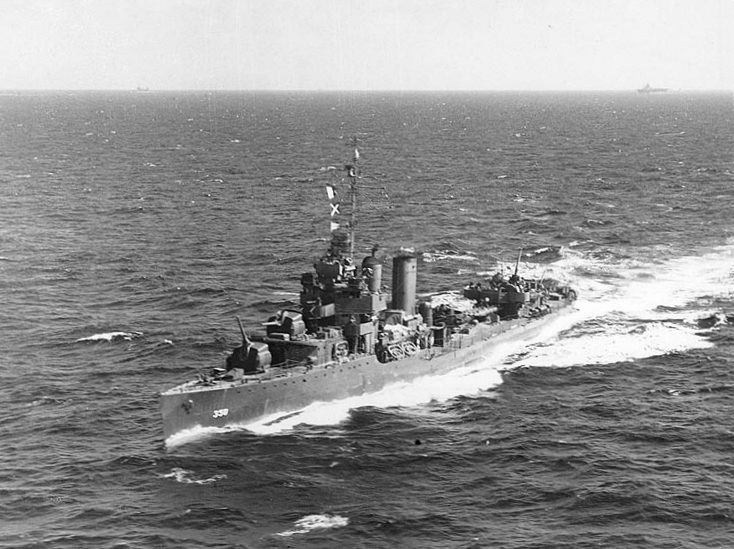
Hull was named for Isaac Hull, who commanded Constitution in the War of 1812. She was the third Navy ship of that name, a Farragut-class destroyer, DD-350. The New York Navy Yard laid her down on 7 March 1933, launched her on 31 January 1934, and commissioned her on 11 January 1935. Commander R. S. Wentworth had her. After a shakedown to the Azores, Portugal, and the British Isles, she passed the Panama Canal and joined the Pacific Fleet at San Diego in October 1935. In October 1939 her home port moved to Pearl Harbor.
On 7 December 1941 she was moored alongside the tender Dobbin, under repair. She opened fire with her antiaircraft guns. She was not hit. The next day she helped bring Enterprise into Pearl Harbor.
In the first months of 1942 she screened Lexington (CV-2) for strikes on Japanese positions in the Solomons, and she escorted convoys between the West Coast and Hawaii.
On 7 August 1942 she was off Guadalcanal and Tulagi for the landings, screening the bombardment and the transports. The next day Japanese planes attacked the ships. George F. Elliott was on fire. Hull fired four torpedoes into that fire. The torpedoes did not finish her. George F. Elliott was lost.
In 1943, after repairs on the West Coast, she went north to the Aleutians. She bombarded Kiska, and she was there for the landings in August, after the Japanese had already left the island. From late 1943 into the middle of 1944 she worked across the central Pacific: diversionary strikes at Wake, the bombardment of Makin, screening and patrols in the Marshalls, the raid on Truk in April 1944, the bombardment of Saipan in June, and the carrier screen in the Philippine Sea, where she fired at aircraft. She was later off Guam. Ten battle stars. Extra guns and radar had been put on a small hull from the early 1930s.
In November 1944 she joined a Third Fleet fueling group under Admiral William F. Halsey, in support of the fast carriers in the Philippine Sea. Fueling began on 17 December and was cancelled as the sea rose. On 18 December the group was inside Typhoon Cobra. The course she was given left the wind on her port beam. She could not turn her bow out of the trough, and the rolls grew worse. Boats and depth charges went over the side. Water came into the pilothouse and down the stacks. Captain James A. Marks later reported that she lay over at 80 degrees or more. He stayed on the port wing of the bridge until the water reached him, and then he stepped into the sea as she went over and sank. Eleven officers and 191 enlisted men were lost. Seven officers, Marks among them, and 55 enlisted men were picked up in the days after. Most of them were taken by the destroyer escort Tabberer. Monaghan and Spence sank in the same storm.
A court of inquiry called it an error of judgment to take the fleet into that typhoon, and it did not punish Halsey. Her wreck has not been found.